Why China is building so many coal plants despite its solar and wind boom

Advertisement

Advertise with us

BEIJING (AP) — Even as China's expansion of solar and wind power raced ahead in 2025, the Asian giant opened many more coal power plants than it had in recent years — raising concern about whether the world's largest emitter will reduce carbon emissions enough to limit climate change.

Read this article for free:


or

Already have an account? Log in here »

To continue reading, please subscribe:

Subscribe and receive a limited-edition Free Press branded hat or tote.

Digital Subscription

One year of digital access for only $205*

  • Enjoy unlimited reading on winnipegfreepress.com
  • Read the E-Edition, our digital replica newspaper
  • Access News Break, our award-winning app
  • Play interactive puzzles

*First annual payment billed as $205.00 + GST for one year. This annual subscription will automatically renew at $233.00 + GST every 52 weeks (10% off the regular annual price of $259.35). Offer available to new and qualified returning subscribers only. Cancel any time.

To continue reading, please subscribe:

Add Free Press access to your Brandon Sun subscription for only an additional

$1 for the first 4 weeks*

  • Enjoy unlimited reading on winnipegfreepress.com
  • Read the E-Edition, our digital replica newspaper
  • Access News Break, our award-winning app
  • Play interactive puzzles
Start now

*Your next Brandon Sun subscription payment will increase by $1.00 and you will be charged $17.95 plus GST for four weeks. After four weeks, your payment will increase to $24.95 plus GST every four weeks.

Hey there, time traveller!
This article was published 03/02/2026 (239 days ago), so information in it may no longer be current.

BEIJING (AP) — Even as China’s expansion of solar and wind power raced ahead in 2025, the Asian giant opened many more coal power plants than it had in recent years — raising concern about whether the world’s largest emitter will reduce carbon emissions enough to limit climate change.

More than 50 large coal units — individual boiler and turbine sets with generating capacity of 1 gigawatt or more — were commissioned in 2025, up from fewer than 20 a year over the previous decade, a research report released Tuesday said. Depending on energy use, 1 gigawatt can power from several hundred thousand to more than 2 million homes.

Overall, China brought 78 gigawatts of new coal power capacity online, a sharp uptick from previous years, according to the joint report by the Centre for Research on Energy and Clean Air, which studies air pollution and its impacts, and Global Energy Monitor, which develops databases tracking energy trends.
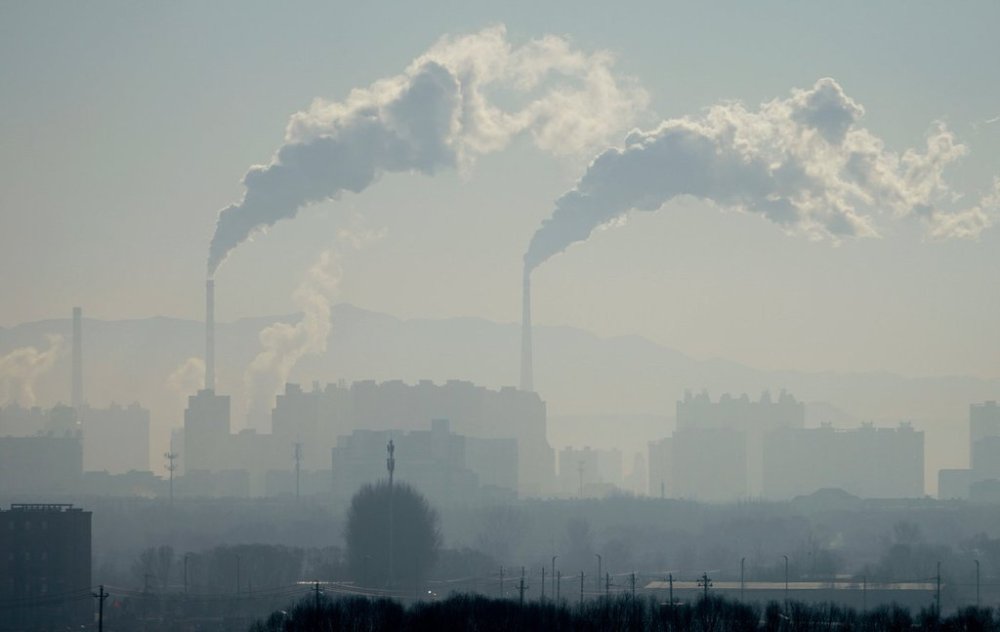
A power plant is seen from a train from Beijing to Shenyang in northwestern China on Jan. 3, 2026. (AP Photo/Ng Han Guan)

“The scale of the buildout is staggering,” said report co-author Christine Shearer of Global Energy Monitor. “In 2025 alone, China commissioned more coal power capacity than India did over the entire past decade.”

At the same time, even larger additions of wind and solar capacity nudged down the share of coal in total power generation last year. Power from coal fell about 1% as growth in cleaner energy sources covered all the increase in electricity demand last year.

China added 315 gigawatts of solar capacity and 119 gigawatts of wind in 2025, according to statistics from the government’s National Energy Administration.

Blackouts in 2021-22 prompted coal plant building spree

The massive growth in wind and solar begs the question: Why is China still building coal power plants and, by most analyses, way more than it actually needs?

The answer is complicated.

China is at an earlier development stage than the United States or Europe, so it needs more energy to keep growing. If more of the nation’s 1.4 billion people climb into the middle class, more will be able to afford air conditioners and washing machines.

Electricity is needed to keep China’s factories humming and to meet the high power demands of artificial intelligence, a government priority as it seeks to make the country a leader in technology.

Power shortages in parts of China in 2021 and 2022 reinforced longstanding concerns about energy security. Some factories temporarily halted production and one city imposed rolling blackouts.

The government’s response was to signal that it wanted more coal plants, leading to a surge in applications and permits for their construction.

That 2022-23 surge drove the big jump in capacity last year as the new units came on line, said Qi Qin, an analyst at the Centre for Research on Energy and Clean Air and another co-author of the report. “Once permits are issued, projects are difficult to reverse,” she said.

Construction started on 83 gigawatts of coal power last year, the report said, suggesting a large amount of new capacity may come online this year.

Excess coal capacity could slow the transition to wind and solar

The government position is that coal provides a stable backup to sources such as wind and solar, which are affected by weather and the time of day. The shortages in 2022 resulted partly from a drought that hit hydropower, a major energy source in western China.

Coal should “play an important underpinning and balancing role” for years to come, the National Development and Reform Commission, the lead economic planning agency, said in guidance issued last year on making coal plants cleaner and more efficient.

The China Coal Transportation and Distribution Association, an industry group, said last week that coal-fired power would remain essential for power-system stability, even as other sources of energy replace it.

The risk of building so much coal-fired capacity is it could delay the transition to cleaner energy sources, Qin said. Political and financial pressure may keep plants operating, leaving less room for other sources of power, she said.

The report urged China to accelerate retirement of aging and inefficient coal plants and commit in its next five-year plan, which will be approved in March, to ensuring that power-sector emissions do not increase between 2025 and 2030.

“Whether China’s coal power expansion ultimately translates into higher emissions will depend on … whether coal power’s role is genuinely constrained to backup and supporting rather than baseload generation,” Qin said.

___

Associated Press video journalist Olivia Zhang contributed to this report.

___

The Associated Press’ climate and environmental coverage receives financial support from multiple private foundations. AP is solely responsible for all content. Find AP’s standards for working with philanthropies, a list of supporters and funded coverage areas at AP.org.


Report Error Submit a Tip

More Stories

Jets pick up netminder as relatively new 23-man roster announced

Mike McIntyre 7 minute read Preview

Jets pick up netminder as relatively new 23-man roster announced

Mike McIntyre 7 minute read Monday, Sep. 28, 2026

Let’s get the caveats out of the way: Nothing is set in stone, nor written in permanent ink, and what you see right now could change in the blink of an eye.

With that being said, allow us to introduce you to the 2026-27 Winnipeg Jets — where change is very much in the air.

The 23-man roster submitted to the NHL offices by Monday’s 4 p.m. deadline includes seven players who were not on the team at this time last year. In fact, there could be as many as 10 new faces in the opening-night lineup on Friday against Boston when you factor in three regulars didn’t start the 2025-26 campaign due to injury.

That’s a lot of turnover, which isn’t surprising for a team that finished 26th overall in the standings and was — to most fans and pundits — too old and too slow.

Read
Monday, Sep. 28, 2026

Orange Shirt Day project fits students to a tee

Maggie Macintosh 5 minute read Preview

Orange Shirt Day project fits students to a tee

Maggie Macintosh 5 minute read Monday, Sep. 28, 2026

On the eve of Orange Shirt Day, hundreds of black T-shirts will be handed out to teenagers at Elmwood High School — and there wasn’t a mixup in the clothing procurement process.

The student-run business behind the initiative wanted to make a statement about “truth and reconciliation” being a year-round activity, said Daniel Concepcion, a Grade 12 student.

Daniel said given that black is a staple in the wardrobe of teenagers, he hopes these shirts won’t sit on hangers for 364 days of the year.

“Every child matters, every part of the day, every day,” the 17-year-old said.

Read
Monday, Sep. 28, 2026

Expert urges food, drink makers to look to foreign markets

Gabrielle Piché 5 minute read Preview

Expert urges food, drink makers to look to foreign markets

Gabrielle Piché 5 minute read Yesterday at 5:04 PM CDT

Canada’s slowing population growth could restrict business expansion, a top economist for Farm Credit Canada warned Manitoba manufacturers.

Craig Johnston, the federal Crown corporation’s chief economist, addressed Prairie businesses at Farm Credit Canada’s Food and Beverage Summit Tuesday.

“There could be some modest growth in Canadian consumption of food and beverage,” Johnston said, relaying population numbers inside a Victoria Inn Hotel conference room.

Still, per-person spending on food is “stagnant, if not somewhat rising,” Johnson later told reporters.

Read
Yesterday at 5:04 PM CDT

Retiree sues neighbour over alleged dog attack

Scott Billeck 2 minute read Yesterday at 2:00 AM CDT

A Winnipeg man is suing his neighbour over an alleged dog attack he says occurred while he was helping him with a lawnmower.

Arthur Cabel, a retiree who lives on Selkirk Avenue, is seeking unspecified damages from neighbour Saisamone Saegone, according to a statement of claim filed in the Manitoba Court of King’s Bench last week.

Cabel claims he went to Saegone’s home in the afternoon on Sept. 23, 2024, to help him with his lawnmower.

According to the lawsuit, Saegone’s large dog, initially in a fenced backyard, escaped, approaching Cabel and “mauling, attacking and biting him.”

Jets defenceman spent whole summer working on getting to the next level

Ken Wiebe 8 minute read Preview

Jets defenceman spent whole summer working on getting to the next level

Ken Wiebe 8 minute read Monday, Sep. 28, 2026

Tyrel Bauer makes no apologies for the pugilistic piece of his path.

The Winnipeg Jets defenceman is ready to drop the gloves and throw down when the situation calls for it and he takes great pride in protecting his teammates.

It’s a big part of the reason Bauer will be among the 23 players submitted by the Jets on the opening-day roster on Monday.

“I’ve fought and clawed, both metaphorically and literally and now I just want to show that I can play as well,” Bauer said during a chat with the Free Press during training camp. “(Toughness) is always something that I have, it’s always something in my back pocket and something that I take a lot of pride in doing, for my teammates, for the city and the people who invest in this hockey club. That will never change.

Read
Monday, Sep. 28, 2026

Why China is building so many coal plants despite its solar and wind boom

Ken Moritsugu, The Associated Press 4 minute read Preview

Why China is building so many coal plants despite its solar and wind boom

Ken Moritsugu, The Associated Press 4 minute read Tuesday, Feb. 3, 2026

BEIJING (AP) — Even as China's expansion of solar and wind power raced ahead in 2025, the Asian giant opened many more coal power plants than it had in recent years — raising concern about whether the world's largest emitter will reduce carbon emissions enough to limit climate change.

More than 50 large coal units — individual boiler and turbine sets with generating capacity of 1 gigawatt or more — were commissioned in 2025, up from fewer than 20 a year over the previous decade, a research report released Tuesday said. Depending on energy use, 1 gigawatt can power from several hundred thousand to more than 2 million homes.

Overall, China brought 78 gigawatts of new coal power capacity online, a sharp uptick from previous years, according to the joint report by the Centre for Research on Energy and Clean Air, which studies air pollution and its impacts, and Global Energy Monitor, which develops databases tracking energy trends.

“The scale of the buildout is staggering,” said report co-author Christine Shearer of Global Energy Monitor. “In 2025 alone, China commissioned more coal power capacity than India did over the entire past decade.”

Read
Tuesday, Feb. 3, 2026