Premier Moe announces ‘Patients First’ health-care plan to address issues

Advertisement

Advertise with us

REGINA - Saskatchewan Premier Scott Moe released a plan Monday that aims to bolster patient care with a focus on nurse practitioners, private surgeries and virtual appointments.

Read this article for free:


or

Already have an account? Log in here »

To continue reading, please subscribe:

Subscribe and receive a limited-edition Free Press branded hat or tote.

Digital Subscription

One year of digital access for only $205*

  • Enjoy unlimited reading on winnipegfreepress.com
  • Read the E-Edition, our digital replica newspaper
  • Access News Break, our award-winning app
  • Play interactive puzzles

*First annual payment billed as $205.00 + GST for one year. This annual subscription will automatically renew at $233.00 + GST every 52 weeks (10% off the regular annual price of $259.35). Offer available to new and qualified returning subscribers only. Cancel any time.

To continue reading, please subscribe:

Add Free Press access to your Brandon Sun subscription for only an additional

$1 for the first 4 weeks*

  • Enjoy unlimited reading on winnipegfreepress.com
  • Read the E-Edition, our digital replica newspaper
  • Access News Break, our award-winning app
  • Play interactive puzzles
Start now

*Your next Brandon Sun subscription payment will increase by $1.00 and you will be charged $17.95 plus GST for four weeks. After four weeks, your payment will increase to $24.95 plus GST every four weeks.

Hey there, time traveller!
This article was published 09/03/2026 (219 days ago), so information in it may no longer be current.

REGINA – Saskatchewan Premier Scott Moe released a plan Monday that aims to bolster patient care with a focus on nurse practitioners, private surgeries and virtual appointments.

Moe told a news conference the “Patients First” plan seeks to reduce surgery wait times to three months and lower diagnostic wait times to two months by 2028.

To achieve these goals, the province is to expand diagnostic services and use more private surgery clinics that perform publicly funded procedures, he said.
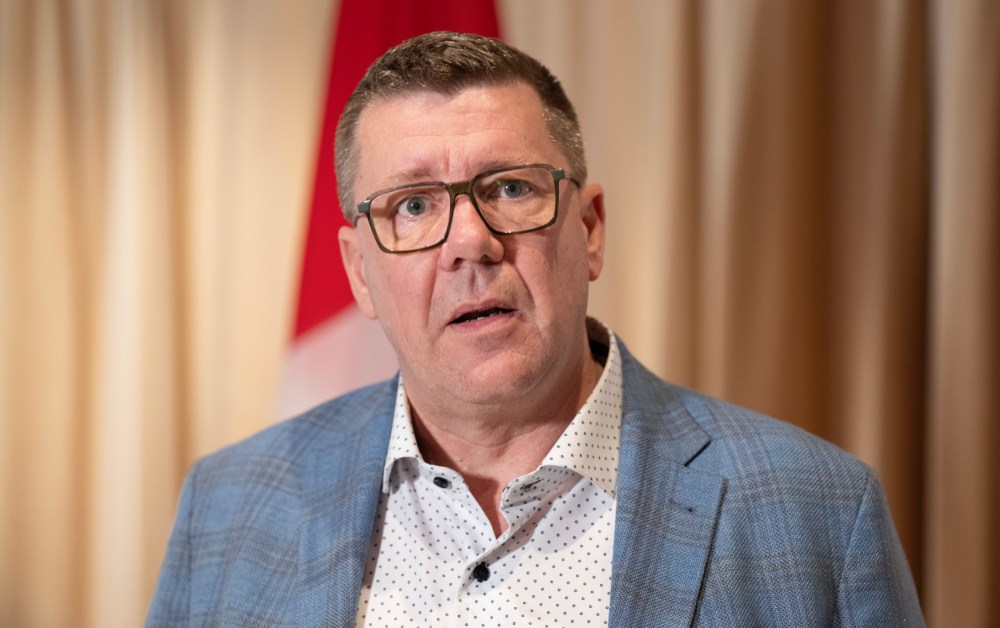
Saskatchewan Premier Scott Moe speaks with reporters in Mumbai, India, Friday, Feb. 27, 2026. THE CANADIAN PRESS/Adrian Wyld

“We have listened to people across the province, listened to patients, listened to families and listened to providers … and we have heard you,” the premier told reporters in Saskatoon.

The 25-page plan says the province intends to “expand the scope” of private providers to deliver publicly funded surgeries. Currently, such providers can do surgeries on joints, eyes and the vascular system.

To shorten diagnostic turnaround times, the report says Saskatchewan will modernize laboratories and expand the capacity of scanners, including by adding an MRI machine in Estevan.

On nurse practitioners, it says there will be “no limit” on expanding their contracts to deliver care.

The province is to test team-based models led by nurse practitioners, the report says. It is also to add 26 more nurse practitioner training spots in colleges, and registered nurses looking to pursue an education in the field are eligible for grants.

The report also lays out a program that would make virtual care visits available to all residents, though the initiative would roll out to certain communities first.

The province plans to also build more urgent care centres in Saskatoon, Regina, Prince Albert, Moose Jaw and North Battleford to lessen the strain on hospitals.

“This is the start of the conversation, but I would say that this plan we’re putting forward today is comprehensive,” Moe said.

Health Minister Jeremy Cockrill called the move “really exciting stuff” for nurse practitioners and communities in need of more primary care options.

“I want to say this very clearly to families and patients — we’ve heard you, and standing still is no longer an option,” Cockrill said.

The Opposition NDP slammed the Saskatchewan Party’s plan as one that rehashes an old proposal.

New Democrats pointed to a 2012 plan that also billed itself as putting patients first. It had promised to connect all residents to a family care team with a physician. It also promised surgeries in less than three months.

“Why didn’t this government keep its 2012 health-care promises to the people of Saskatchewan?” health critic Meara Conway told the legislative assembly. “Why should people believe that this time it’s going to be any different here?”

Cockrill told the assembly the plan should be taken seriously.

“That side talks about ideas. This side actually comes up with ideas and executes,” he said.

Conway took aim at Cockrill’s comment of “standing still,” arguing the province should have always been moving.

Cockrill later told reporters he thinks governments have been paralyzed in making changes.

“When you’re concerned about upsetting this group or upsetting that group, there’s a bit of paralysis there,” he said.

“Oftentimes the discussions around health care are kind of an either or … privately delivered or more publicly delivered. What I hear from patients, day in and day out, is ‘We don’t care.'”

He said Saskatchewan is hiring more health-care staff and doing more surgeries than before. The report cites a 30 per cent increase in surgeries since 2020, adding 155 more acute care beds and contracting 30 nurse practitioners.

Conway, whose party supports more nurse practitioners and virtual care, said she’s not convinced privatization has made measurable differences.

“If you look at the results, the case for privatization just isn’t there,” she said. “We see these contracts going to their donors, often very lucrative contracts, with very little transparency.”

Cockrill said private surgery centres can do double the number of cataract procedures than those in hospitals.

“When you’re setting up and you’re doing the same surgery over and over and over again, I think that is an opportunity to move that out of the hospital and save those operating room times for those patients,” he said.

This report by The Canadian Press was first published March 9, 2026.

Report Error Submit a Tip

More Stories

Gang member who shot rival, bystander back in prison after release revoked

Erik Pindera 4 minute read Preview

Gang member who shot rival, bystander back in prison after release revoked

Erik Pindera 4 minute read Monday, Oct. 12, 2026

A Winnipeg man who shot a rival teenage gangster and an innocent 11-year-old bystander at the crowded Red River Exhibition more than four years ago has been sent back to prison.

Mocree Chuck Scatch-Dubour, now in his early 20s, left prison in April on statutory release on his 5 1/2-year federal sentence for the 2022 shooting. Scatch-Dubour was sentenced to the prison term as an adult in the spring of 2023 after pleading guilty to discharge of a firearm with intent to wound, aggravated assault and possession of a restricted firearm.

By law, most federal inmates automatically receive statutory release after two-thirds of their sentence, if they have not already been paroled.

Parole Board of Canada officials formally revoked Scatch-Dubour’s release this month after he unlawfully left his halfway house in June.

Read
Monday, Oct. 12, 2026

Every few years, a sword over the baby

Hersh Seth 5 minute read Preview

Every few years, a sword over the baby

Hersh Seth 5 minute read 2:00 AM CDT

On Oct. 19, people in Alberta will answer 10 referendum questions. Nine are about things such as immigration, voter ID, judges and the Senate. The other asks if Alberta should remain in Canada or begin the legal steps toward a binding vote on leaving.

I want to share a perspective, as a patriotic Canadian, which I feel is lacking from the discourse.

Many of us who read those nine complaints can understand where Alberta is coming from. Ottawa kept control of the Prairies’ Crown lands and resources until 1930, allowing the East to grow at the West’s expense. The national energy program of the 1970s is still a sore spot west of Kenora, nearly 50 years later. Ontario and Quebec have almost 60 per cent of the seats in the House of Commons, so you can win everywhere from the Lakehead to the Pacific and still not change anything. Decisions are made about us, not with us. That frustration is real and being a Manitoban shouldn’t mean having to be Ottawa’s lawyer in this case. We are the original West, born in 1870 from Métis resistance to the same kind of treatment Alberta is protesting now.

So yes, we can understand how truly frustrated they are with the state of things in this country. But what bothers us even more is seeing someone threaten our children’s future every few years and call it leadership in their province.

Read
2:00 AM CDT

Creatures’ comfort key to coping with loss

Maureen Scurfield 4 minute read Yesterday at 2:00 AM CDT

DEAR MISS LONELYHEARTS: Not long ago I lost my husband to illness at far too young an age. My spouse was a great guy, but I do want another one.

I just want to pass on a little tip. When my husband was dying, he encouraged me to bring home warm and loving pets to our acreage just outside the city. They were my saviours when my husband was ill.

Since he has died, they continue to help me keep warm, happy and affectionate. They were my greatest comfort in the later stages when my man was in too much pain to hold me or be held. The cats and the dog would welcome me home from the hospital and transfer their cuddling to me, giving me all the attention I needed, and I always felt so loved.

I have been dating a fair bit for a fairly recent widow because I’m ready to be held and loved, and I feel my husband and the pets saying, “Way to go.”

Ontario to move northwest regions to permanent daylight time

Liam Casey, The Canadian Press 3 minute read Preview

Ontario to move northwest regions to permanent daylight time

Liam Casey, The Canadian Press 3 minute read Updated: Yesterday at 11:29 AM CDT

TORONTO - Ontario is set to move parts of the province's northwest region to permanent daylight time in order to align with Manitoba, Indigenous Affairs Minister Greg Rickford told The Canadian Press.

Rickford said there is overwhelming consensus among municipalities, First Nations and businesses to make the time change permanent.

The province intends to make a regulatory change in the Time Act on Nov. 1 to allow regions west of the 90th meridian to align with Manitoba, he said.

Manitoba Premier Wab Kinew announced last month the province would stop twice-annual clock changes and stay on daylight time year-round in the central time zone, leaving it one hour ahead of the other Prairie provinces rather than aligned with them.

Read
Updated: Yesterday at 11:29 AM CDT

Israel and Palestine: 30 wasted years

Gwynne Dyer 5 minute read Yesterday at 2:00 AM CDT

Here is how the high command of the Israel Defence Forces (IDF) laid down the rules for “remotely” killing suspected Palestinian activists in the densely populated Gaza Strip after the surprise Hamas attack on Israel on Oct. 7, 2023.

Police, street groups looking to extend co-ordinated outreach-first approach to drug-use, trafficking crackdown

Chris Kitching 6 minute read Preview

Police, street groups looking to extend co-ordinated outreach-first approach to drug-use, trafficking crackdown

Chris Kitching 6 minute read Updated: Yesterday at 5:36 PM CDT

Winnipeg police and street outreach groups are discussing how to extend an initiative that tries to link people with addictions and homelessness services, while targeting open drug use and dealing.

Read
Updated: Yesterday at 5:36 PM CDT