Manitoba’s nursing regulator apologizes for discrimination against Indigenous Peoples

Advertisement

Advertise with us

WINNIPEG - Manitoba's nursing regulator publicly apologized on Wednesday for its role in discriminating against First Nations, Inuit and Métis people in the health-care system. 

Read this article for free:


or

Already have an account? Log in here »

To continue reading, please subscribe:

Subscribe and receive a limited-edition Free Press branded hat or tote.

Digital Subscription

One year of digital access for only $205*

  • Enjoy unlimited reading on winnipegfreepress.com
  • Read the E-Edition, our digital replica newspaper
  • Access News Break, our award-winning app
  • Play interactive puzzles

*First annual payment billed as $205.00 + GST for one year. This annual subscription will automatically renew at $233.00 + GST every 52 weeks (10% off the regular annual price of $259.35). Offer available to new and qualified returning subscribers only. Cancel any time.

To continue reading, please subscribe:

Add Free Press access to your Brandon Sun subscription for only an additional

$1 for the first 4 weeks*

  • Enjoy unlimited reading on winnipegfreepress.com
  • Read the E-Edition, our digital replica newspaper
  • Access News Break, our award-winning app
  • Play interactive puzzles
Start now

*Your next Brandon Sun subscription payment will increase by $1.00 and you will be charged $17.95 plus GST for four weeks. After four weeks, your payment will increase to $24.95 plus GST every four weeks.

WINNIPEG – Manitoba’s nursing regulator publicly apologized on Wednesday for its role in discriminating against First Nations, Inuit and Métis people in the health-care system. 

The College of Registered Nurses of Manitoba hosted a ceremony including Indigenous advocacy groups, health-care organizations and other regulatory partners on the same day it says the province has proclaimed Indigenous Nurses Day. 

“To all First Nations, Inuit and Métis, we affirm our deep sorrow for the harms that you and your ancestors have experienced, and the intergenerational effects that our actions and inactions have caused or contributed to. We realize we have much work to do, and that an apology alone is not enough to affect change,” said Deb Elias, the regulator’s registrar.
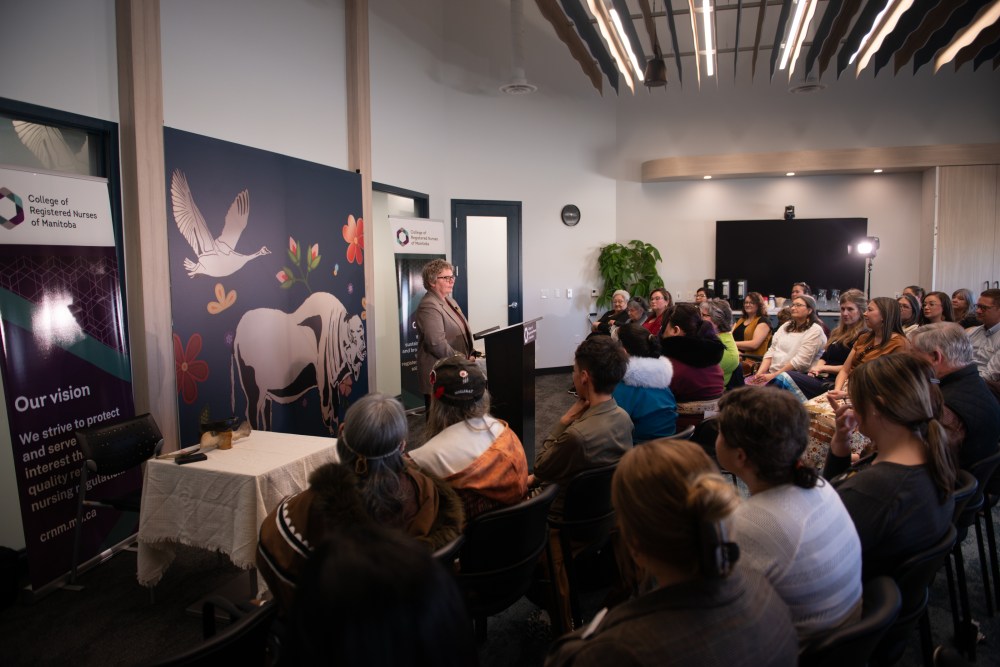
Deb Elias, the College of Registered Nurses of Manitoba Registrar, speaks in Winnipeg, on Wednesday, May 13, 2026, in this handout photo. THE CANADIAN PRESS/Handout - Martin Lussier (Mandatory Credit)

Elias went on to say that the apology is “long overdue” and that despite there being ample documentation of systemic racism affecting Indigenous patients and nurses working in the system, the college has failed to address the issues with the level of urgency required to make change. 

“(The apology) is the first step to acknowledging essentially the truth of what’s happened and what continues to happen, knowing that we need to have concrete actions moving forward,” Elias later said in an interview with The Canadian Press. 

The college’s role is to ensure that the more than 15,200 registered nurses and nurse practitioners in the province are qualified to provide safe and ethical care. 

Elias said these health-care workers have significant power and influence in the health system, and they should be providing inclusive and culturally safe care.

Research has shown that systemic racism has led to barriers in care and some patients choosing not to seek medical help. In some cases, it has resulted in fatalities. 

Brian Sinclair, an amputee, died in 2008 after waiting 34 hours in a Winnipeg emergency room. An inquest into the First Nations man’s death found that medical staff assumed he was intoxicated. A report issued by a group of doctors later said his death was a result of racism. 

The college created an Indigenous advisory group last fall to help develop a reconciliation action plan that would include adding more Indigenous staff and voices to its operations.

Elias said the college hopes to release the plan by the end of this year. 

She said the college has heard from non-Indigenous nurses that there is an appetite for more training on First Nations, Inuit and Métis culture and traditional healing practices, and that the regulator is willing to push the envelope on this. 

The regulatory body has also heard from some Indigenous nurses who have felt discriminated against in the public system and have chosen to work within their own communities, where they feel more safe. 

“Today was emotional for many of us,” said Caroline Chartrand, a senior nurse adviser at the health organization Keewatinohk Inniniw Minoayawin. “As First Nations nurses, we have been advocating for change, cultural safety and accountability for a very long time.”

First Nations groups commended the apology but said it must also lead to concrete change. 

“We are here to ensure this moment results in meaningful system change that protects First Nations people from further harm and creates accountability across health-care regulation,” said Michelle Monkman, interim chief executive officer of Keewatinohk Inniniw Minoayawin. “Public health and safety must benefit everyone equally, including First Nations citizens.”

The apology should also encourage the wider health system to learn about shared history between Indigenous and non-Indigenous people and the effects of systemic racism on the well-being of First Nations people, said Monkman. 

The Assembly of Manitoba Chiefs said the apology is an important acknowledgment of First Nations people’s experiences within health-care systems and institutions in the province. 

The group said it’s important that there is support for First Nations nurses, health-care professionals and students. 

“Reconciliation is not a single moment or statement,” said Grand Chief Kyra Wilson. 

“It is ongoing work grounded in truth, accountability and building relationships based on respect.”

This report by The Canadian Press was first published May 13, 2026. 

Report Error Submit a Tip

More Stories

Gillingham in lead with decided voters

Nicole Buffie 6 minute read Preview

Gillingham in lead with decided voters

Nicole Buffie 6 minute read Friday, Sep. 18, 2026

A cloud of uncertainty is hanging over Winnipeg as October’s municipal election nears.

Three months after a poll showed more than 40 per cent of Winnipeggers wanted to see someone other than current mayor Scott Gillingham elected, a new Abacus Data poll indicates more than half of Winnipeg voters are undecided heading into next month’s civic election.

Of decided voters, 55 per cent favour Gillingham compared to 23 per cent for former councillor and provincial cabinet minister Kevin Klein and 11 per cent for funeral director Mike Vogiatzakis.

Of all respondents, just over 50 per cent said they were unsure while 13 per cent said they will not vote.

Read
Friday, Sep. 18, 2026

Cabernet Sauvignon star of wine festival

Ben Sigurdson 5 minute read Preview

Cabernet Sauvignon star of wine festival

Ben Sigurdson 5 minute read Saturday, Sep. 19, 2026

The Winnipeg Wine Festival will celebrate the king of red wine grapes next weekend — the theme of this year’s festival, which takes place Sept. 25 and 26 at the RBC Convention Centre, is Cabernet Sauvignon.

Cab Sauv, as it’s also known, is the world’s most widely planted wine grape of any colour, first coming to prominence in the 1800s in France’s Bordeaux region, where the grape is still popular. Rather than single-variety wines, Bordeaux reds tend to be blends, with those coming from the left bank of the Gironde estuary being Cabernet-dominant, while right-bank wines are Merlot-dominant, with Cabernet Sauvignon playing a supporting role. Cabernet and Merlot work well together and many other countries have followed suit in blending the two.

A team at University of California Davis put Cabernet Sauvignon through a DNA test in 1996 and discovered its parent grapes are Cabernet Franc and Sauvignon Blanc — it’s likely that at some point the two varieties, planted next to each other in some vineyard, crossed and mutated and became the grape we know today. (Someone growing grapes in the 19th century must have had an inkling of what was up, as the grape has been called Cabernet Sauvignon since long before the DNA test.)

Flavour-wise, most Cabernet Sauvignon wines are big and bold, with a core of deep dark berry flavours, some graphite and spice notes and relatively bright acidity. It’s a grape that is well-suited to barrel aging, with most examples seeing at least some time in wood.

Read
Saturday, Sep. 19, 2026

National Black Canadians Summit celebrates culture, combats racism

Gabrielle Piché 4 minute read Preview

National Black Canadians Summit celebrates culture, combats racism

Gabrielle Piché 4 minute read Saturday, Sep. 19, 2026

Despite the event’s name — the National Black Canadians Summit — Bruce Miller felt he should attend.

He booked a ticket. And so, this weekend, the Indigenous Manitoban joined roughly 1,500 people flocking to the RBC Convention Centre.

It’s a full schedule — addresses from a former Canadian governor general, sessions on Black mental health and anti-Black racism.

The annual event draws politicians, artists and other professionals from across the country.

Read
Saturday, Sep. 19, 2026

AC/DC leaves Winnipeg crowd thunderstruck

Rob Williams 5 minute read Preview

AC/DC leaves Winnipeg crowd thunderstruck

Rob Williams 5 minute read 12:11 AM CDT

AC/DC proved once again that rock ‘n’ roll ain’t noise pollution.

A rowdy stadium of about 35,000 people at Princess Auto Stadium couldn’t agree more as the Australian rock legends made their first trip to the city since 2015 on their PWR/UP tour, cranking out two hours and 20 minutes of raw and raunchy high-voltage material, a mix of blues, crunchy power chords, melodic riffs and double entendres that spanned five decades.

Their wide-ranging appeal was apparent in the demographic makeup of the crowd, which ranged from young children to seniors, many clad in $30 glowing devil horns from the well-stocked merch booth that also offered posters, banners, beer koozies, lanyards, tour books and T-shirts.

There is no one in music quite like guitar god Angus Young. He is 71, but onstage he is ageless, a hyperactive teenager dressed in his signature blue schoolboy uniform and yellow and blue cap, running around, duck-walking and leaping in the air while cranking out riff after riff and extended solos on his trusty black Gibson SG.

Read
12:11 AM CDT

American Hostage stars recall warmth of Winnipeggers during brutal winter

Randall King 7 minute read Preview

American Hostage stars recall warmth of Winnipeggers during brutal winter

Randall King 7 minute read Friday, Sep. 18, 2026

TORONTO — When you stream the eight-part series American Hostage, a sense of familiarity may strike.

That’s because the show was shot in Winnipeg — especially in the Exchange District — from November of last year to the beginning of February, with Winnipeg portraying Indianapolis circa 1977.

The whole world seemed to be watching that midwest American city that year as a hostage crisis unfolded involving one Tony Kiritsis, an angry man who goes ballistic when a mortgage brokerage was poised to foreclose on property he had dreamed of developing into a shopping centre.

Kiritsis kidnapped his mortgage broker, Richard Hall, wiring a shotgun to the back of his head, and demanded a public airing of his grievances, with the reluctant help of popular radio broadcaster Fred Heckman.

Read
Friday, Sep. 18, 2026

Desperate Poilievre wants Canadians to believe the sky is falling when it’s just cloudy outside

Tom Brodbeck 5 minute read Preview

Desperate Poilievre wants Canadians to believe the sky is falling when it’s just cloudy outside

Tom Brodbeck 5 minute read Friday, Sep. 18, 2026

Pierre Poilievre has a problem.

Canadians just don’t seem to be paying much attention to him anymore.

So, naturally, the Conservative Opposition leader has decided to turn up the volume.

At a recent party caucus retreat in Penticton, B.C., Poilievre delivered the familiar message: Canada is in trouble, Canadians are hurting and the Liberal government is making everything worse.

Read
Friday, Sep. 18, 2026