Testing is underway on vaccines to intercept brewing colon cancer before it takes root
Advertisement
Read this article for free:
or
Already have an account? Log in here »
To continue reading, please subscribe:

Digital Subscription
One year of digital access for only $205*
- Enjoy unlimited reading on winnipegfreepress.com
- Read the E-Edition, our digital replica newspaper
- Access News Break, our award-winning app
- Play interactive puzzles
*First annual payment billed as $205.00 + GST for one year. This annual subscription will automatically renew at $233.00 + GST every 52 weeks (10% off the regular annual price of $259.35). Offer available to new and qualified returning subscribers only. Cancel any time.
To continue reading, please subscribe:
Add Free Press access to your Brandon Sun subscription for only an additional
$1 for the first 4 weeks*
- Enjoy unlimited reading on winnipegfreepress.com
- Read the E-Edition, our digital replica newspaper
- Access News Break, our award-winning app
- Play interactive puzzles
*Your next Brandon Sun subscription payment will increase by $1.00 and you will be charged $17.95 plus GST for four weeks. After four weeks, your payment will increase to $24.95 plus GST every four weeks.
Read unlimited articles for free today:
or
Already have an account? Log in here »
Dr. Stacy Norton was only 7 years old when her mother died of colon cancer, one of several family members struck by aggressive tumors at unusually young ages. Decades later, Norton rolled up her sleeve to help test if a new kind of vaccine might protect her and her own children from cancer.
The Houston doctor is among an estimated 1 million Americans who have Lynch syndrome, a faulty gene passed from a parent that puts them at extremely high risk of colorectal cancer and more vulnerable to certain other cancers, too. They’re often urged to get yearly colonoscopies — far more often than usual — that can spot and remove precancerous growths called polyps.
Now scientists are creating vaccines that aim to go further, teaching the immune system to intercept this type of brewing colon cancer before it turns into a full-fledged tumor. At least three potential Lynch syndrome vaccines are in development, including two in early clinical trials in the U.S. and a third beginning in Britain.
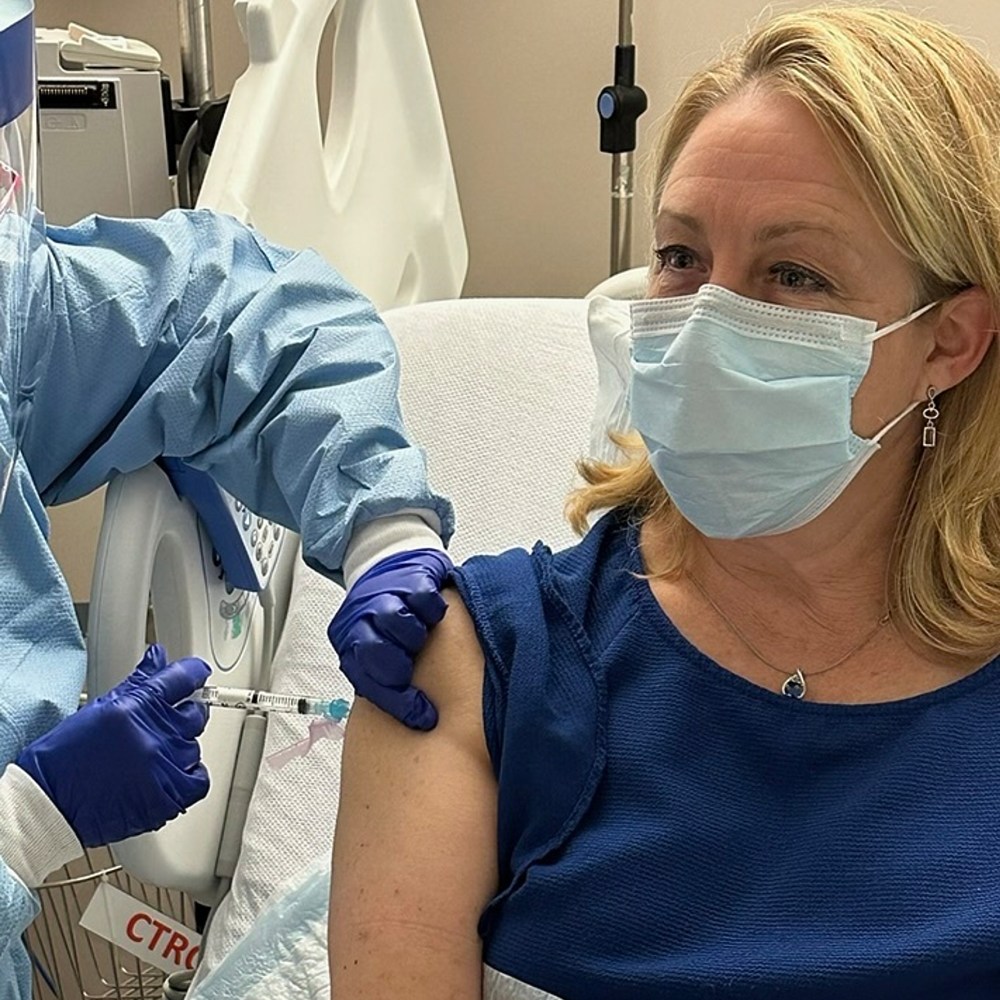
The shot that Norton helped test appears promising enough that its lead researcher, Dr. Eduardo Vilar-Sanchez of the MD Anderson Cancer Center, expects a larger study to begin early next year.
“It gives me hope,” said Norton, 59, of Houston Methodist Willowbrook Hospital. She had already survived a different Lynch-caused cancer and has two children in their 20s who inherited her mutation. If a vaccine pans out, “perhaps they won’t have to have a colonoscopy every single year for the rest of their lives.”
Lynch syndrome is caused by an inherited genetic mutation
Everyone has what are called mismatch-repair genes, which are essentially spellcheckers to help fix DNA mistakes that can occur when our cells multiply. With Lynch syndrome, one of those genes can’t do its job properly, making it harder for the body to stop a buildup of abnormalities that can lead to tumors, often before age 50.
Colorectal cancer is the most common consequence. The average person has a 5% risk of developing it during their lifetime. A Lynch carrier’s risk can reach as high as 80% depending on which faulty gene they inherit, Vilar-Sanchez said.
Another big risk is endometrial, or uterine, cancer. Lynch carriers also are more likely to get other cancers including pancreatic, stomach, ovarian and certain skin cancers — and a kind of brain tumor that killed Norton’s sister at age 25.
Norton knew some of her mother’s relatives had also experienced colon cancer, but she was in her 40s before a gene test confirmed she has Lynch syndrome. She switched from every-so-often to yearly colonoscopies. As an obstetrician/gynecologist familiar with other Lynch risks, Norton also decided to have a precautionary hysterectomy. Surgeons discovered early-stage cancer in her removed uterus.
Possible vaccines to stop gene-caused cancer
Today there are two cancer-preventing vaccines, the HPV and hepatitis B shots that block infection from those tumor-causing viruses. But developing vaccines to prevent gene-caused cancer is more challenging than alerting the body to foreign intruders like a virus.
Lynch-fueled growths “tend to accumulate hundreds of mutations that are going to generate proteins that are novel, not made by our normal cells,” Vilar-Sanchez said. “You can train the immune system to recognize those proteins.”
In a first-step study, Norton and 44 other Lynch carriers tested a vaccine made by Swiss biotech Nouscom that teaches the immune system to spot 209 of those abnormalities in Lynch-caused precancers. That revved up tumor-eliminating T cells and a year later, colonoscopies showed fewer precancerous growths and no advanced polyps, the MD Anderson team reported in Nature Medicine.
“Can we even further stimulate the immune system” to keep up with Lynch syndrome-spurred tumor formation, asked Dr. John Marshall, a Georgetown University oncologist and adviser to the Colorectal Cancer Alliance who wasn’t involved with the study. “This early paper suggests that yeah, maybe we can.”
For the first time since 2014, Norton’s own colonoscopies one and two years after vaccination were polyp-free. She’s also part of a subset of study participants given a booster shot a year later; more data on that is expected this fall.
Oxford University researchers are beginning initial testing of a similar approach to attack Lynch-spurred precancers, a vaccine made by Massachusetts-based Moderna using the mRNA technology behind its COVID-19 shot.
And scientists are awaiting results from a slightly larger study comparing California-based ImmunityBio’s Tri-Ad5 vaccine, which flags some different cancer markers, to a placebo.
Is Lynch syndrome tied to the rise in young adult colon cancer?

About 158,000 people are diagnosed with colorectal cancer in the U.S. each year, most of them over 50. Cases in younger adults are increasing, though it isn’t clear why.
Lynch syndrome affects about 1 in 279 people. While most don’t know it, more may be learning they have the inherited disorder, Vilar-Sanchez said, as genetic testing is increasingly discussed with people with Lynch-related cancer in the family or who get certain tumors at young ages. That in turn can show if close relatives might also be at risk.
For the average person, U.S. guidelines call for routine colorectal cancer screening — with a colonoscopy or other kinds of tests — to begin at age 45. But at any age, get a checkup for symptoms such as blood in stool or rectal bleeding; changes in bowel habits such as diarrhea, constipation or narrowing of stool that lasts more than a few days; unintended weight loss; and cramps or abdominal pain.
___
The Associated Press Health and Science Department receives support from the Howard Hughes Medical Institute’s Department of Science Education and the Robert Wood Johnson Foundation. The AP is solely responsible for all content.