Allegheny County Council passes parental leave mandate in 11-4 vote

Advertisement

Advertise with us

Many employees in Allegheny County will soon be eligible to receive up to 12 weeks of paid parental leave after council this evening passed the first policy of its kind in the country.

Read this article for free:


By clicking the button above, an account will be created and you will begin to receive some of our recommended newsletters. You may opt out of any newsletter by visiting your Email and Communication Preferences page or by clicking "unsubscribe" at the bottom of any email.

or

Already have an account? Log in here »

To continue reading, please subscribe:

Digital Subscription

One year of digital access for only $1.44 a week*

  • Enjoy unlimited reading on winnipegfreepress.com
  • Read the E-Edition, our digital replica newspaper
  • Access News Break, our award-winning app
  • Play interactive puzzles

*Billed as $5.77 plus GST every four weeks. After 52 weeks, price increases to the regular rate of $19.95 plus GST every four weeks. Offer available to new and qualified returning subscribers only. Cancel any time.

To continue reading, please subscribe:

Add Free Press access to your Brandon Sun subscription for only an additional

$1 for the first 4 weeks*

  • Enjoy unlimited reading on winnipegfreepress.com
  • Read the E-Edition, our digital replica newspaper
  • Access News Break, our award-winning app
  • Play interactive puzzles
Start now

*Your next Brandon Sun subscription payment will increase by $1.00 and you will be charged $17.95 plus GST for four weeks. After four weeks, your payment will increase to $24.95 plus GST every four weeks.

Many employees in Allegheny County will soon be eligible to receive up to 12 weeks of paid parental leave after council this evening passed the first policy of its kind in the country.

The policy will go into effect one year after County Executive Sara Innamorato signs the bill. The bill advanced Tuesday follows six months of disagreement largely between business groups on one side and healthcare workers and parents on the other. The vast majority of the dozens of additional speakers who showed up Tuesday to comment spoke in favor of the measure, oftentimes describing the challenges of parenting in wrenching detail.

Businesses with 15 or more employees will be required to offer the leave. The employee count requirement was added as a concession to small businesses — and the length of the leave was shortened from 18 weeks — after the county received more than 1,400 public comments.

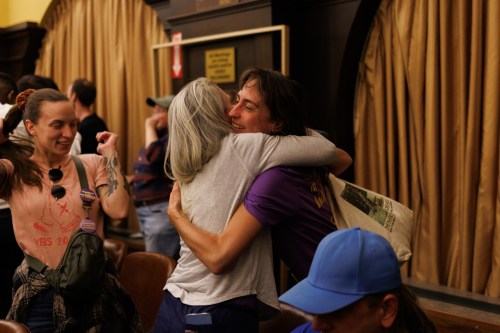
Leigh Carroll, right, embraces Jean Stone after a paid parental leave bill passes Allegheny County Council at the Allegheny County Courthouse in Pittsburgh, Tuesday, Oct. 20, 2026. (Danny Arensberg/Pittsburgh's Public Source)

Still, the new policy marks a major victory for Innamorato, who advocated for its passage while sharing her own experience of pregnancy. In the weeks before the final vote, Innamorato held several public events with supporters, while business groups released a survey last week showing that more than 400 businesses oppose the new policy.

“By passing the first county-level paid parental leave policy in the country, we’re showing that we’re serious about protecting workers and their families at one of the most economically and medically vulnerable times in their lives,” Innamorato said in a statement.

It is the first paid parental leave policy in the country passed as a public health measure. Political experts told Public Source that the policy could be emulated by cities and counties in purple and red states that don’t have their own policies at the state level.

Lucy Rose Ruccio, holding her six-week-old baby, urged the council to “seize this historic moment” and vote for a policy that would “reverberate for years to come.”

It is only the second parental leave policy in the country to put the entire cost burden on businesses, and it’s the first to ensure that parents receive 100% of their incomes for 12 weeks. The 14 Democratic-led states that already have policies pay between 50% and 90% of a parent’s income while on leave. Allegheny County’s maximum weekly payout of $4,200 is more than twice as generous as any existing state policy.

Councilor Pat Catena said the council should wait for Harrisburg to act because the policy could drive up costs for childcare and healthcare, which families would end up paying. “The very families we intend to help could end up paying the price,” Catena said. “Our responsibility is not to pass legislation but to adopt policies that work in practice and protect our local economy.”

Paul Klein, the chair of the council’s health committee, said the county couldn’t wait for federal or state action. “In Allegheny County we have decided that it is a moral imperative,” he said. “If we don’t do this, who will? And if not now, when?”

The policy applies to both birthing parents and their spouses, to parents who adopt and to parents who experience a stillbirth. One speaker held up a picture of her infant who died in the hospital, one of several wrenching stories that Councilor John Palmiere said helped persuade him to support the bill. One of Palmiere’s grandchildren died in his crib.

“Tonight really really hit home for me,” Palmiere said. “I’ve had my doubts about some of these issues and this ordinance. … You know what: So what?”

Palmiere voted yes. After three hours of comments and discussion, the final vote was 11 in favor and four opposed, followed by a standing ovation in the courthouse’s Gold Room.

The Pittsburgh Regional Alliance, a business advocacy organization, promptly issued a statement saying the mandate “weakens our region’s ability to attract investments, retain talent, and grow jobs” and “creates an anti-competitive environment that places our employers at a distinct disadvantage compared to neighboring counties and regional peers.”

Several council members said they knew there were problems with the legislation as written and that the county would have to adjust as problems became apparent. “As we move into the implementation phase, there will be issues that arise that are unexpected,” said councilor Kathleen Madonna-Emmerling. “We will deal with them.”

___

This story was originally published by Pittsburgh’s Public Source and distributed through a partnership with The Associated Press.

Report Error Submit a Tip

More Stories

Allegheny County Council passes parental leave mandate in 11-4 vote

Oliver Morrison/pittsburgh’s Public Source, The Associated Press 5 minute read Preview

Allegheny County Council passes parental leave mandate in 11-4 vote

Oliver Morrison/pittsburgh’s Public Source, The Associated Press 5 minute read Yesterday at 1:13 PM CDT

Many employees in Allegheny County will soon be eligible to receive up to 12 weeks of paid parental leave after council this evening passed the first policy of its kind in the country.

The policy will go into effect one year after County Executive Sara Innamorato signs the bill. The bill advanced Tuesday follows six months of disagreement largely between business groups on one side and healthcare workers and parents on the other. The vast majority of the dozens of additional speakers who showed up Tuesday to comment spoke in favor of the measure, oftentimes describing the challenges of parenting in wrenching detail.

Businesses with 15 or more employees will be required to offer the leave. The employee count requirement was added as a concession to small businesses — and the length of the leave was shortened from 18 weeks — after the county received more than 1,400 public comments.

Still, the new policy marks a major victory for Innamorato, who advocated for its passage while sharing her own experience of pregnancy. In the weeks before the final vote, Innamorato held several public events with supporters, while business groups released a survey last week showing that more than 400 businesses oppose the new policy.

Read
Yesterday at 1:13 PM CDT

Outbreak should never have happened

Editorial 4 minute read Preview

Outbreak should never have happened

Editorial 4 minute read 2:00 AM CDT

The headline offered a vague sense that something had been accomplished, but it most certainly did not describe anything worth celebrating:

“Manitoba declares measles outbreak over.”

The news item in the Oct. 17 Free Press noted provincial public health officials had confirmed Manitoba’s last laboratory-confirmed case of measles was identified in August, and that the absence of any new cases since had allowed for the aforementioned declaration.

The end of the outbreak — which began in February 2025 and included a significant stretch this year during which Manitoba experienced more measles cases than any other province — is certainly worth noting. But it bears reminding that the real story here is that this province, and others across Canada, experienced a resurgence of this highly communicable but successfully eradicated disease in the first place.

Read
2:00 AM CDT

Chief medical officer quits, cites work environment ‘challenges’

Chris Kitching 6 minute read Preview

Chief medical officer quits, cites work environment ‘challenges’

Chris Kitching 6 minute read 5:47 PM CDT

Manitoba’s provincial chief medical officer is resigning from his position at Shared Health, citing the role’s demands and work environment challenges in an email viewed by the Free Press.

Dr. José François, who’s held the executive position since April 2024, sent an email to provincial medical specialty leads that said his final day will be Jan. 17, 2027, after he submitted his resignation Wednesday. Several other senior leaders have departed the provincial health authority in recent months.

“Serving in this role has been a privilege,” François, a longtime family physician from Ste. Anne, wrote in the email.

He said his “greatest pleasure” was working alongside and supporting an “exceptional group” of provincial medical specialty leads and chief medical officers.

Read
5:47 PM CDT

MPI gambles with low rate request

Editorial 4 minute read Preview

MPI gambles with low rate request

Editorial 4 minute read Updated: Yesterday at 10:16 AM CDT

It sounds a bit like a gamble from a player in an industry that is almost pathologically averse to gambling.

Read
Updated: Yesterday at 10:16 AM CDT

Police HQ report ‘outrageous’: Kinew

Joyanne Pursaga 6 minute read Preview

Police HQ report ‘outrageous’: Kinew

Joyanne Pursaga 6 minute read Tuesday, Oct. 20, 2026

Premier Wab Kinew says public inquiry findings that taxpayers were overcharged more than $40 million for the Winnipeg Police Service headquarters project and two city leaders broke the public trust are “outrageous.”

Inquiry commissioner Garth Smorang’s report, which was released Monday, concluded former mayor Sam Katz “violated the public trust” and council code of conduct, while the city’s former chief administrative officer Phil Sheegl suffered from a “complete lack of a moral compass.”

Smorang also found the city was overcharged $43.3 million for the project, with $42 million of that going to key contractor Caspian Projects.

“It’s outrageous that people who were elected betrayed the public here in the city. It’s outrageous that there were people in business who ripped you off, ripped me off — I was paying property taxes in Winnipeg at the time — and ripped all of us off to the tune of $43.3 million. That’s crazy,” said Kinew.

Read
Tuesday, Oct. 20, 2026

WAG-Qaumajuq names first Indigenous director, CEO

Jen Zoratti 4 minute read Preview

WAG-Qaumajuq names first Indigenous director, CEO

Jen Zoratti 4 minute read 5:16 PM CDT

John Mahli Lawa’ Hampton has been selected to take the helm of Canada’s oldest civic art gallery, WAG-Qaumajuq announced Thursday.

Read
5:16 PM CDT