CDC to significantly ease pandemic mask guidelines Friday

Advertisement

Advertise with us

WASHINGTON (AP) — The Biden administration will significantly loosen federal mask-wearing guidelines to protect against COVID-19 transmission on Friday, according to two people familiar with the matter, meaning most Americans will no longer be advised to wear masks in indoor public settings.

Read this article for free:


or

Already have an account? Log in here »

To continue reading, please subscribe:

Subscribe and receive a limited-edition Free Press branded hat or tote.

Digital Subscription

One year of digital access for only $205*

  • Enjoy unlimited reading on winnipegfreepress.com
  • Read the E-Edition, our digital replica newspaper
  • Access News Break, our award-winning app
  • Play interactive puzzles

*First annual payment billed as $205.00 + GST for one year. This annual subscription will automatically renew at $233.00 + GST every 52 weeks (10% off the regular annual price of $259.35). Offer available to new and qualified returning subscribers only. Cancel any time.

To continue reading, please subscribe:

Add Free Press access to your Brandon Sun subscription for only an additional

$1 for the first 4 weeks*

  • Enjoy unlimited reading on winnipegfreepress.com
  • Read the E-Edition, our digital replica newspaper
  • Access News Break, our award-winning app
  • Play interactive puzzles
Start now

*Your next Brandon Sun subscription payment will increase by $1.00 and you will be charged $17.95 plus GST for four weeks. After four weeks, your payment will increase to $24.95 plus GST every four weeks.

Hey there, time traveller!
This article was published 24/02/2022 (1640 days ago), so information in it may no longer be current.

WASHINGTON (AP) — The Biden administration will significantly loosen federal mask-wearing guidelines to protect against COVID-19 transmission on Friday, according to two people familiar with the matter, meaning most Americans will no longer be advised to wear masks in indoor public settings.

The Centers for Disease Control and Prevention on Friday will announce a change to the metrics it uses to determine whether to recommend face coverings, shifting from looking at COVID-19 case counts to a more holistic view of risk from the coronavirus to a community. Under current guidelines, masks are recommended for people residing in communities of substantial or high transmission — roughly 95% of U.S. counties, according to the latest data.

The new metrics will still consider caseloads, but also take into account hospitalizations and local hospital capacity, which have been markedly improved during the emergence of the omicron variant. That strain is highly transmissible, but indications are that it is less severe than earlier strains, particularly for people who are fully vaccinated and boosted. Under the new guidelines, the vast majority of Americans will no longer live in areas where indoor masking in public is recommended, based on current data.

President Joe Biden removes his face mask to speak in the South Court Auditorium in the Eisenhower Executive Office Building on the White House complex, Tuesday, Feb. 22, 2022, in Washington. (AP Photo/Alex Brandon)

The new policy comes as the Biden administration moves to shift its focus to preventing serious illness and death from COVID-19, rather than all instances of infection, as part of a strategy adjustment for a new “phase” in the response as the virus becomes endemic.

The two people familiar with the change spoke on the condition of anonymity to preview the CDC’s action before the announcement.

The change comes as nearly all U.S. states that had put in place indoor mask-wearing mandates for the winter omicron surge are letting them lapse as cases have precipitously dropped nationwide. Some have eliminated the mandates entirely, while others have kept mask-wearing requirements in place for schools and medical facilities.

It was not immediately clear how the new CDC guidance would affect U.S. federal mandates requiring face coverings on public transportation.

The CDC’s director, Dr. Rochelle Walensky, has said a change has been in the works.

“We must consider hospital capacity as an additional important barometer. Our hospitals need to be able to take care of people with heart attacks and strokes. Our emergency departments can’t be so overwhelmed that patients with emergent issues have to wait in line,” she said during a White House briefing last week.

However, she declined to give a specific day when the CDC would announce a change. CDC officials on Thursday refused to confirm a release date.
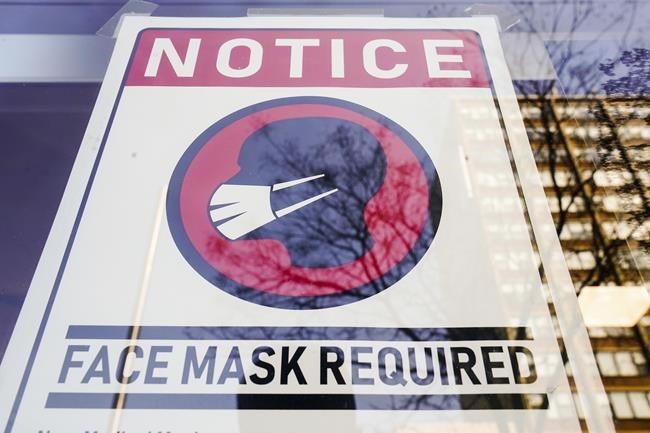
FILE - A sign requiring masks as a precaution against the spread of the coronavirus is posted on a store front in Philadelphia, on Feb. 16, 2022. The Biden administration will significantly loosen federal mask-wearing guidelines to protect against COVID-19 transmission on Friday, according to two people familiar with the matter. (AP Photo/Matt Rourke, File)

“At @CDCgov, we have been analyzing our #COVID19 data and shifting our focus to preventing the most severe outcomes and minimizing healthcare strain,” Walensky tweeted Thursday night, offering no details on Friday’s announcement.

AP writer Mike Stobbe contributed.

Report Error Submit a Tip

More Stories

Ready to crack over late-night ‘snacks’

Maureen Scurfield 4 minute read Yesterday at 2:00 AM CDT

DEAR MISS LONELYHEARTS: My new love has a seriously annoying habit that could break us up now that we’re actually living together.

I’m not getting much sleep, and it has nothing to do with having too much sex! Every night at about 2 a.m., my man gets up and goes to the fridge, makes a giant sandwich and pours a huge glass of apple juice, then sits there scarfing it down, with music on for a bit of entertainment. This often wakes me up, and when I complain he just invites me to join him “for a bite.”

Really? The last thing I need is to eat a fourth meal of the day in the middle of the night. He says it’s an old habit from his football days, when he was so hungry all the time and he still enjoys it. He says he isn’t about to change that for me, so, tough luck.

It’s a big problem as I can’t just fall back to sleep after he rattles around the kitchen and then comes back and jumps back into bed with me.

Rural residents ‘outraged’ property owner charged after shots fired during confrontation with alleged thieves: MLA

Zoe Pierce 5 minute read Preview

Rural residents ‘outraged’ property owner charged after shots fired during confrontation with alleged thieves: MLA

Zoe Pierce 5 minute read Thursday, Aug. 20, 2026

A rural Manitoba MLA says he has heard from constituents who are “shocked and outraged” that a 66-year-old man is facing charges after he fired shots at a group of people accused of stealing from his property.

Read
Thursday, Aug. 20, 2026

Rail-traffic alert beacons, signs will give drivers chance to change routes, save time

Joyanne Pursaga 2 minute read Preview

Rail-traffic alert beacons, signs will give drivers chance to change routes, save time

Joyanne Pursaga 2 minute read Yesterday at 1:51 PM CDT

A new rail-crossing alert system will help Winnipeg drivers avoid train delays.

Roadside TRAINFO beacons and digital message boards will now flash at locations prior to select rail crossings. They will alert drivers to approaching trains, with adequate time to let them choose an alternate route and avoid the wait.

The flashing beacons are now located at the following high train-traffic spots:

Pandora Avenue at Day Street, Redonda Street and Ravenhurst Street, to note trains at the Ravenhurst rail crossing north of Dugald Road.East and west of the multiple rail crossings on Marion Avenue between Archibald Street and Lagimodiere Boulevard, to note trains along the corridor.At the intersection of McGillivray Boulevard and Waverley Street, to note trains crossing McGillivray at Pembina Highway.Digital message sign boards will also be placed on Sterling Lyon Boulevard and Kenaston Boulevard to note when trains are present at the McGillivray/Pembina crossing.

Read
Yesterday at 1:51 PM CDT

ER wait times have hit all-time highs in Winnipeg and are impacting nearly all aspects of hospital operations

Tom Brodbeck 16 minute read Preview

ER wait times have hit all-time highs in Winnipeg and are impacting nearly all aspects of hospital operations

Tom Brodbeck 16 minute read Yesterday at 6:00 AM CDT

On most days at Health Sciences Centre’s adult emergency department, all 58 treatment beds are filled with sick patients. Another dozen or so brought in by ambulance line the hallways on stretchers, with only one nurse to look after them.

Out in the waiting room, about 30 or 40 people — sometimes more — are slouched in chairs in pain or discomfort, waiting hours to see a doctor. Most have been assessed by a triage nurse, but many will have to wait 10 to 20 hours to be examined by a physician because there’s no room for them in the treatment area.

Some patients leave because they can no longer tolerate the excruciating wait, only to return days later, sicker than they were before.

Welcome to the emergency department at Manitoba’s largest hospital, where some of the highest-acuity patients seek medical care but now face delays that were unimaginable a few years ago.

Read
Yesterday at 6:00 AM CDT

CDC to significantly ease pandemic mask guidelines Friday

Zeke Miller, The Associated Press 3 minute read Preview

CDC to significantly ease pandemic mask guidelines Friday

Zeke Miller, The Associated Press 3 minute read Thursday, Feb. 24, 2022

WASHINGTON (AP) — The Biden administration will significantly loosen federal mask-wearing guidelines to protect against COVID-19 transmission on Friday, according to two people familiar with the matter, meaning most Americans will no longer be advised to wear masks in indoor public settings.

The Centers for Disease Control and Prevention on Friday will announce a change to the metrics it uses to determine whether to recommend face coverings, shifting from looking at COVID-19 case counts to a more holistic view of risk from the coronavirus to a community. Under current guidelines, masks are recommended for people residing in communities of substantial or high transmission — roughly 95% of U.S. counties, according to the latest data.

The new metrics will still consider caseloads, but also take into account hospitalizations and local hospital capacity, which have been markedly improved during the emergence of the omicron variant. That strain is highly transmissible, but indications are that it is less severe than earlier strains, particularly for people who are fully vaccinated and boosted. Under the new guidelines, the vast majority of Americans will no longer live in areas where indoor masking in public is recommended, based on current data.

The new policy comes as the Biden administration moves to shift its focus to preventing serious illness and death from COVID-19, rather than all instances of infection, as part of a strategy adjustment for a new “phase" in the response as the virus becomes endemic.

Read
Thursday, Feb. 24, 2022

Wait times for MRIs getting worse in Brandon, Dauphin

Rylee Gerrard 4 minute read 2:01 AM CDT

BRANDON — Wait times for MRI scans have surged in the Prairie Mountain Health region during the last two years.

Despite a campaign promise by the NDP in September 2023 to increase the number of allied health professionals capable of administering diagnostic imaging in northern and rural areas, wait times for MRIs have increased dramatically in Brandon and Dauphin.

Median imaging wait times tripled at Dauphin Regional Health Centre between 2024 and 2026, increasing from eight to 24 weeks, according to the province’s wait time dashboard.

The Brandon Regional Health Centre median wait times for MRI scans more than doubled during the same period, from nine to 23 weeks.