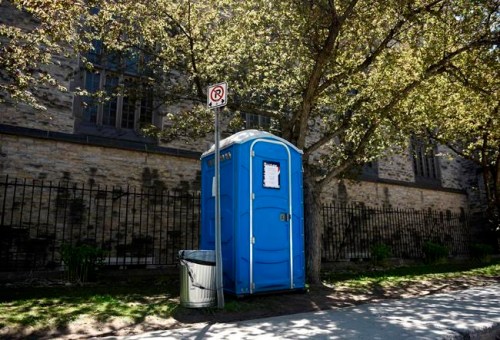
COVID-19 pandemic highlights need for more public toilets, experts say

Advertisement

Advertise with us

TORONTO - The COVID-19 pandemic is highlighting the need for more public toilets in communities across Canada, particularly as softening restrictions encourage people to spend more time outside their homes, advocates and experts say.

Read this article for free:


or

Already have an account? Log in here »

To continue reading, please subscribe:

Subscribe and receive a limited-edition Free Press branded hat or tote.

Digital Subscription

One year of digital access for only $205*

  • Enjoy unlimited reading on winnipegfreepress.com
  • Read the E-Edition, our digital replica newspaper
  • Access News Break, our award-winning app
  • Play interactive puzzles

*First annual payment billed as $205.00 + GST for one year. This annual subscription will automatically renew at $233.00 + GST every 52 weeks (10% off the regular annual price of $259.35). Offer available to new and qualified returning subscribers only. Cancel any time.

To continue reading, please subscribe:

Add Free Press access to your Brandon Sun subscription for only an additional

$1 for the first 4 weeks*

  • Enjoy unlimited reading on winnipegfreepress.com
  • Read the E-Edition, our digital replica newspaper
  • Access News Break, our award-winning app
  • Play interactive puzzles
Start now

*Your next Brandon Sun subscription payment will increase by $1.00 and you will be charged $17.95 plus GST for four weeks. After four weeks, your payment will increase to $24.95 plus GST every four weeks.

Hey there, time traveller!
This article was published 21/05/2020 (2312 days ago), so information in it may no longer be current.

TORONTO – The COVID-19 pandemic is highlighting the need for more public toilets in communities across Canada, particularly as softening restrictions encourage people to spend more time outside their homes, advocates and experts say.

The health crisis is drawing broader attention to an issue that has long been a barrier for racialized, trans and disabled people, as well those dealing with homelessness or poverty, the experts say.

Scarce access to washrooms was recently raised as a hurdle for essential workers, such as transit and truck drivers who could no longer rely on coffee shops and other businesses once those were ordered closed.
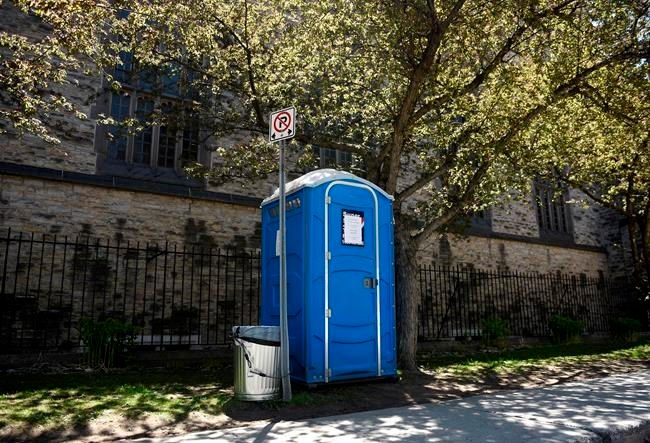
A porta-pottie beside Knox Presbyterian Church in downtown Ottawa, placed to allow people including those who are homeless or precariously housed to access a washroom, is seen on Wednesday, May 20, 2020 during the COVID-19 pandemic. THE CANADIAN PRESS/Justin Tang

In the early days of Ontario’s lockdown, Toronto Mayor John Tory pleaded with shuttered businesses to allow essential workers to use their bathrooms.

But as some provinces begin to reopen their economies — and residents increasingly venture outside — the demand for restrooms will rise, even though commercial facilities will remain largely off-limits, said Lezlie Lowe, author of “No Place To Go: How Public Toilets Fail Our Private Needs.”

“We don’t have this tradition of on-street, accessible, paid-for-by-municipal-governments bathroom provision. What we have in Canada is, we have Starbucks and Tim Hortons and McDonald’s and the other cafes and restaurants involved that we go into,” she said.

“We really consider those public toilets, but they’re not — they’re publicly accessible toilets, they’re effectively customer toilets.”

With those still out of commission, “people are going to have a sort of slap in the face and realize, ‘Oh my god, I was making do all this time with these publicly accessible toilets,’ and now people will hopefully start to realize how bad it is,” she said.

The dearth of public toilets could also undermine the economic recovery by preventing people from staying out longer and spending more money, Lowe said.

Some Canadian cities, including Toronto and Ottawa, have installed temporary portable washrooms and handwashing stations to help offset the closure of commercial and civic spaces.

“The city continues to explore opportunities to locate additional portable toilets and handwashing stations at strategic locations across the city,” Toronto Coun. Joe Cressy wrote in announcing the new facilities earlier this month.

In Prince George, B.C., municipal officials have reopened public washrooms in a downtown plaza for the duration of the pandemic, with the facilities in operation and monitored in the mornings and evenings.

While so-called porta-potties serve an important purpose, they don’t fulfill the same range of needs as permanent facilities, which are often used for child care, administering medication and other things, said Emily Scoular, who wrote her master’s thesis at the University of British Columbia on public washrooms.

The costs of building and maintaining public toilets have typically been a deterrent for municipalities, but Scoular said the current situation shows a need to rethink how much of that responsibility has been relegated to private business.

“You’re asking people to be healthy, leave their homes, get exercise, participate in the public realm, and I think the city and city facilities need to kind of come and meet us on that,” she said.

“I know Toronto and Vancouver are closing streets to allow (physical) distancing, and that’s one thing that encourages people to leave their houses, but another is making sure needs are met.”

For some advocates whose calls for more public toilets vastly predate the pandemic, the attention recently given to the issue is an encouraging first step.

“Maybe this is what it takes to get some serious attention paid to public health, including toi­lets,” those behind Ottawa’s “GottaGo!” campaign wrote in a recent op-ed published in a local community newspaper.

“A crisis can be an opportunity, so now is the time for all of us to advocate for a network of public toi­lets that include running water and soap for handwashing.”

This report by The Canadian Press was first published on May 21, 2020.

Report Error Submit a Tip

More Stories

Near-future U.S. the setting for surreal dual-world storyline

Reviewed by Morley Walker 4 minute read Preview

Near-future U.S. the setting for surreal dual-world storyline

Reviewed by Morley Walker 4 minute read 2:01 AM CDT

It’s not every day you encounter a seriously intended literary novel that attempts to dramatize a mind-bending physics theory like quantum entanglement.

But then the B.C.-born-and-raised Emily St. John Mandel is not your everyday Canadian literary writer.

In her late 40s, she has lived in the U.S. for her entire writing career. She is best known for her 2014 dystopian novel Station Eleven, about a Shakespearean acting troupe navigating a pandemic-ravaged America.

Her new outing, her seventh, Exit Party, shares DNA with detective and sci-fi genres more than with conventional literary fiction.

Read
2:01 AM CDT

Manitoba abandoning spring, fall clock changes

Carol Sanders 8 minute read Preview

Manitoba abandoning spring, fall clock changes

Carol Sanders 8 minute read Updated: Yesterday at 8:48 AM CDT

Time’s up for the time change in Manitoba.

Manitobans won’t be setting their clocks back an hour in November. The province has decided to permanently stay on daylight time after surveying residents on the twice annual clock adjustment.

“We heard from Manitobans loud and clear — no more changing the clocks in Manitoba,” Premier Wab Kinew said in a news release Thursday.

Most of the 72,000 votes submitted in an online EngageMB survey — 92 per cent — said they would like to see the practice end. The survey asked if they preferred earlier sunrises in winter with standard time or the later sunsets in summer with daylight time. More than half of survey participants (58 per cent) indicated a preference to stay on permanent daylight time; 34 per cent voted to eliminate the time change but stay on standard time.

Read
Updated: Yesterday at 8:48 AM CDT

Hellebuyck standoff caused by… Nathan MacKinnon?

Mike McIntyre 6 minute read Preview

Hellebuyck standoff caused by… Nathan MacKinnon?

Mike McIntyre 6 minute read Yesterday at 6:34 PM CDT

Looking for someone to blame in the Connor Hellebuyck fiasco and cast as public enemy No. 1? How about long-time Winnipeg Jets nemesis Nathan MacKinnon?

Allow us to explain as we fire up the time machine and head back to February in Italy.

Oh, what could have been if MacKinnon had been able to score on what appeared to be an open net late in the third period of the men’s gold medal game with Hellebuyck down and seemingly out of position.

Instead, the star forward fired wide, keeping the score deadlocked at 1-1 as the clock ticked down on regulation.

Read
Yesterday at 6:34 PM CDT

Jets vets weigh in on franchise goalie Hellebuyck not reporting to training camp

Mike McIntyre 7 minute read Preview

Jets vets weigh in on franchise goalie Hellebuyck not reporting to training camp

Mike McIntyre 7 minute read Thursday, Sep. 17, 2026

Hockey is the ultimate team sport, where it’s supposed to be about the crest on your chest rather than the name on your back.

So how is Connor Hellebuyck’s trade request and subsequent training camp strike playing out inside the Winnipeg Jets locker room — particularly among other core players he’s gone to battle with over the years?

“Obviously the news is heartbreaking,” Jets forward Kyle Connor said Thursday.

“It feels like we had such a special group here and for whatever reason — I can’t speak to the reason until we hear from the man, I’m not going to speculate on what it is but I know that a lot of guys in that room that are heartbroken.”

Read
Thursday, Sep. 17, 2026

Gillingham in lead with decided voters

Nicole Buffie 6 minute read Preview

Gillingham in lead with decided voters

Nicole Buffie 6 minute read Yesterday at 6:55 PM CDT

A cloud of uncertainty is hanging over Winnipeg as October’s municipal election nears.

Three months after a poll showed more than 40 per cent of Winnipeggers wanted to see someone other than current mayor Scott Gillingham elected, a new Abacus Data poll indicates more than half of Winnipeg voters are undecided heading into next month’s civic election.

Of decided voters, 55 per cent favour Gillingham compared to 23 per cent for former councillor and provincial cabinet minister Kevin Klein and 11 per cent for funeral director Mike Vogiatzakis.

Of all respondents, just over 50 per cent said they were unsure while 13 per cent said they will not vote.

Read
Yesterday at 6:55 PM CDT

A quick look at where provinces and territories stand on time changes

The Canadian Press 2 minute read Preview

A quick look at where provinces and territories stand on time changes

The Canadian Press 2 minute read Updated: Yesterday at 6:28 AM CDT

WINNIPEG - Manitoba's government said Thursday the province will be sticking with daylight time year-round, making it the latest jurisdiction to move away from twice-annual time changes. Here's a look at where things stand across Canada:

British Columbia said in March that it was moving to permanent Pacific daylight time. The change also means that parts of northeastern B.C., which have been on mountain standard time year round, are now in alignment with the rest of the province.

Alberta also switched to permanent daylight time this year in what it calls Alberta time. The change means it now has the same time as Saskatchewan year round.

Saskatchewan has been on permanent central standard time since 1966.

Read
Updated: Yesterday at 6:28 AM CDT