COVID-19 variant of interest vs. variant of concern: What does it mean?
Advertisement
Read this article for free:
or
Already have an account? Log in here »
To continue reading, please subscribe:

Digital Subscription
One year of digital access for only $205*
- Enjoy unlimited reading on winnipegfreepress.com
- Read the E-Edition, our digital replica newspaper
- Access News Break, our award-winning app
- Play interactive puzzles
*First annual payment billed as $205.00 + GST for one year. This annual subscription will automatically renew at $233.00 + GST every 52 weeks (10% off the regular annual price of $259.35). Offer available to new and qualified returning subscribers only. Cancel any time.
To continue reading, please subscribe:
Add Free Press access to your Brandon Sun subscription for only an additional
$1 for the first 4 weeks*
- Enjoy unlimited reading on winnipegfreepress.com
- Read the E-Edition, our digital replica newspaper
- Access News Break, our award-winning app
- Play interactive puzzles
*Your next Brandon Sun subscription payment will increase by $1.00 and you will be charged $17.95 plus GST for four weeks. After four weeks, your payment will increase to $24.95 plus GST every four weeks.
Read unlimited articles for free today:
or
Already have an account? Log in here »
Hey there, time traveller!
This article was published 22/04/2021 (1959 days ago), so information in it may no longer be current.
A variant that appears to be wreaking havoc in India has been detected in Canada and sparked a temporary ban on direct passenger flights from India and Pakistan on Thursday. But experts say it’s too early to know how concerning this new version of the COVID-19 virus is.
The variant — named B.1.617 — has so far been classified as a “variant of interest” by the World Health Organization, rather than a “variant of concern,” the term attached to the variants first detected in the United Kingdom, Brazil and South Africa.
Raywat Deonandan, an epidemiologist with the University of Ottawa, said Thursday that a variant of interest is one that is “suspected” to either be more contagious than the initial strain, cause more severe disease, or escape the protection offered by vaccines.
A variant of interest can become a variant of concern if more evidence emerges that it does one or more of those things, he added.
Here’s what we know about the new variant:
HOW TRANSMISSIBLE IS IT?
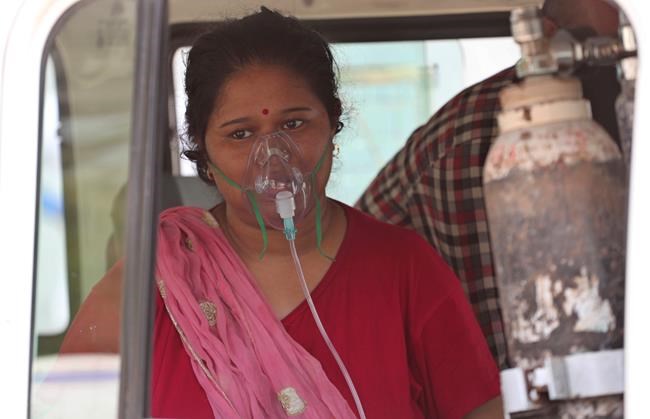
India is dealing with massive surges in COVID-19 activity — there were 300,000 new cases reported Wednesday with 2,000 deaths linked to the virus — but the Indian government has not confirmed the new variant is fueling the current wave.
Deonandan said the variant appears to be responsible for about 60 per cent of cases in India’s most populated region, which would suggest a higher transmissibility.
He said it’s “probably around 20 to 30 per cent,” more contagious, but added that experts still don’t know if the variant causes more severe disease.
“It may be a little less bad than B.1.1.7 (the variant first detected in the U.K.),” Deonandan said. “But our biggest concern is: If it becomes common here, are we then fighting off essentially another B.1.1.7?”
Dr. Zain Chagla, an infectious disease expert with McMaster University, said it’s important to flag this variant as one of interest because it does seem account for more and more of India’s caseload.
But, he added, other factors — including the country’s densely populated urban centres and mutligenerational homes with poorly ventilated spaces — may be contributing to how quickly it’s spreading there.
“Is it because of situations that lead to high levels of transmission and super spreading, or is there something biologically different about this variant?” Chagla said. “Or is it some combination of the two?”
Alain Lamarre, an immunology and virology professor at the Institut national de la recherche scientifique in Quebec, doesn’t think the new variant of interest is more concerning than the variants first detected in South Africa and Brazil.
He said he’s more concerned about the variant first discovered in the U.K., which is “clearly more transmissible and more virulent.”
WILL CURRENT VACCINES WORK AGAINST THE NEW VARIANT?
The variant first detected in India has a double mutation on the spike protein gene, which our current COVID-19 vaccines target. But experts say there’s no evidence right now that the approved vaccines won’t work against it.
Deonandan said the variant may diminish vaccine efficacy, “at least a little bit,” because that’s what we’ve seen with the variants of concern so far.
But, he added, that doesn’t mean efficacy will drop from 95 per cent to zero, for example.
Deonandan likened the coronavirus’s spike protein to the license plate on a car, with vaccines giving our cells that plate number so they know to keep it out when they see it.
“But if the license plate has changed, will the cell still recognize the car?” he said. “So the question is: Has an entire digit on the plate changed, or is it just a smudge on the corner?”
Deonandan added that the mRNA vaccines seem to be adept at catching different versions of the virus by targeting many aspects of the spike protein.
“So, they may say: ‘Look out for all license plates beginning with the letter B,’ rather than this specific license plate,” he said.
Lamarre said adapting mRNA vaccines like those by Moderna and Pfizer-BioNTech to new variants would be faster and easier than altering other types of inoculations.
“The approval process will be quicker as well because the proof of concept has been done and we know that the mRNA vaccines are safe and efficient,” he said.
WHERE HAS THE VARIANT APPEARED IN CANADA?
The B.C. Ministry of Health said Thursday there had been 39 cases of the B.1.617 lineage in the province on April 4, before it was identified as a variant of interest.
Quebec confirmed Wednesday what’s believed to be the province’s first case of the new variant, causing Premier Francois Legault to urge the federal government to tighten restrictions on air travel.
Legault said the premiers of Ontario, Alberta and British Columbia were among those behind a letter sent to the federal government expressing concerns about new variants coming into the country.
Deputy chief public health officer Dr. Howard Njoo said Thursday that Canada will be making adjustments at the border for incoming flights “very soon.”
B.C.’s top doctor Bonnie Henry said some of the 39 cases of the variant in that province were directly related to travel from India, but others had no travel link.
The cases were seen “at different times over the last month-and-a-half to two months,” Henry added.
CAN WE CALL THE VARIANT A “DOUBLE MUTANT?”
While some have dubbed the variant a “double mutant,” Chagla said that’s a misnomer that conjures up false images of a super virus.

The earlier variants of concern don’t have a single mutation, Chagla said, but instead a set of them that change the virus in certain ways.
Having two mutations on the spike protein doesn’t necessarily mean the variant is more dangerous than one that has a single mutation on that gene, Chagla added.
“That’s a terrible term,” he said of the double-mutant label. “When you see double mutations as compared to single mutations people get freaked out, but in reality many of these are combinations of mutations.”
— With files from Jacob Serebrin in Montreal
This report by The Canadian Press was first published April 22, 2021.