Economy blows past expectations, adds 259,000 jobs in February
Advertisement
Read this article for free:
or
Already have an account? Log in here »
To continue reading, please subscribe:

Digital Subscription
One year of digital access for only $205*
- Enjoy unlimited reading on winnipegfreepress.com
- Read the E-Edition, our digital replica newspaper
- Access News Break, our award-winning app
- Play interactive puzzles
*First annual payment billed as $205.00 + GST for one year. This annual subscription will automatically renew at $233.00 + GST every 52 weeks (10% off the regular annual price of $259.35). Offer available to new and qualified returning subscribers only. Cancel any time.
To continue reading, please subscribe:
Add Free Press access to your Brandon Sun subscription for only an additional
$1 for the first 4 weeks*
- Enjoy unlimited reading on winnipegfreepress.com
- Read the E-Edition, our digital replica newspaper
- Access News Break, our award-winning app
- Play interactive puzzles
*Your next Brandon Sun subscription payment will increase by $1.00 and you will be charged $17.95 plus GST for four weeks. After four weeks, your payment will increase to $24.95 plus GST every four weeks.
Read unlimited articles for free today:
or
Already have an account? Log in here »
Hey there, time traveller!
This article was published 12/03/2021 (2038 days ago), so information in it may no longer be current.
OTTAWA – Canada’s economy added 259,000 jobs last month, whipping past expectations to pull the country closer to pre-pandemic employment levels, with young women staring at the longest road to recovery.
One year into the pandemic, Canada’s job market is 599,100 jobs short of where it was in February of last year, or 3.1 per cent below pre-pandemic levels.
The shortfall is higher for young workers at 10.2 per cent, with young women between the ages of 15 and 24 the most affected group through this pandemic.
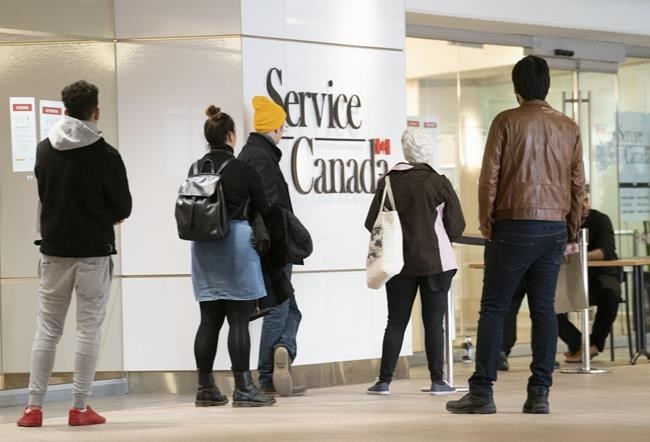
Statistics Canada said Friday that young women are down 181,000 jobs from February 2020, or off 14.1 per cent from pre-pandemic levels. For young men, the shortfall is 96,000, or 7.3 per cent.
The details add to the portrait of the pandemic’s disproportionate economic impact on women, dubbed the “shecession,” that the federal Liberals hope to address through a panel of experts that first met with Finance Minister Chrystia Freeland on Thursday.
“It reminds us that the shecession is not just mothers,” said Vass Bednar, executive director of McMaster University’s master of public policy program, and former chair of a federal expert panel on youth employment.
“There might be other reasons that women’s jobs are either being eliminated, or that they need more support coming back to the labour market.”
Ottawa has suggested it will use jobs as a gauge for planned stimulus measures to be unveiled in a spring budget.
While Prime Minister Justin Trudeau called the gains good news for workers and their families, Conservative critic Pierre Poilievre warned the government can’t yet pat itself on the back as he called for tax reform and other measures to get more people back to work.
The Bank of Canada is also monitoring employment data, noting the uneven impacts of job losses in its reasoning this week for holding its key interest rate target at 0.25 per cent.
Overall, the gain in February almost wiped out the 266,000 jobs lost over the previous two months, as lockdowns from December and January lifted in much of the country.
Almost all the job increases were among low-wage and part-time workers in areas like retail and accommodation.
The Conference Board of Canada noted the reopening of many retail outlets, mainly in Quebec and Ontario where lockdowns were particularly strict, brought back 122,300 jobs in February after losses of almost 168,000 jobs in January.
BMO chief economist Douglas Porter said similar gains could soon be seen in other hard-hit sectors like restaurants, hotels and entertainment if restrictions ease further.
“There is hope that as those sectors are eventually able to reopen, that we could recover quite quickly,” Porter said, adding he expects another gain in March.
The gains blew past expectations and were reminiscent of the first wave of the pandemic when employment rebounded far faster than expected as the economy began reopening, CIBC senior economist Royce Mendes wrote in a note.
The national unemployment rate fell to 8.2 per cent, the lowest level since March 2020 at the onset of the COVID-19 pandemic.
The rate would have been higher, 10.7 per cent, had Statistics Canada included in calculations Canadians who wanted to work but didn’t search for a job.
The youth unemployment rate fell to 17.1 per cent in February, compared with the 10.4 per cent in the same month last year.
Typically, the youth unemployment rate is higher for men than women, but that trend has flipped during the pandemic, Statistics Canada said.
The agency noted that half of young women are employed in three highly affected sectors: accommodation, food services and retail.
“The higher unemployment rate is actually because of the labour market turbulence. It’s not because of young women leaving the workforce by choice, for example, to go back to school,” said Leah Nord, senior director of workforce strategies at the Canadian Chamber of Commerce.
Nord said the figures speak to an urgent need for focused training programs so young workers can gain new skills, and improve what they already have.

Bryn de Chastelain, chair of the Canadian Alliance of Student Associations, said the federal government should expand a key summer jobs program to help students cover tuition and earn experience in troubled job market.
“Students are not feeling that they’re going to have an opportunity to get valuable work experience in their field of study and start to build the skills that they need in order to start a career,” said de Chastelain, a graduating student at Saint Mary’s University.
Employers may have to relax the premium they place on experience when hiring a young person, or shift their perspective to include things like volunteering, as many may now have experience gaps in formal employment, Bednar said.
“People might not be able to get that first job as easily as before and it’s really agitating for a generation of workers that is already set to fare worse than the generation before them,” she said.
This report by The Canadian Press was first published March 12, 2021.