‘The value of your elders’: First Nation using youth to spread COVID-19 message
Advertisement
Read this article for free:
or
Already have an account? Log in here »
To continue reading, please subscribe:

Digital Subscription
One year of digital access for only $205*
- Enjoy unlimited reading on winnipegfreepress.com
- Read the E-Edition, our digital replica newspaper
- Access News Break, our award-winning app
- Play interactive puzzles
*First annual payment billed as $205.00 + GST for one year. This annual subscription will automatically renew at $233.00 + GST every 52 weeks (10% off the regular annual price of $259.35). Offer available to new and qualified returning subscribers only. Cancel any time.
To continue reading, please subscribe:
Add Free Press access to your Brandon Sun subscription for only an additional
$1 for the first 4 weeks*
- Enjoy unlimited reading on winnipegfreepress.com
- Read the E-Edition, our digital replica newspaper
- Access News Break, our award-winning app
- Play interactive puzzles
*Your next Brandon Sun subscription payment will increase by $1.00 and you will be charged $17.95 plus GST for four weeks. After four weeks, your payment will increase to $24.95 plus GST every four weeks.
Read unlimited articles for free today:
or
Already have an account? Log in here »
Hey there, time traveller!
This article was published 28/12/2020 (2092 days ago), so information in it may no longer be current.
MORLEY, Alta. – A First Nation in Alberta is turning to its youth to help spread the message to older members about the dangers of COVID-19.
Three reserves in the shadow of the Rocky Mountains make up the Stoney Nakoda First Nation, where there have been only a couple of outbreaks of the novel coronavirus since the pandemic began.
CEO Ryan Robb said the First Nation, including Morley about 70 kilometres west of Calgary, has faced a difficult challenge. Stoney remains the first language for an overwhelming majority of members, regardless of their age.
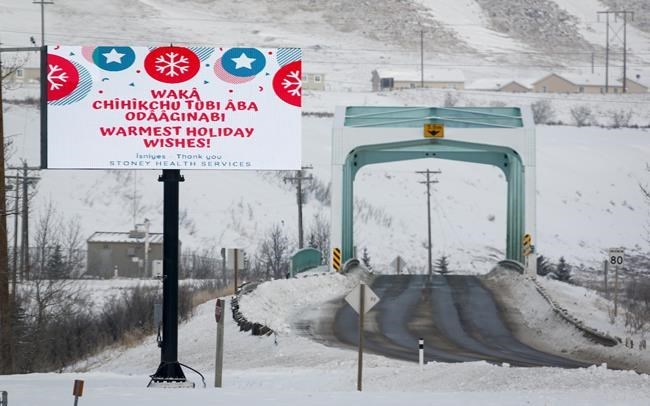
“They have an extremely high language retention, even though we’re very, very close to a major city,” said Robb in an interview. “Quite quickly we realized we needed to get our information out in Stoney as well as English.”
Robb said that included messages from chief and council played on the radio in both languages and a large digital billboard that flashes bilingual information along the road into the community
Audio files have also been created that can be downloaded onto phones.
“We made it in a very simple, small, downloadable file,” Robb said. “We translated it into Stoney and I can take my phone to go see my grandmother to play it in Stoney, so she may understand.”
Robb said a lot of messaging is being delivered in schools to get young people onside over fear of harming their grandparents.
“Make sure you’re protecting grandma and grandpa. The value of your elders is really important for First Nations,” he said.
“I may not be worried about it as a 20-year-old or a 30-year-old, but guess what? I don’t want to give it to my grandparents.”
Robb said as in many ethnic communities, multiple generations live together in small homes, so containing the spread of the virus is essential.
“We have 1,100 households on the three reserves. How are we managing to keep this into four or five houses rather than just running rampant through the entire reserve?”
The Alberta government has recognized that many COVID-19 hot spots in the province share similar circumstances with First Nations, so outreach teams are going into communities to get the message and resources out.
“These hardest-hit neighbourhoods tend to be lower income areas, where people naturally live in high density housing arrangements, sometimes with multi-generational families that can make it very difficult for family members to self-isolate effectively if needed,” Alberta Premier Jason Kenney said earlier this month.
“Many of these families also have English language barriers, which in some cases makes it more difficult for them to obtain current and accurate health information and to access the social supports that are available to them.”
Dr. John Conly, a professor at Calgary’s Cumming School of Medicine and an expert on infectious diseases, spent time working on the Stoney Nakoda Nation.
Conly, who has had more than 100 patients with COVID-19, said he’s not surprised at the measures being taken to get out vital information.
“We see that in many of our new immigrant settings as well. We’ve got Punjabi, Vietnamese, Mandarin, Cantonese and Spanish, even in Calgary,” he said.
“Some COVID materials they have to put in eight to 10 languages, because there are many people who may have some fluency in English, but when it gets to be more sophisticated, their first tongue is always their best delivery in terms of information.”
This report by The Canadian Press was first published December 28, 2020
— Follow @BillGraveland on Twitter