All travellers arriving by air, except from U.S., need COVID-19 test at airport
Advertisement
Read this article for free:
or
Already have an account? Log in here »
To continue reading, please subscribe:

Digital Subscription
One year of digital access for only $205*
- Enjoy unlimited reading on winnipegfreepress.com
- Read the E-Edition, our digital replica newspaper
- Access News Break, our award-winning app
- Play interactive puzzles
*First annual payment billed as $205.00 + GST for one year. This annual subscription will automatically renew at $233.00 + GST every 52 weeks (10% off the regular annual price of $259.35). Offer available to new and qualified returning subscribers only. Cancel any time.
To continue reading, please subscribe:
Add Free Press access to your Brandon Sun subscription for only an additional
$1 for the first 4 weeks*
- Enjoy unlimited reading on winnipegfreepress.com
- Read the E-Edition, our digital replica newspaper
- Access News Break, our award-winning app
- Play interactive puzzles
*Your next Brandon Sun subscription payment will increase by $1.00 and you will be charged $17.95 plus GST for four weeks. After four weeks, your payment will increase to $24.95 plus GST every four weeks.
Read unlimited articles for free today:
or
Already have an account? Log in here »
Hey there, time traveller!
This article was published 30/11/2021 (1764 days ago), so information in it may no longer be current.
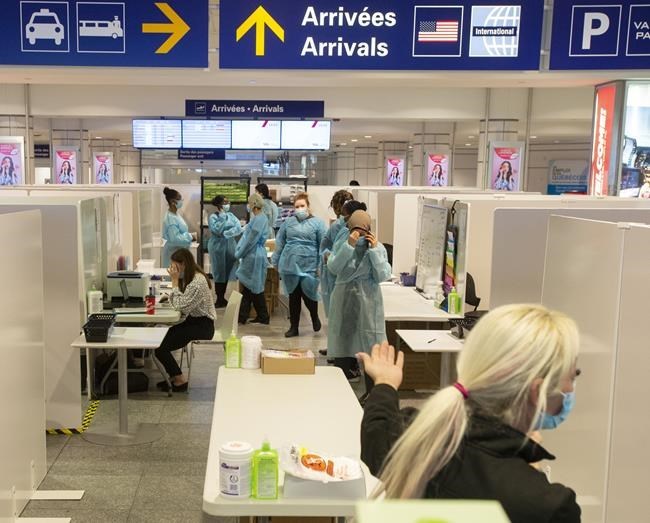
OTTAWA – All air travellers entering Canada, except for those coming from the United States, will now need to be tested for COVID-19 upon arrival at the airport and isolate until they get their results, even if they are fully vaccinated against the virus.
The stricter measures come as public health officials around the world warn of the potentially dangerous new Omicron variant of COVID-19. Canada has now confirmed cases in British Columbia, Ontario, Quebec and Alberta — all involving people who recently returned from Nigeria.
With that in mind, the federal government is also expanding its border closure to foreign nationals who have recently travelled through three more African countries — Nigeria, Egypt and Malawi — where officials first became aware of the new variant.
That is in addition to the seven southern African countries announced last week: South Africa, Mozambique, Botswana, Zimbabwe, Lesotho, Namibia and eSwatini.
The Associated Press reported Tuesday that new findings suggested the Omicron variant was already present in Europe nearly a week before authorities in South Africa reported its existence to the World Health Organization, which prompted questions about the choice to focus on Africa.
Dr. Theresa Tam, the chief public health officer, said one of the factors is the positivity rate among travellers arriving in Canada.
“We now have confirmed Omicron cases, all of our cases reported so far have been … from Nigeria,” Tam said at a news conference in Ottawa on Tuesday.
Federal Health Minister Jean-Yves Duclos said the government will consult with provinces and territories Tuesday evening, before bringing in similar testing and isolation measures for travellers coming from the U.S.
Most travellers will be allowed to isolate at home while they wait for their results. Canadians and permanent residents arriving from the 10 listed countries, or without a safe place to quarantine, will need to stay in a quarantine hotel until their airport COVID-19 test comes back negative.
There are still many questions about the new variant, including the severity of disease it causes and the transmissibility of the virus.
The World Health Organization has warned the impact could be very serious. On Tuesday, it advised that anyone who is unvaccinated against COVID-19 or at risk of developing severe COVID-19 disease and dying, including people 60 years of age or older, should put off travel.
The new measures at the airport may take time to implement, Duclos said, and they could also lead to delays at the border, according to Public Safety Minister Marco Mendicino.
“Our border service officers will never compromise the health and safety of Canadians for the sake of border wait times,” Mendicino said.
Transport Minister Omar Alghabra said travellers who choose to leave the country should be aware that COVID-19 protection measures could change at any moment.
A more stringent vaccine mandate for domestic travellers also came into effect Tuesday.
Unvaccinated travellers over the age of 12 can no longer board a plane or passenger train in Canada, and a negative COVID-19 test won’t serve as a substitute for most people.
The policy was rolled out Oct. 30, but the federal government allowed a short transition period for unvaccinated travellers who could board as long as they provided a negative molecular COVID-19 test taken within 72 hours of their trip. It does not apply to commuter trains.
The government has issued warnings on social media that even Canadians and permanent residents abroad will not be able to fly home beyond their point of entry without having received a full slate of approved vaccines.
There are some exceptions, including valid medical exemptions, travel to remote communities only accessible by plane, and those transiting through Canada en route to another destination.
Most people who qualify for an exemption will need a recent COVID-19 test.
Finally, the government has requested guidance from the National Advisory Committee on Immunization about whether it should bring in new standards on the use of COVID-19 vaccine booster doses in the face of the new variant.
“We are explicitly asking NACI to come up quickly with a revised view on where and how and to whom these boosters should be administered,” Duclos said.
The WHO has urged countries not to offer boosters to healthy adults until high-risk people in other countries around the world have been vaccinated.
Duclos said Canada is doing comparably well when it comes to supporting developing countries in their vaccination efforts.
“We know that this pandemic is going to end only when it ends globally and that’s why we must obviously look after the health and safety of Canadians, but we also must be supporting other countries,” he said.
New domestic health measures will likely also be discussed with the provinces, Duclos said.
This report by The Canadian Press was first published Nov. 30, 2021.
Related Articles
Omicron variant: What we know so far




Advertisement Advertise With Us
Advertisement Advertise With Us