Business idea began as a way to bring their young daughters together
It's called a lavvu
Advertisement
Read this article for free:
or
Already have an account? Log in here »
To continue reading, please subscribe:

Digital Subscription
One year of digital access for only $205*
- Enjoy unlimited reading on winnipegfreepress.com
- Read the E-Edition, our digital replica newspaper
- Access News Break, our award-winning app
- Play interactive puzzles
*First annual payment billed as $205.00 + GST for one year. This annual subscription will automatically renew at $233.00 + GST every 52 weeks (10% off the regular annual price of $259.35). Offer available to new and qualified returning subscribers only. Cancel any time.
To continue reading, please subscribe:
Add Free Press access to your Brandon Sun subscription for only an additional
$1 for the first 4 weeks*
- Enjoy unlimited reading on winnipegfreepress.com
- Read the E-Edition, our digital replica newspaper
- Access News Break, our award-winning app
- Play interactive puzzles
*Your next Brandon Sun subscription payment will increase by $1.00 and you will be charged $17.95 plus GST for four weeks. After four weeks, your payment will increase to $24.95 plus GST every four weeks.
Read unlimited articles for free today:
or
Already have an account? Log in here »
Hey there, time traveller!
This article was published 02/09/2017 (3241 days ago), so information in it may no longer be current.
Jennifer Robins chuckles when a reporter takes a stab at the word lavvu, which just so happens to be the signature item available through her online, environmentally friendly home decor store, Kate + Norah Co.
Robins, a substitute teacher and married mother of two, credits her daughters Emily, 5, and Isabelle, 2, as she offers a tip how to remember the correct pronunciation of lavvu, a kind of weather shelter most commonly associated with the Sami, the Indigenous people who inhabit Sápmi, the Arctic region that stretches across the northernmost sections of Norway, Sweden, Finland and Russia.
“The right way to say is it la-voo, which, over time, has become my girls’ way of saying ‘love you,’” Robins says, seated in the dining room of her neat-as-a-pin Westwood bungalow. “It’s actually become a bit of a joke between my husband Christian and me, where we’ll go to bed some nights and I’ll be like, ‘lavvu,’ and he’ll be all, ‘yeah, lavvu, too.’”
When Emily and Isabelle were 4 and 1, respectively, they didn’t exactly get along, their mother admits. More to the point, Emily had zero patience for her younger sibling.
“Maybe it was because she’s three years older or maybe it was because babies are loud and fussy… anyways, Emily didn’t really like Issy for that first year or so,” Robins goes on. “So when Issy was starting to get mobile, I decided to create a playspace downstairs where they could interact and hopefully form a sisterly bond, so to speak.”
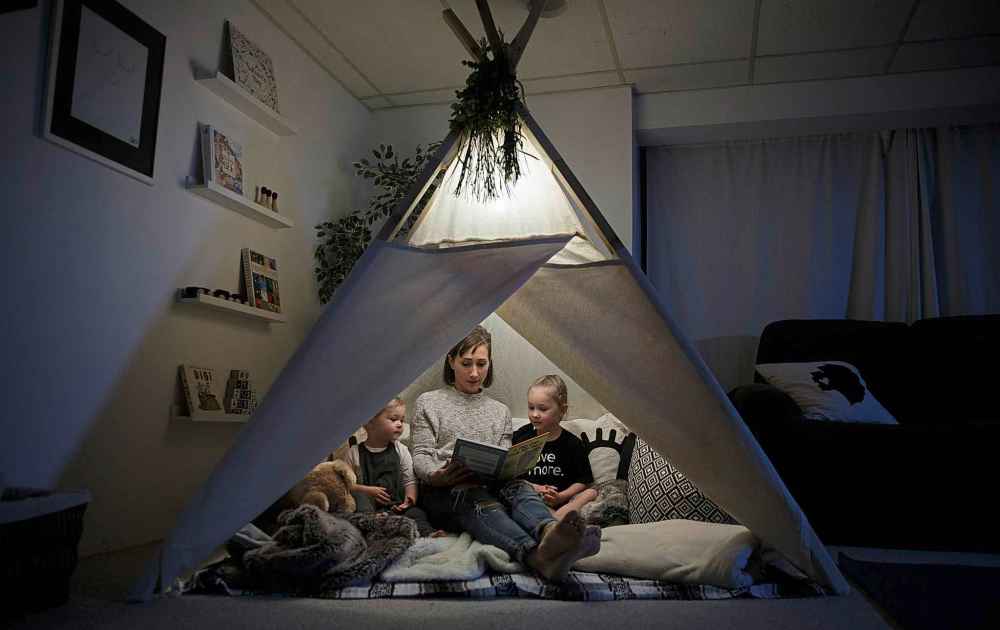
One of the key components Robins had in mind was a four-sided tent which, when she was growing up, her maternal grandparents, both of whom were born in Poland, often referred to as a lavvu. She spent a couple of weeks shopping for play tents on the internet but the ones she spotted were either too expensive, not the right size or, most importantly, not made out of suitable material. (Isabelle suffered from severe diaper rash when she was a baby, Robins says, a malady that wasn’t alleviated until she and her husband replaced every bar of soap, bottle of shampoo and box of laundry detergent in their household with organic, biodegradable options. Over time, Christian and Jennifer adopted the same, natural approach when it came to almost every other object their daughter came into contact with.)
“To make a long story short, I decided to make them a tent myself, using unbleached, undyed cotton, the same fabric I’d been using to sew things like bonnets and pacifier straps. But because the material was so expensive and was costing us so much money — I mean, it took me three tries to get their tent just right — one day Christian remarked, ‘I bet there are other parents in the same boat as us who’d like your stuff, too. Maybe you should try selling it.’”
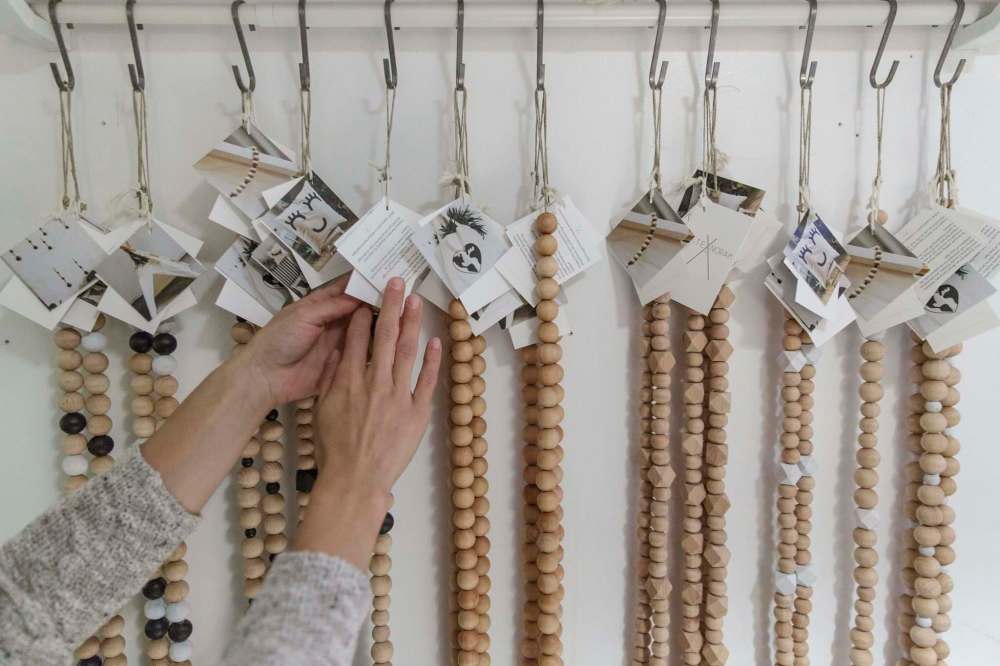
Robins, a self-taught seamstress, “opened” her first Etsy shop in May 2016, just before Mother’s Day. In addition to play tents, she also offered a “hodgepodge” of homemade baby paraphernalia under the banner Monkey Things. Buoyed by orders from as far away as Texas, she applied for Third + Bird’s 2016 Christmas market, a makers’ event she felt her products were perfectly suited to. Two weeks after submitting the necessary paperwork, she received an email stating her biz failed to make the final cut for the juried affair.
“I was really bummed out because I sincerely thought everything I made was really cool but I guess it wasn’t meant to be. But because I’m a teacher by schooling, I thought, OK, maybe this was an opportunity to learn and why don’t I ask them what I should do differently, the next time around?”
Chandra Kremski and Charla Smeall, the brains behind Third + Bird, responded almost immediately, telling Robins she should cut back on her peripheral items and make her tents the focal point of her business. Taking their advice, Robins made two other moves. First, she changed the name of her biz to catchier-sounding Kate + Norah Co. (www.kateandnorahco.com) — Katherine and Norah being her daughters’ middle names — and second, she promised herself that, going forward, she would only refer to her tents by their proper title.
“Because of my grandparents, I’d always been familiar with the term lavvu, but originally, I thought it was too risky to come right out and call them that, because I didn’t think anybody would know what I was talking about,” says Robins, who participated in Third + Bird’s most recent sale, which was held at the downtown Bay store in May. “But it didn’t feel right to me to call them teepees, which they aren’t. So finally I thought, you know, if I’m going to do this, I’m going to do this true and authentic, pay respect to my European roots and if it catches on, great. And if not, well, at least I was genuine.”
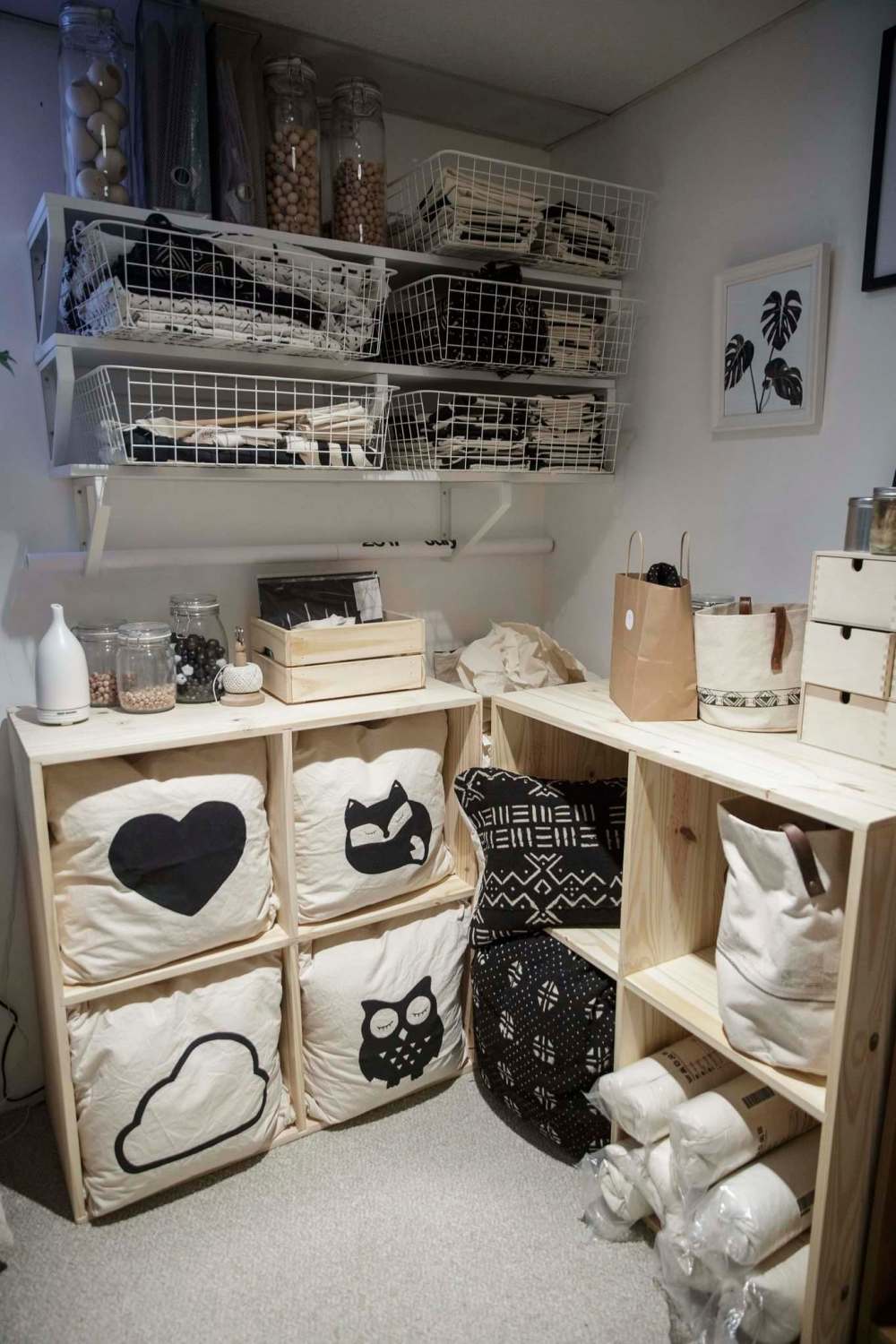
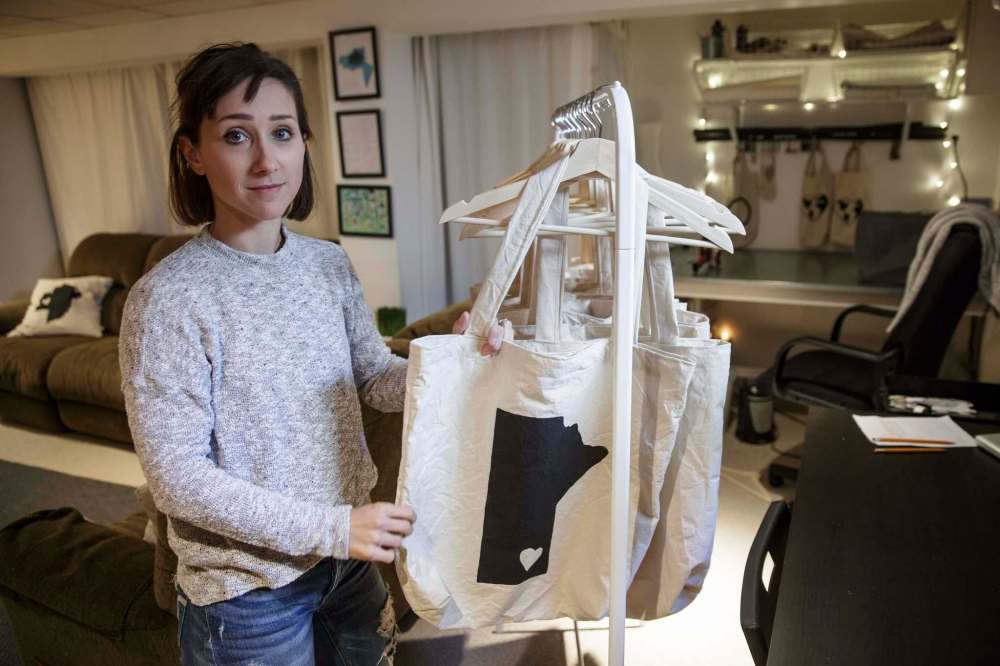
Robins sells three sizes of lavvus, which are supported by cedar poles that have been stained and sealed using Manitoba beeswax and virgin olive oil. She also has a line of throw pillows kids can fill their lavvu with, if they want to kick back, relax and read a book or two. The paint she uses on her provincially inspired pillows, which feature outlines of the individual provinces, is water-based and non-toxic, she points out.
“It sounds silly but it’s true all this started because of my daughter’s sensitive tush,” she says. “If that hadn’t been the case, maybe I would have just bought a tent from somebody else, and wouldn’t have cared whether it was environmentally friendly or sustainable. But because of what we went through, my husband and I have learned so much, No. 1 being we don’t inherit the Earth from our ancestors, we borrow it from our children. So for sure, I don’t want to make this world worse for my kids.”
In turn, Robins says, her eldest daughter has also learned about the environment, and will tell anybody willing to listen that “garbage is bad, recycling is better but composting is the best.”
Along the way, she’s also picked up a thing or two about economics.
“When I first started my business, I told Emily I was doing it to make a little extra money to help with groceries and bills and stuff but that maybe one day, I could save enough for all of us to go to Disneyworld. So now every time she finds out I’ve sold another lavvu, she asks, ‘Now is that enough to go to Disneyworld?’”
david.sanderson@freepress.mb.ca
Dave Sanderson was born in Regina but please, don’t hold that against him.
Our newsroom depends on a growing audience of readers to power our journalism. If you are not a paid reader, please consider becoming a subscriber.
Our newsroom depends on its audience of readers to power our journalism. Thank you for your support.