New sensors monitor sick babies without wires blocking hugs

Advertisement

Advertise with us

WASHINGTON - Peek into any U.S. hospital's baby ICU, and you'll see sick and premature newborns covered in wired monitors that tear at fragile skin and make it hard for parents to cuddle their kids.

Read this article for free:


or

Already have an account? Log in here »

To continue reading, please subscribe:

Subscribe and receive a limited-edition Free Press branded hat or tote.

Digital Subscription

One year of digital access for only $205*

  • Enjoy unlimited reading on winnipegfreepress.com
  • Read the E-Edition, our digital replica newspaper
  • Access News Break, our award-winning app
  • Play interactive puzzles

*First annual payment billed as $205.00 + GST for one year. This annual subscription will automatically renew at $233.00 + GST every 52 weeks (10% off the regular annual price of $259.35). Offer available to new and qualified returning subscribers only. Cancel any time.

To continue reading, please subscribe:

Add Free Press access to your Brandon Sun subscription for only an additional

$1 for the first 4 weeks*

  • Enjoy unlimited reading on winnipegfreepress.com
  • Read the E-Edition, our digital replica newspaper
  • Access News Break, our award-winning app
  • Play interactive puzzles
Start now

*Your next Brandon Sun subscription payment will increase by $1.00 and you will be charged $17.95 plus GST for four weeks. After four weeks, your payment will increase to $24.95 plus GST every four weeks.

Hey there, time traveller!
This article was published 28/02/2019 (2726 days ago), so information in it may no longer be current.

WASHINGTON – Peek into any U.S. hospital’s baby ICU, and you’ll see sick and premature newborns covered in wired monitors that tear at fragile skin and make it hard for parents to cuddle their kids.

Now researchers have created tiny skin-like wireless sensors that may finally cut those cords.

“This need was so compelling,” said John Rogers, a Northwestern University bioengineer who led the sensors’ development. “Without the wires, it’s much easier for the parents, mothers in particular, to interact and hold their babies.”
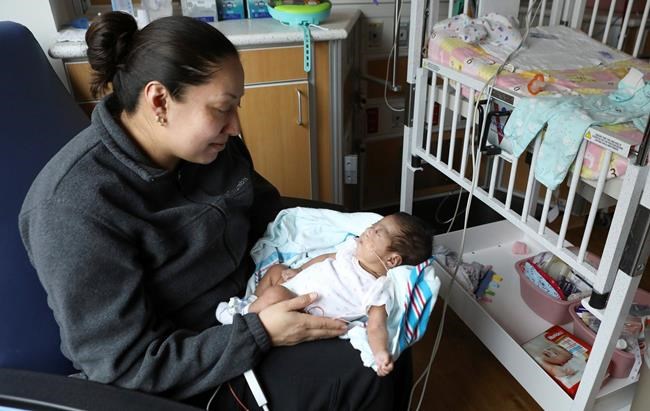
Theodora Flores holds one of her twin daughters, Genesis, in a patient room at the Ann & Robert H. Lurie Children’s Hospital of Chicago on Wednesday, Feb. 27, 2019. Genesis is wearing wireless sensors developed by researchers at Northwestern University to monitor newborns without hurting their skin or blocking parents' cuddles. (AP Photo/Teresa Crawford)

Nearly 300,000 U.S. newborns wind up in neonatal intensive care units each year, because they were born prematurely or with serious health problems. It’s critical to track their heartbeat and other vital signs so doctors and nurses can rapidly spot if their youngest patients are in trouble.

But today, that means sticky electrodes tethered by wires to a variety of beeping monitors that surround the incubator. The nest of wires impedes skin-to-skin contact with a parent that’s known to help preemies thrive, much less rock a baby or breast feed, said Dr. Amy Paller, a Northwestern pediatric dermatologist.

And no matter how carefully doctors and nurses remove the electrodes, preemies whose skin isn’t fully developed are prone to injuries and scarring.

Going wireless in the NICU is a lot harder than, say, measuring a jogger’s heart rate with a FitBit.

First, Rogers’ team developed ultrathin sensors made of a flexible silicone that moves like skin and clings without any strong adhesive.

Then the researchers embedded the sensors with spring-like electronics that flex as the body moves, and are waterproof and made with materials that — unlike today’s NICU monitors — don’t interfere with X-rays or MRI scans.

And key to being lightweight, they don’t need batteries. Under the crib mattress sits a transmitter that wirelessly charges the sensors much like some smartphone chargers — while simultaneously relaying all the sensors’ measurements to hospital computers.

Replacing today’s multiple monitors takes just two wireless sensors — one made for the chest or back, and one to wrap around a foot — that work together. For example, the upper sensor measures heart activity, while the foot sensor uses light to measure blood oxygen levels. How long it takes a heartbeat’s pulse to reach the foot corresponds to blood pressure, Rogers explained — no bruising blood pressure cuff required.

How reliable are they? Researchers put the wireless sensors on the bodies of 20 babies in Northwestern-affiliated NICUs who also had the normal wired monitoring. The wireless sensors worked just as well, Rogers and Paller reported Thursday in the journal Science.

“This is a promising technology and may eliminate stick-on sensors,” said Dr. Rosemary Higgins, a neonatologist at the National Institute of Child Health and Human Development, who wasn’t involved with the research.

The studies are continuing and Rogers said the sensors now have been used on about 80 babies with similar results and no sign of skin trouble.
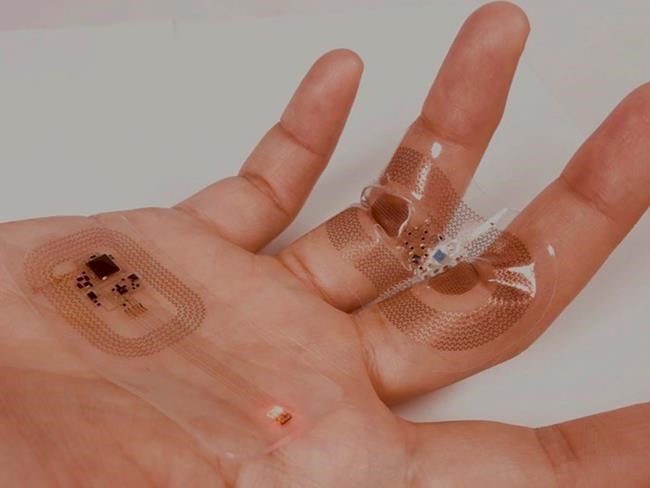
This 2019 photo provided by Northwestern University shows a pair of soft, flexible wireless sensors at John Rogers' laboratory, located in the Technological Institute at the university in Evanston, Ill. They could replace the tangle of wire-based sensors that currently monitor babies in hospitals' neonatal intensive care units. (Northwestern University via AP)

“It’s really amazing,” said Theodora Flores, as she held one of her twin daughters, Genesis, in the Ann & Robert H. Lurie Children’s Hospital of Chicago this week. Genesis is part of the wireless testing and the new mom said fewer wires would mean, “I can move freely with her a little bit more.”

It would take far more testing for Food and Drug Administration approval of wireless sensors.

But Rogers said the bigger need is in developing countries that can’t afford today’s wired monitoring even for preemies. He estimates the new sensors could be made for about $10 to $15. With funding from the Bill and Melinda Gates Foundation and Save the Children, Rogers is preparing for a pilot trial of the wireless sensors in Zambia in April, with the goal of testing up to 20,000 sensors in India, Pakistan and Zambia by year’s end.

The technology “has great potential impact on monitoring practices all over the world and may give many neonates a more equitable opportunity to survive,” Dr. Ruth Guinsburg of the Federal University of Sao Paulo, Brazil, wrote in a commentary in Science.

___

AP video journalist Teresa Crawford contributed to this report from Chicago.

The Associated Press Health & Science Department receives support from the Howard Hughes Medical Institute’s Department of Science Education. The AP is solely responsible for all content.

Report Error Submit a Tip

More Stories

Impaired driving victim honoured

Morgan Modjeski 5 minute read Preview

Impaired driving victim honoured

Morgan Modjeski 5 minute read 6:16 PM CDT

Ten years after he was killed in a collision involving an impaired driver in 2016, Robbie Anderson’s name has been added to MADD Canada’s Manitoba Memorial honouring those killed in drunk and drug-impaired-related crashes.

His older brother Chris Anderson, was one of two dozen people who gathered at the Glen Eden Funeral Home and Cemetery in West St. Paul Saturday to remember their loved ones, 86 victims whose names are etched into the granite monument near the heart of the graveyard.

“It’s heavy,” said Anderson when asked what it was like to be part of the ceremony and see his brother’s name added. “It’s been something I’ve been thinking about for a while.”

Grateful for MADD’s work and its efforts to honour Robbie, who was 27 when he died, Anderson said his brother, represented the “absolute best of us.”

Read
6:16 PM CDT

Big Loser’s latest a winning mix of country, folk

Ben Waldman 5 minute read Preview

Big Loser’s latest a winning mix of country, folk

Ben Waldman 5 minute read 6:00 AM CDT

The yellow trucker hat for sale on Facebook Marketplace said “Selkirk Lumber,” so Adam Wayne Brown knew he had to hammer home a deal.

Like the other millennial members of Winnipeg folk-country band Big Loser, the bassist has an affinity for the nostalgic, taking every opportunity — through music, through lyrics and through wardrobe — to recall the unique circumstances of growing up in a changing Interlake.

“I remember the matte yellow trucks driving around — the lumber trucks — and so I’ve had this strange memory of something disappearing from my youth and then persisting,” says Brown, who, like the band’s frontman Alex Paradoski, moved to Winnipeg more than a decade ago.

“I have a photo of the Lockport Bridge in my dining room,” chimes in Paradoski, whose first job as a teenager was bunning wieners and chopping fries at Skinner’s, a drive-in mainstay since 1929 along Highway 44.

Read
6:00 AM CDT

PCs say Hutterite colonies singled out by Bill 21

Alex Lambert 4 minute read Preview

PCs say Hutterite colonies singled out by Bill 21

Alex Lambert 4 minute read Yesterday at 2:01 AM CDT

SOURIS — Members of Hutterite colonies in the province took aim at the NDP government’s proposed changes to drinking water legislation during a public meeting Thursday in Souris.

The meeting was hosted by Progressive Conservative MLA Colleen Robbins (Spruce Woods) to hear from rural residents about their concerns over Bill 21, which the government says will improve oversight on wells and other water systems in the province.

“There’s not enough clarity, but I feel that the overreach that this bill will bring is not clearly defined, and it could have a lot of negative consequences,” attendee Gilbert Hofer, a member of Green Acres colony near Wawanesa, said after the meeting, which drew about 20 people.

The legislation would allow public health officers to designate the type of water source based on its intended use, water quality and use duration rather than solely the number of connections it has.

Read
Yesterday at 2:01 AM CDT

Manitoba family finalist for cattle producers environmental award

Aaron Epp 4 minute read Preview

Manitoba family finalist for cattle producers environmental award

Aaron Epp 4 minute read 2:00 AM CDT

A family in western Manitoba is one of seven finalists for a national environmental award honouring beef cattle producers.

Connor and Kyla English, alongside Connor’s parents, Brian and Leanne English, are nominated for the Canadian Cattle Association’s Environmental Stewardship Award. The 30-year-old award is presented to beef farmers and ranchers who explore innovative ways to protect, preserve and enhance their operations and the environment simultaneously.

This year’s recipient will be announced on Wednesday during a banquet at the Canadian Beef Industry Conference in Winnipeg.

The English family’s roots near Bradwardine — about 265 kilometres west of Winnipeg — date back to 1898. Today, Connor, Kyla, Brian and Leanne manage a herd of about 320 breeding cows on nearly 445 hectares (1,100 acres) of owned and rented pasture and forage land.

Read
2:00 AM CDT

Trailblazing Western Scrap Metals heavy-equipment operator relishes role at massive crane’s control

David Sanderson 7 minute read Preview

Trailblazing Western Scrap Metals heavy-equipment operator relishes role at massive crane’s control

David Sanderson 7 minute read Yesterday at 10:15 AM CDT

Less than five per cent of heavy-equipment operators in the country are women but that number is trending upward, according to a study conducted by trade magazine Crane & Hoist Canada.

It was reported that in Ontario roughly eight per cent of jobs in the transport and heavy-equipment field are currently held by women. Furthermore, in 2024 almost 20 per cent of graduates at an Edmonton-based heavy-equipment operator training school were female, the article stated.

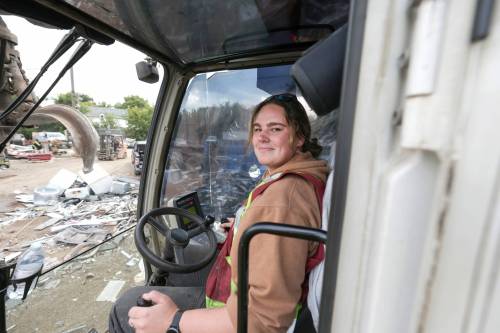
That brings us to Harmony Guspodarchuk, the first female crane operator in the 70-year history of Western Scrap Metals, a family-owned business at 18 Sutherland Ave.

Three years ago, Guspodarchuk literally stepped into the driver’s seat of a 27,500-kilogram, Liebherr C 924 Heavy Lift Litronic crane. The 29-year-old hasn’t looked back much since.

Read
Yesterday at 10:15 AM CDT

Could renewed interest in strategically critical rare earth elements finally make sub-sector profitable?

Joel Schlesinger 6 minute read Preview

Could renewed interest in strategically critical rare earth elements finally make sub-sector profitable?

Joel Schlesinger 6 minute read 3:00 AM CDT

Rare earth elements are among the most critical of mined resources for modern economies.

They’re essential in manufacturing specialized magnets used in a host of technologies from wind turbines and electric vehicles to hard drives, smartphones, television screens, and fibre optics. Most notably, however, rare earth minerals are increasingly vital to the defence industry.

These 17 elements — closely related chemically and usually found all together in mineral deposits — have indeed been growing in geopolitical importance as the United States, Canada and other Western nations recognize their dependence on production from China.

It is the world’s largest producer and processor of rare earths, including the most in-demand elements neodymium and praseodymium used to manufacture very light and powerful magnets for an array of technologies, including the most advanced weapons of modern warfare.

Read
3:00 AM CDT