No-cost birth control, now the norm, faces court challenges
Advertisement
Read this article for free:
or
Already have an account? Log in here »
To continue reading, please subscribe:

Digital Subscription
One year of digital access for only $205*
- Enjoy unlimited reading on winnipegfreepress.com
- Read the E-Edition, our digital replica newspaper
- Access News Break, our award-winning app
- Play interactive puzzles
*First annual payment billed as $205.00 + GST for one year. This annual subscription will automatically renew at $233.00 + GST every 52 weeks (10% off the regular annual price of $259.35). Offer available to new and qualified returning subscribers only. Cancel any time.
To continue reading, please subscribe:
Add Free Press access to your Brandon Sun subscription for only an additional
$1 for the first 4 weeks*
- Enjoy unlimited reading on winnipegfreepress.com
- Read the E-Edition, our digital replica newspaper
- Access News Break, our award-winning app
- Play interactive puzzles
*Your next Brandon Sun subscription payment will increase by $1.00 and you will be charged $17.95 plus GST for four weeks. After four weeks, your payment will increase to $24.95 plus GST every four weeks.
Read unlimited articles for free today:
or
Already have an account? Log in here »
Hey there, time traveller!
This article was published 15/01/2019 (2748 days ago), so information in it may no longer be current.
WASHINGTON – Millions of American women are receiving birth control at no cost to them through workplace health plans, the result of the Obama-era Affordable Care Act, which expanded access to contraception.
The Trump administration sought to allow more employers to opt out because of religious or moral objections. But its plans were put on hold by two federal judges, one in Pennsylvania and the other in California, in cases that could eventually reach the Supreme Court.
The judges blocked the Trump policy from going into effect while legal challenges from state attorneys general continue.
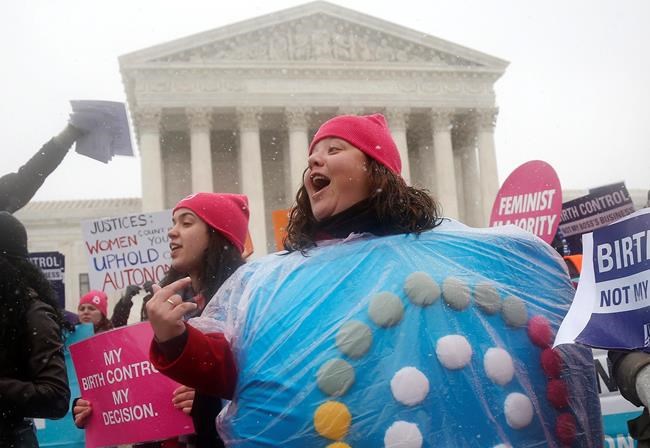
Here’s a look at some of the issues behind the confrontation over birth control, politics and religious beliefs:
A TURNING POINT-THE AFFORDABLE CARE ACT
Well into the 1990s many states did not require health insurance plans to cover birth control for women.
“Plans were covering Viagra, and they weren’t covering birth control,” said Alina Salganicoff, director of women’s health policy with the nonpartisan Kaiser Family Foundation.
By the time President Barack Obama’s health law passed in 2010, employers and insurers largely began covering birth control as an important part of health care for women.
The ACA took that a couple of steps further. It required most insurance plans to cover a broad range of preventive services, including vaccinations and cancer screenings, but also women’s health services. And it also required such preventive services to be offered at no charge.
Employers and insurers were required to cover at least one of each class of birth control approved by the Food and Drug Administration. That included costly long-acting contraceptives, generally more effective than birth control pills.
It’s estimated that 55 million to more than 62 million women now receive birth control at no cost, with only a small share paying for contraception.
“The irony I find about this battle is that in the period of time this policy has been in effect, teen pregnancies have gone way down and the number of abortions has gone way down,” said Kathleen Sebelius, Health and Human Services secretary under Obama.
While those rates were already going down before the health law, the trend does continue.
TRUMP ADMINISTRATION’S RELIGIOUS AND MORAL EXEMPTIONS
The Obama administration originally exempted a narrow group of employers — houses of worship— from the birth control coverage requirement.
Following pushback from religious institutions and social conservatives, the Obama administration created an “accommodation.” Women employees of religious-affiliated social service organizations, universities and hospitals could continue to get birth control as part of their health care coverage but their employer would not have to pay.
The Supreme Court broadened that work-around to include smaller private companies with a religious objection.
That didn’t go far enough for social and religious conservatives, a core component of President Donald Trump’s political base. Some religious organizations see Obama’s “accommodation” as morally objectionable because it facilitates contraception.
“It still forces religious people to provide a health plan that includes things that violate their religion,” said Mark Rienzi, senior lawyer for the Becket Fund for Religious Liberty, which led opposition to the Obama policies.
The Trump administration’s regulations broadened the religious exemption to any employer with an objection based on religious beliefs and created a new exemption for certain employers with moral objections. The administration made Obama’s workaround optional for employers and instituted other changes.
“It’s definitely not a tweak,” Sebelius said. An employer can say “I don’t believe in birth control, and I’m not going to provide it,” she added.
Sebelius explained that Congress through the ACA clearly intended health plans to cover women’s health services. All HHS did was spell out how that would be done. If the Trump administration wants to change that, it would have to repeal the law, she added, not just change a regulation.
Rienzi said the Trump administration hasn’t pulled its policy “out of nowhere.” U.S. laws traditionally have protected people with religious and moral objections to government policies.
WHAT’S NEXT?
The Obama-era policy remains in place for now, with U.S. District Judge Wendy Beetlestone in Philadelphia placing a national hold on the Trump administration rules.
More than a dozen states are trying to reverse Trump’s policy, including California, New York, Pennsylvania and New Jersey.
The Justice Department hasn’t revealed its next move. It could ask federal appeals courts or the Supreme Court to lift the injunctions from lower-court judges and allow the Trump rules to go into effect while the cases continue.
The issue could eventually end up before the Supreme Court, which has become more conservative since the last time it considered the ACA’s birth control coverage requirement.
The Trump administration estimates that up to 126,400 women could be affected, having to find other ways to cover birth control if the rule is put into place.
But women’s rights groups say there’s no real way to know.
“The majority of employers want to cover birth control,” said Mara Gandal-Powers, a senior lawyer with the National Women’s Law Center. “We know that there are dozens of employers and entities that sued the Obama administration. But one of the problems with the (Trump administration) rule is that there is no master list of employers who object to birth control.”