5,800 years of droppings: Unique approach yields first long-term seabird trend data

Advertisement

Advertise with us

Scientists have sifted through nearly 6,000 years of seabird droppings to get what they say could be the first long-term reading on how their numbers are affected by humans.

Read this article for free:


or

Already have an account? Log in here »

To continue reading, please subscribe:

Subscribe and receive a limited-edition Free Press branded hat or tote.

Digital Subscription

One year of digital access for only $205*

  • Enjoy unlimited reading on winnipegfreepress.com
  • Read the E-Edition, our digital replica newspaper
  • Access News Break, our award-winning app
  • Play interactive puzzles

*First annual payment billed as $205.00 + GST for one year. This annual subscription will automatically renew at $233.00 + GST every 52 weeks (10% off the regular annual price of $259.35). Offer available to new and qualified returning subscribers only. Cancel any time.

To continue reading, please subscribe:

Add Free Press access to your Brandon Sun subscription for only an additional

$1 for the first 4 weeks*

  • Enjoy unlimited reading on winnipegfreepress.com
  • Read the E-Edition, our digital replica newspaper
  • Access News Break, our award-winning app
  • Play interactive puzzles
Start now

*Your next Brandon Sun subscription payment will increase by $1.00 and you will be charged $17.95 plus GST for four weeks. After four weeks, your payment will increase to $24.95 plus GST every four weeks.

Hey there, time traveller!
This article was published 07/12/2020 (2079 days ago), so information in it may no longer be current.

Scientists have sifted through nearly 6,000 years of seabird droppings to get what they say could be the first long-term reading on how their numbers are affected by humans.

“It’s a stinky job, but someone has to do it,” said John Smol of Queen’s University, co-author of a paper published Monday in the journal Proceedings of the National Academy of Sciences.

Smol said the work sheds light on one of the biggest problems in environmental and conservation science: What happened in any particular region before humans showed up?
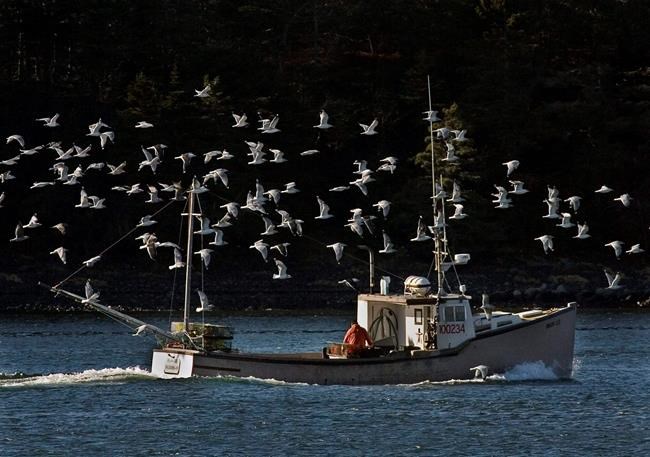
A lobster boat is escorted by a flock of sea gulls as it heads to port in Eastern Passage, N.S., on Monday, Dec. 29, 2008. A paper published today describes how scientists drilled down through 5,800 years of lake sediments — mostly the droppings of thousands of seabirds that have nested there for millennia — on an island off Canada's East Coast to estimate bird populations over the centuries. THE CANADIAN PRESS/Andrew Vaughan

“We call it shifting baselines,” he said. “What is natural? What is a healthy population?”

He and his colleagues decided to see what lake sediments on an uninhabited island near Newfoundland could reveal about its large colony of Leach’s storm petrel, the most common seabird in the northwest Atlantic.

“Lake sediments are like a history book” said Smol. “We’re retrieving these notebooks written in the mud.”

Extensive research on petrel guano revealed five different markers that could be used to estimate bird numbers. They included chemicals in the guano or evidence of algae blooms the droppings nourished. More of each marker meant more birds.

Meanwhile, the scientists used radioactive dating — the same kind used by archeologists — to establish a time sequence for the guano.

It turned out that a gucky, guano-rich, five-metre-long sediment core from the lake reached back 5,800 years into storm petrel history. Previous data only went as far back as the 1980s.

The sediment sequence showed petrelnumbers went up and down over the centuries, sometimes dramatically.

But a big drop occurred in the early 19th century — almost exactly coinciding with the recolonization and permanent establishment of the French colony in the nearby islands of St. Pierre and Miquelon.

The link between the two events isn’t clear. The birds — so oily that they were used occasionally as candles — were not commonly eaten.

“We can’t say it was completely human-induced, but the timing is very, very coincidental,” said Smol.

The end result is that the abundance of Leach’s storm petrel today is only about 16 per cent of what it was before European settlement.

“Here is a way to reconstruct populations on time frames that are ecologically and environmentally relevant,” Smol said. “It also shows that before humans were a significant factor, there were changes.”

The study shows that the human footprint goes backfurther than most people think.It also shows that the definition of “healthy populations” can depend on the time scale used to measure them.

The study raises questions about what conservation targets should be, especially as habitats around the world shrink for thousands of different species.

Even at 16 per cent of the historical average, there are still about 200,000 breeding pairs of Leach’s storm petrel on the island under study.

“It depends what you mean by healthy and stable,” said Smol. “What is ‘healthy’? What is ‘natural’?

“It depends on the moving baselines.”

This report by The Canadian Press was first published Dec. 7, 2020.

— Follow @row1960 on Twitter

Report Error Submit a Tip

More Stories

A better approach, but not yet enough

Editorial 4 minute read Preview

A better approach, but not yet enough

Editorial 4 minute read 2:00 AM CDT

In late June, when the Winnipeg Police Service launched a 10-day ‘crackdown’ on open drug use and illegal drug sales in areas in and around downtown, it did so without consulting or informing community outreach and social services agencies working in the targeted areas.

Inevitably, the WPS action drew criticism from several front-line agencies, which issued a collective statement just two days after the police operation began, pointing out that heavy-handed policing would drive vulnerable people away from the help they desperately need.

“Every day we work to build trust with people who have experienced trauma, discrimination, and barriers to care,” Kate Sjoberg, executive director of Resource Assistance for Youth, said at the time. “Actions that create fear around accessing services can undo months or years of relationship-building and place people at greater risk of preventable harm.”

At the time, WPS Chief Gene Bowers held up his hand and said, “That’s on me.”

Read
2:00 AM CDT

Lasting legacy or pining for a pipe dream?

Laura Cameron 5 minute read 2:00 AM CDT

The federal government is investing in major infrastructure, promising to expedite “projects of national interest” and pitching them to private investors at a summit in September.

The Manitoba government has its sights set on a pipeline and LNG export terminal at Churchill. Instead, Manitoba should be putting forward feasible, future-facing infrastructure proposals that would leave a positive lasting legacy of energy affordability, independence and security for Manitobans.

A pipeline and LNG terminal at Churchill are not viable for several reasons — the technical challenges of building a pipeline over thawing permafrost; the prohibitive cost of ice-breaking tankers to move LNG through the Arctic; and a forecasted global oversupply of LNG and uncertain long-term export markets.

Given these challenges, a private company coming out of the woodwork to invest seems exceptionally unlikely. Private proponents are also not interested in building oil pipelines to the west, and Prime Minister Mark Carney has now made clear his priority to work with Premier Danielle Smith on a West Coast pipeline, which would cost upwards of $35 billion (on top of the over $34 billion in public funds already spent on the Trans Mountain pipeline). It would seem this pours more cold water on the idea of a third publicly funded pipeline to Hudson Bay.

RCMP searching for missing 34-year-old woman

1 minute read Saturday, Aug. 15, 2026

Police are asking for the public’s help locating a 34-year-old woman last heard from almost a week ago.

Tamara Stevens, who also goes by Tammy, was last heard from on Sunday last weekend and was reported missing Tuesday morning, said a Thompson RCMP news release Saturday.

RCMP and family are worried for her well-being.

Stevens is believed to be in Thompson and is described as 5'7, with a slender build and long red hair, said RCMP. She also has a piercing on her lip and was last seen wearing black T-Shirt featuring the Twilight character Jacob, pants and work boots.

Puzzles Palace

1 minute read Monday, Jul. 27, 2026

To solve our puzzles, please subscribe with this special offer: |

Today’s horoscope

Georgia Nicols 4 minute read Preview

Today’s horoscope

Georgia Nicols 4 minute read Yesterday at 2:00 AM CDT

MOON ALERT: There are no restrictions to shopping or important decisions today. The moon is in Libra.

ARIES (March 21-April 19)

The day is a mixed bag. For the most part, it’s romantic, friendly, congenial and a great time to socialize with others and enjoy playful activities with kids. Nevertheless, you might meet a real sourpuss or someone who is a wet blanket. Keep things light!

TAURUS (April 20-May 20)

Read
Yesterday at 2:00 AM CDT

Letters, Aug. 17

7 minute read 2:00 AM CDT

Be statesmanlike, Pierre

Re: Canadians have moved on, Poilievre hasn’t (Aug. 7); Poilievre’s trade bluster a desperate bid for attention (Aug. 12)

If I were Pierre Poilievre, I wouldn’t be just thinking about becoming the next prime minister. I’d be thinking about legacy in larger terms — meaning how would I ultimately want to be remembered.

And I would want to be remembered as the politician who, even if not having achieved the ultimate goal of becoming prime minister, left the political world as a respected statesman. As such, with respect to trade and the relationship with the United States, I would be guided by the following maxim found in Tom Brodbeck’s Aug. 12 column: The goal should be to maximize Canada’s leverage while reducing its vulnerability.