Forest Service maxed out as wildfires break across US West

Advertisement

Advertise with us

WESTWOOD, Calif. (AP) — The U.S. Forest Service said Friday it's operating in crisis mode, fully deploying firefighters and maxing out its support system as wildfires continue to break out across the U.S. West, threatening thousands of homes and entire towns.

Read this article for free:


or

Already have an account? Log in here »

To continue reading, please subscribe:

Subscribe and receive a limited-edition Free Press branded hat or tote.

Digital Subscription

One year of digital access for only $205*

  • Enjoy unlimited reading on winnipegfreepress.com
  • Read the E-Edition, our digital replica newspaper
  • Access News Break, our award-winning app
  • Play interactive puzzles

*First annual payment billed as $205.00 + GST for one year. This annual subscription will automatically renew at $233.00 + GST every 52 weeks (10% off the regular annual price of $259.35). Offer available to new and qualified returning subscribers only. Cancel any time.

To continue reading, please subscribe:

Add Free Press access to your Brandon Sun subscription for only an additional

$1 for the first 4 weeks*

  • Enjoy unlimited reading on winnipegfreepress.com
  • Read the E-Edition, our digital replica newspaper
  • Access News Break, our award-winning app
  • Play interactive puzzles
Start now

*Your next Brandon Sun subscription payment will increase by $1.00 and you will be charged $17.95 plus GST for four weeks. After four weeks, your payment will increase to $24.95 plus GST every four weeks.

Hey there, time traveller!
This article was published 12/08/2021 (1844 days ago), so information in it may no longer be current.

WESTWOOD, Calif. (AP) — The U.S. Forest Service said Friday it’s operating in crisis mode, fully deploying firefighters and maxing out its support system as wildfires continue to break out across the U.S. West, threatening thousands of homes and entire towns.

The roughly 21,000 federal firefighters working on the ground is more than double the number of firefighters sent to contain forest fires at this time a year ago, and the agency is facing “critical resources limitations,” said Anthony Scardina, a deputy forester for the agency’s Pacific Southwest region.

An estimated 6,170 firefighters alone are battling the Dixie Fire in Northern California, the largest of 100 large fires burning in 14 states, with dozens more burning in western Canada.
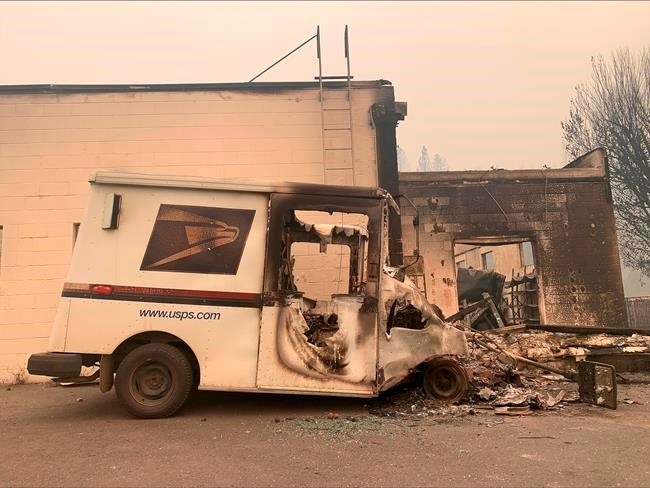
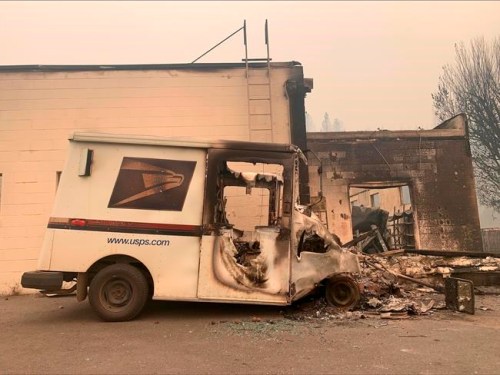
The remains of a burned U.S Postal truck is seen in Greenville, Calif., after the Dixie Wildfires Thursday, Aug. 12, 2021. California's largest single wildfire in recorded history is running through forestlands as fire crews try to protect rural communities from flames that have destroyed hundreds of homes. The Dixie Fire is the largest single fire in California history and the largest currently burning in the U.S. It is about half the size of the August Complex, a series of lightning-caused 2020 fires across seven counties that were fought together and that state officials consider California's largest wildfire overall. (AP Photo/Eugene Garcia)

The fire began a month ago and has destroyed more than 1,000 homes, businesses and other structures, much of it in the small town of Greenville in the northern Sierra Nevada.

The fire had ravaged more than 800 square miles (well over 2,000 square kilometers) — an area larger than the city of London — and continued to threaten more than a dozen rural and forest communities.

Containment lines for the fire held overnight, but it was just 31% surrounded. Gusty and erratic winds were threatening to spread the fire to Westwood, a lumber town of 1,700. Lightning could spark new blazes even as crews try to surround a number of other forest fires ignited by lightning last month.

“Mother nature just kind of keeps throwing us obstacles our way,” said Edwin Zuniga, a spokesman with the California Department of Forestry and Fire Protection, working together with the Forest Service to tamp out the blaze.

Meanwhile, firefighters and residents were scrambling to save hundreds of homes as flames advance across the Northern Cheyenne Indian Reservation in southeastern Montana.
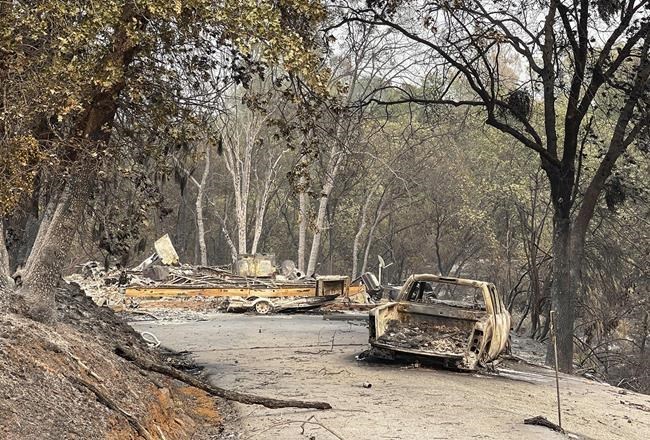
Charred metal and ash are all that remain of
Charred metal and ash are all that remain of "Pete" Reyna's Chicago Park home which burned Wednesday night due to the River Fire, Aug. 7, 2021. (Elias Funez/The Union via AP)

The blaze was still burning near the tribal headquarters town of Lame Deer, where a mandatory evacuation remained in place and a second fire was threatening from the opposite direction.

Smoke from the blazes grew so thick Friday morning that the health clinic in Lame Deer was shut down after its air filters could not keep up with the pollution, Northern Cheyenne Tribe spokesperson Angel Becker said.

Smoke drove air pollution levels to unhealthy or very unhealthy levels in portions of Montana, Idaho, Oregon Washington and Northern California, according to Environmental Protection Agency air quality monitoring.

An air quality alert covering seven Montana counties warned of extremely high levels of small pollution particles found in smoke, which can cause lung issues and other health problems if inhaled.

The fires near Lame Deer combined have burned 275 square miles (710 square kilometers) this week, so far sparing homes but causing extensive damage to pasture lands that ranchers depend on to feed their cows and horses.
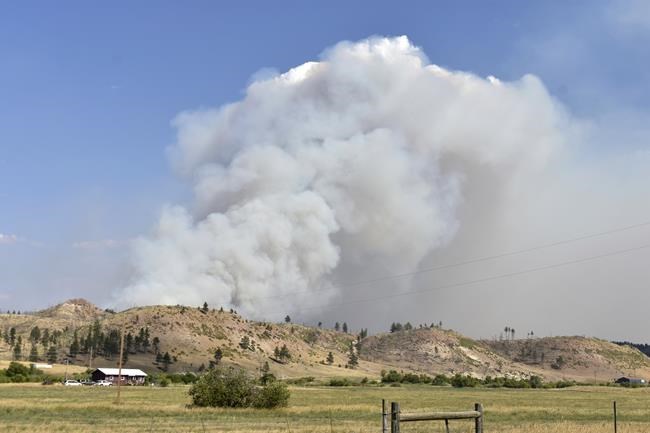
A plume of smoke rises from the Richard Spring wildfire on Wednesday, Aug. 11, 2021, north of Lame Deer, Mont. The fire spread quickly Wednesday as strong winds pushed the flames across rough, forested terrain. (AP photo/Matthew Brown)

Gusts and low humidity were creating extremely dangerous conditions as flames devoured brush, short grass and timber, fire officials said.

Hot, dry weather with strong afternoon winds also propelled several fires in Washington state, and similar weather was expected into the weekend, fire officials said.

In southeastern Oregon, two new wildfires started by lightning Thursday near the California border were spreading through juniper trees, sagebrush and evergreen trees.

Gov. Kate Brown declared an emergency for one of the fires to mobilize crews and other resources to the area of ranches, rural subdivisions and RV parks about 14 miles (23 kilometers) from the small town of Lakeview.

The blaze grew from a lightning strike to 11 square miles (28 square kilometers) in less than 24 hours, said Tamara Schmidt, a U.S. Forest Service spokeswoman.
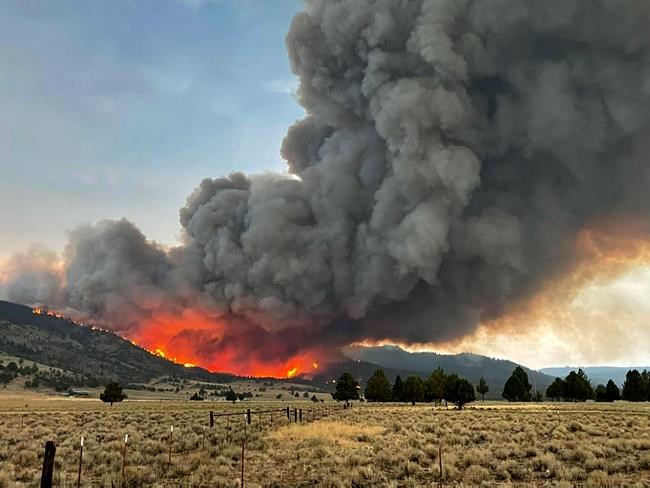
This Thursday, Aug. 12, 2021 photo provided by the U.S. Forest Service shows a wildfire burning from the Patton Meadows fire in southern Oregon. The fire west of Lakeview, Oregon near the California border started with a lightning strike Thursday and rapidly grew to 11 square miles in size amid tinder-dry drought conditions. The fire is near the Bootleg Fire, which until recently was the nation's largest wildfire. (U.S. Forest Service via AP)

Authorities Thursday evening ordered the evacuation of an RV park that stood in the path of the Oregon’s Patton Meadow Fire.

The fires are near the area torched Oregon’s Bootleg Fire which started July 6 and burned an area more than half the size of Rhode Island before crews gained the upper hand. The fire is not yet fully contained and was the nation’s largest until being eclipsed by the Dixie Fire.

Triple-digit temperatures and bone-dry conditions in Oregon, enduring a third day of extreme heat, could increase fire risks through the weekend.

Climate change has made the U.S. West warmer and drier in the past 30 years and will continue to make the weather more extreme and wildfires more destructive, according to scientists.

More than 6,000 square miles (almost 16,000 square kilometers) have been burned in the U.S. so far this year. That’s well ahead of the amount burned by this point last year, but below the 10-year average, according to the National Interagency Fire Center.
A plume of smoke rises from the Richard Spring wildfire on Wednesday, Aug. 11, 2021, north of Lame Deer, Mont. The fire spread quickly Wednesday as strong winds pushed the flames across rough, forested terrain. (AP photo/Matthew Brown)

Parts of Europe also are burning, including in Greece, where where a massive wildfire has decimated forests and torched homes, and was still smoldering 10 days after it started.

___

Nguyen reported from Oakland, Calif. Matthew Brown in Billings, Mont., Olga R. Rodriguez in San Francisco and Gillian Flaccus in Portland contributed to this report.
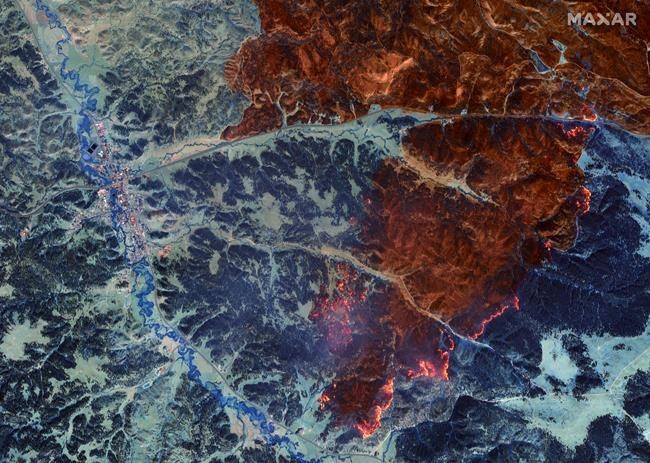

This satellite image provided by Maxar Technologies shows a shortwave infrared (SWIR) satellite imagery overview of the Lame Deer and Richard Spring wildfire in Montana on Friday, Aug. 13, 2021. Maxar SWIR satellite imagery is able to penetrate the wildfire smoke and clearly detects the hot spots and active fires. Burned trees and vegetation appears in shades of orange/rust, healthy (not burned) vegetation appears in shades of blue. (Satellite Image ©2021 Maxar Technologies via AP)
Report Error Submit a Tip

More Stories

Of frogs, roses, kings and a Great Lake

Editorial 4 minute read Preview

Of frogs, roses, kings and a Great Lake

Editorial 4 minute read 2:01 AM CDT

A rose by any other name would smell as sweet, as the saying goes. Basically, if you change something’s name, you don’t actually change the nature of the thing.

That being said, if even 15 years ago an American president had called an entire news conference to announce he was renaming one of the Great Lakes by writing on a map with a red pen and issuing an executive order purporting to rename Lake Ontario as “Lake America,” all and sundry would question his mental health.

Maybe, after witnessing so much from Donald Trump, we’ve all just been hardened off and the foolish is now expected daily. Perhaps it’s the political equivalent of the fable of the boiling frog.

As the fable goes, drop a frog into a pot of boiling water and it will jump right out. But put the frog in room temperature water and bring the pot to a boil, the frog will stay until its death. (It’s unlikely the frog would actually wait.)

Read
2:01 AM CDT

‘Not his best work,’ Kinew says of Trump’s order to rename Lake Ontario

Carol Sanders 3 minute read Preview

‘Not his best work,’ Kinew says of Trump’s order to rename Lake Ontario

Carol Sanders 3 minute read Thursday, Aug. 27, 2026

An executive order by U.S. President Donald Trump to rename Lake Ontario as Lake America is “sad,” Premier Wab Kinew says.

Read
Thursday, Aug. 27, 2026

Advocate assembles gift bundles for Trans Day of Remembrance

Janine LeGal 6 minute read Preview

Advocate assembles gift bundles for Trans Day of Remembrance

Janine LeGal 6 minute read 7:00 AM CDT

In a world rife with chaos and division, there’s never been a better time for kindness, joy… and a cookie.

Kalyn Falk is on a mission to provide all three.

Falk founded the Trans Day of Remembrance Care Package Project in 2020 as a way to mourn those lost and to ensure that trans and non-binary people in the community feel valued, seen and cared for.

Trans Day of Remembrance is observed every year on Nov. 20 to honour the memory of transgender, two-spirit and non-binary people who lost their lives to acts of anti-transgender violence and systemic oppression.

Read
7:00 AM CDT

Forest Service maxed out as wildfires break across US West

Eugene Garcia And Daisy Nguyen, The Associated Press 7 minute read Preview

Forest Service maxed out as wildfires break across US West

Eugene Garcia And Daisy Nguyen, The Associated Press 7 minute read Friday, Aug. 13, 2021

WESTWOOD, Calif. (AP) — The U.S. Forest Service said Friday it's operating in crisis mode, fully deploying firefighters and maxing out its support system as wildfires continue to break out across the U.S. West, threatening thousands of homes and entire towns.

The roughly 21,000 federal firefighters working on the ground is more than double the number of firefighters sent to contain forest fires at this time a year ago, and the agency is facing “critical resources limitations,” said Anthony Scardina, a deputy forester for the agency's Pacific Southwest region.

An estimated 6,170 firefighters alone are battling the Dixie Fire in Northern California, the largest of 100 large fires burning in 14 states, with dozens more burning in western Canada.

The fire began a month ago and has destroyed more than 1,000 homes, businesses and other structures, much of it in the small town of Greenville in the northern Sierra Nevada.

Read
Friday, Aug. 13, 2021

Motion seeks to remove longtime head of Southern Chiefs’ Organization due to ‘behaviour’ concerns

Carol Sanders 4 minute read Preview

Motion seeks to remove longtime head of Southern Chiefs’ Organization due to ‘behaviour’ concerns

Carol Sanders 4 minute read Wednesday, Aug. 26, 2026

For the second time in a year, the leadership of Southern Chiefs’ Organization Grand Chief Jerry Daniels is being called into question.

A motion obtained by the Free Press calls “immediately” for a special summit of the 33 SCO chiefs to consider removing Daniels, who’s been at the helm since 2017.

The Aug. 17 motion, put forward by Lake Manitoba First Nation Chief Cornell McLean and Bloodvein First Nation Chief Lisa Young, cites concerns about “governance, leadership, accountability, transparency, organizational decision-making and confidence of member Nations in the current leadership of the organization.”

McLean would not provide specific examples Wednesday but said the “behaviour” of Daniels is a concern.

Read
Wednesday, Aug. 26, 2026

Winnipeg man among those missing in Nepal flash flood

Free Press staff 2 minute read Preview

Winnipeg man among those missing in Nepal flash flood

Free Press staff 2 minute read 10:06 AM CDT

A Winnipeg man on a pilgrimage in Nepal is among nearly 2,000 people missing after a deadly flash flood devastated a popular tourist region along the Himalayan border earlier this week.

Mohit Kaushik, 49, was travelling with a tour group taking part in the Kailash Manasarovar Yatra, a sacred, days-long pilgrimage to Mount Kailash and Lake Manasarovar in neighbouring Tibet, according to social media posts.

“Our friend and neighbour, Mohit Kaushik, a resident of Winnipeg, Canada, has been out of contact since yesterday while travelling from Timure during his pilgrimage to Kailash Mansarovar,” Swikriti Pokhrel wrote in a social media post. “If you have seen him or find his name on any hospital list, please let us know. Thank you.”

Kaushik has not been heard from since Wednesday, when a glacier collapse in the nearby Himalayas triggered catastrophic flooding and landslides, sending a torrent of ice, rock and debris roughly 100 kilometres downstream.

Read
10:06 AM CDT