Tlicho reflect on legacy of Treaty 11 during 100-year celebrations

Advertisement

Advertise with us

BEHCHOKǪ̀, N.W.T. - As some communities in the Northwest Territories gather to celebrate 100 years since Treaty 11 was signed, many Indigenous people are reflecting on what the historic agreement means today.

Read this article for free:


or

Already have an account? Log in here »

To continue reading, please subscribe:

Subscribe and receive a limited-edition Free Press branded hat or tote.

Digital Subscription

One year of digital access for only $205*

  • Enjoy unlimited reading on winnipegfreepress.com
  • Read the E-Edition, our digital replica newspaper
  • Access News Break, our award-winning app
  • Play interactive puzzles

*First annual payment billed as $205.00 + GST for one year. This annual subscription will automatically renew at $233.00 + GST every 52 weeks (10% off the regular annual price of $259.35). Offer available to new and qualified returning subscribers only. Cancel any time.

To continue reading, please subscribe:

Add Free Press access to your Brandon Sun subscription for only an additional

$1 for the first 4 weeks*

  • Enjoy unlimited reading on winnipegfreepress.com
  • Read the E-Edition, our digital replica newspaper
  • Access News Break, our award-winning app
  • Play interactive puzzles
Start now

*Your next Brandon Sun subscription payment will increase by $1.00 and you will be charged $17.95 plus GST for four weeks. After four weeks, your payment will increase to $24.95 plus GST every four weeks.

Hey there, time traveller!
This article was published 20/08/2022 (1505 days ago), so information in it may no longer be current.

BEHCHOKǪ̀, N.W.T. – As some communities in the Northwest Territories gather to celebrate 100 years since Treaty 11 was signed, many Indigenous people are reflecting on what the historic agreement means today.

The last of the numbered treaties between the Canadian government and Indigenous people, Treaty 11 travelled by river to nine signatory communities in 1921 and 1922. The document, which covers 950,000 square kilometres of what is now Yukon, the Northwest Territories and Nunavut, affects several Dehcho, Tlicho, Sahtu and Gwich’in communities.

Indigenous chiefs signed what they believed at the time was a treaty of peace and friendship on the understanding their rights to trap, hunt and fish on their traditional territory would be protected. The Canadian government, meanwhile, wanted to gain control of the land to pursue mineral and oil-and-gas exploration.
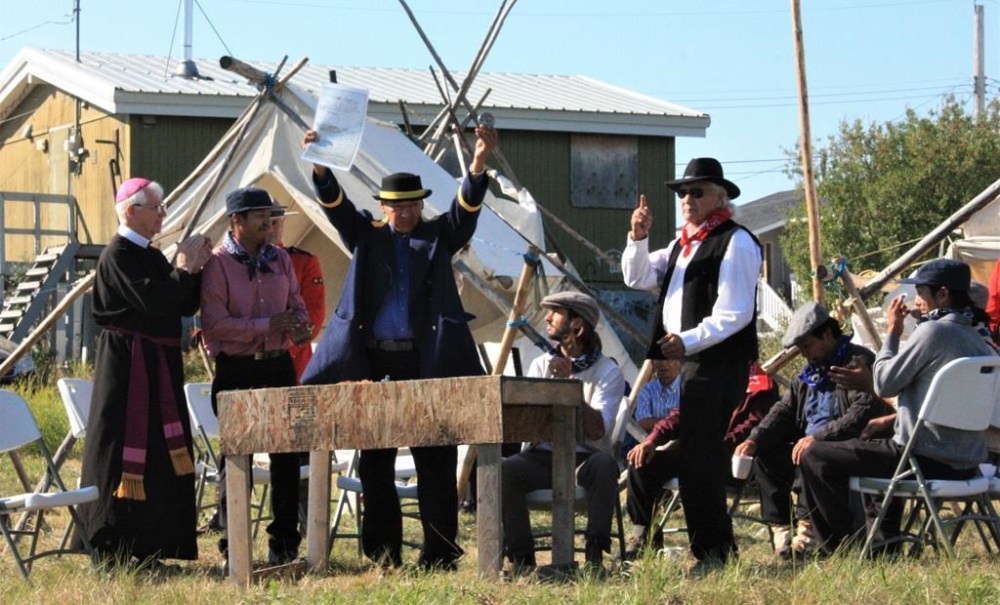
An actor playing Chief Monfwi in a re-enactment of the 1921 signing of Treaty 11 holds up a copy of the treaty and a replica of a metal awarded to the chief in Behchoko, N.W.T., on Aug. 15, 2022. THE CANADIAN PRESS/Emily Blake

“The original treaty that was done in 1921 was for the best interest of the Dominion, so that they can have access to the natural and non-renewable resources for the greater society,” said John Zoe, a senior adviser to the Tlicho government who was chief negotiator when the Tlicho Agreement was ratified in 2005. It was the first combined comprehensive land claim and self-government agreement in the N.W.T.

Zoe said the Canadian government had already written Treaty 11 before heading north and Indigenous people were subsequently excluded from the growth of Canada.

When the treaty reached Behchoko, then known as Fort Rae, in the summer of 1921, many Tlicho people were wary as the promises made to them and the Denesuline who had signed Treaty 8 in Fort Resolution in 1900 had not been kept.

Following several days of negotiations, Chief Monfwi signed Treaty 11 on behalf of the Tlicho people on Aug. 22, 1921.

Today, the Tlicho region includes the communities of Behchoko, Whati, Gameti and Wekweeti.

Whati Chief Alfonz Nitsiza said Chief Monfwi was “very forceful” in ensuring Tlicho rights to harvest would not be restricted and he outlined their traditional territory on a map.

“We always over the years maintained that this is our homeland, this is our rights to harvest,” he said.

The Tlicho government now owns 39,000 square kilometres of land between Great Slave Lake and Great Bear Lake, including surface and subsurface rights.

At the time of signing Treaty 11, Chief Monfwi declared that “as long as the sun rises, the river flows and the land does not move, we will not be restricted from our way of life.”

Zoe said those words have been kept alive and helped to guide the modern Tlicho self-government agreement.

“We now have the ability to strengthen our relationship to our own lands, to our language, our cultural way of life of doing land-based activities — things that we should have been doing for a long time,” he said.

Former Dene national chief Norman Yak’eula’s grandfather, Chief Albert Wright, signed Treaty 11 in Fort Norman, now Tulita, on July 15, 1921. He said it wasn’t until the 1960s that Dene people saw the final wording of the treaty for the first time, and it wasn’t what they had agreed to.

“That’s where we got to see what kind of people the government were,” he said.

“We were dealing with not-so-honourable people of the federal government and churches. They had their agenda, they knew what they wanted, they knew the value of our land.”

Yak’eula said his grandfather was made chief by the government.

Decades after Treaty 8 and Treaty 11 were signed, many Indigenous people in the North challenged the fairness of the treaties and asserted their rights.

Tlicho gathered in Behchoko in 1968 and agreed to refuse to accept treaty payments.

A legal challenge of the proposed Mackenzie Valley Pipeline from more than a dozen Dene chiefs in the early 1970s, known as the Paulette case or Paulette caveat, saw the Supreme Court of Canada uphold findings that they had not relinquished their rights when they signed the treaties. The case helped lead to the negotiation of comprehensive land claim agreements.

Several communities marked the Treaty 11 centenary last summer with feasts, dancing, drumming, games and other traditional activities. Others such as Nahanni Butte and Behchoko waited to host festivities until this summer while Fort Liard has postponed celebrations until 2023.

Zoe said while treaty making is serious, there is also a need to celebrate.

“It’s about the spirit and the intent of the treaty that we must celebrate,” he said. “At the same time, we need to celebrate the agreement that we have with Canada to say that we’re finally recognized as having always been there.”

Yak’eula, who was the chief negotiator for the Sahtu Dene and Métis land claim and Tulita self-government agreement, said the treaty recognizes that the Dene are a nation.

“It means that we are a nation with a set of values, principles and our own way of life,” he said. “The second-most powerful treaties that we have are the comprehensive land claim agreements followed by self-government agreements.”

This report by The Canadian Press was first published Aug. 20, 2022.

___

This story was produced with the financial assistance of the Meta and Canadian Press News Fellowship.

Report Error Submit a Tip

More Stories

Sisters relieved hospital takes accountability after mother’s death

Scott Billeck 5 minute read Preview

Sisters relieved hospital takes accountability after mother’s death

Scott Billeck 5 minute read Thursday, Oct. 1, 2026

Eight months after losing their mother, two Winnipeg sisters say an internal hospital review has finally given them something they had been seeking since her death: accountability.

Chelsea Mann and Samantha Burns said St. Boniface Hospital officials acknowledged mistakes were made in the care of their mother, Judy Burns, during a recent meeting to discuss the findings of a critical incident review into her death.

The acknowledgement marked a significant departure from an earlier meeting with hospital officials, when they felt their concerns were largely dismissed.

Burns, 68, died on Jan. 21, three days after being admitted, after experiencing rectal bleeding.

Read
Thursday, Oct. 1, 2026

Mayoral candidate Vogiatzakis criticized for living outside Winnipeg

Malak Abas 4 minute read Preview

Mayoral candidate Vogiatzakis criticized for living outside Winnipeg

Malak Abas 4 minute read Updated: Yesterday at 6:03 PM CDT

A mayoral hopeful took heat from other candidates Friday for living outside Winnipeg while running in the civic election.

Mike Vogiatzakis’s primary residence is in the Rural Municipality of St. Andrews, about 25 kilometres north of Winnipeg — a community with its own mayor and councillors.

But the funeral director said he owns a home in Winnipeg where he divides his time, and he would move to the city full-time if elected mayor.

“It doesn’t matter where a person lives. Why are we dividing St. Andrews and Manitoba and Winnipeg? I’ve met the criteria to run for mayor,” Vogiatzakis said Friday morning.

Read
Updated: Yesterday at 6:03 PM CDT

Jets bench boss Arniel talks rebuilding from last season’s struggles

Mike McIntyre and Ken Wiebe 12 minute read Preview

Jets bench boss Arniel talks rebuilding from last season’s struggles

Mike McIntyre and Ken Wiebe 12 minute read Thursday, Oct. 1, 2026

Scott Arniel has a lot on his plate these days.

But the head coach of the Winnipeg Jets took some time Thursday to sit down with Free Press hockey writers Mike McIntyre and Ken Wiebe to discuss a number of topics on the eve of a new hockey season. This interview has been condensed and edited for clarity.

Wiebe: What was the evaluation of last season like? What did you personally do in an attempt to improve after going from first-overall to 26th-overall?

I just went back and looked at things and made sure my communication was where it needed to be with my players. Was my communication where it needed to be with my boss, with my general manager (Kevin Cheveldayoff)? How our coaching staff worked. How we handled highs and lows. Things I felt I could have done better.

Read
Thursday, Oct. 1, 2026

Broadening prediction-market gambling a bad idea

Editorial 4 minute read Preview

Broadening prediction-market gambling a bad idea

Editorial 4 minute read 2:01 AM CDT

Let’s make a prediction: sooner or later, when Canadian governments find a way to take their own cut of the action, prediction-contract gambling on everything from sports to entertainment to political decisions is going to come to Canada.

And that’s a horrible, dangerous, pernicious idea.

Unless you have particular access to information — either inside information or strategic information based on skills or education — you’re not likely to make money at it. In fact, structurally, you’re likely to lose. In prediction markets, you basically pay an amount, plus fees from the company involved, to bet on whether something will or will not happen within a certain time frame. The amount you pay for your contract depends on how other people are also betting.

As Wealthsimple describes it, “You buy whichever side you think is right. Prices move with demand, so if the market leans towards one outcome, the more that side costs. If a lot of people are backing the TSX to finish above 38,000, yes gets more expensive and no gets cheaper.”

Read
2:01 AM CDT

Tlicho reflect on legacy of Treaty 11 during 100-year celebrations

Emily Blake, The Canadian Press 5 minute read Preview

Tlicho reflect on legacy of Treaty 11 during 100-year celebrations

Emily Blake, The Canadian Press 5 minute read Saturday, Aug. 20, 2022

BEHCHOKǪ̀, N.W.T. - As some communities in the Northwest Territories gather to celebrate 100 years since Treaty 11 was signed, many Indigenous people are reflecting on what the historic agreement means today.

The last of the numbered treaties between the Canadian government and Indigenous people, Treaty 11 travelled by river to nine signatory communities in 1921 and 1922. The document, which covers 950,000 square kilometres of what is now Yukon, the Northwest Territories and Nunavut, affects several Dehcho, Tlicho, Sahtu and Gwich’in communities.

Indigenous chiefs signed what they believed at the time was a treaty of peace and friendship on the understanding their rights to trap, hunt and fish on their traditional territory would be protected. The Canadian government, meanwhile, wanted to gain control of the land to pursue mineral and oil-and-gas exploration.

“The original treaty that was done in 1921 was for the best interest of the Dominion, so that they can have access to the natural and non-renewable resources for the greater society,” said John Zoe, a senior adviser to the Tlicho government who was chief negotiator when the Tlicho Agreement was ratified in 2005. It was the first combined comprehensive land claim and self-government agreement in the N.W.T.

Read
Saturday, Aug. 20, 2022

May be whiff of truth to ex’s odour ardour

Maureen Scurfield 5 minute read 2:01 AM CDT

DEAR MISS LONELYHEARTS: I ran into an old boyfriend I used to curl on a team with, and we went for drinks. We’ve been almost eight years apart, and I couldn’t remember why we broke up, as we always had such a great time together.

It wasn’t until the second date — this time on a weekend — that it came back to me, with a jolt. Pee-yew! I remembered he doesn’t use deodorant on weekends. Why? He enjoys his own body odour. I recalled that a bit too late, and it was just as awful as ever! I went home early.

Tonight, he called and I refused him another date. I said, “Think back. You remember why we broke up?” Then he said, “Oh yeah, you hated my no-deodorant weekend policy. Well, guess what? Some women don’t mind!” I said I really doubted that, and that ended the conversation. Miss L., wouldn’t any women find stinky underarms offensive?

— Sensitive Nose, Fort Richmond