Bring back dodo? Ambitious plan draws investors, critics

Advertisement

Advertise with us

WASHINGTON (AP) — The dodo bird isn’t coming back anytime soon. Nor is the woolly mammoth. But a company working on technologies to bring back extinct species has attracted more investors, while other scientists are skeptical such feats are possible or a good idea.

Read this article for free:


or

Already have an account? Log in here »

To continue reading, please subscribe:

Subscribe and receive a limited-edition Free Press branded hat or tote.

Digital Subscription

One year of digital access for only $205*

  • Enjoy unlimited reading on winnipegfreepress.com
  • Read the E-Edition, our digital replica newspaper
  • Access News Break, our award-winning app
  • Play interactive puzzles

*First annual payment billed as $205.00 + GST for one year. This annual subscription will automatically renew at $233.00 + GST every 52 weeks (10% off the regular annual price of $259.35). Offer available to new and qualified returning subscribers only. Cancel any time.

To continue reading, please subscribe:

Add Free Press access to your Brandon Sun subscription for only an additional

$1 for the first 4 weeks*

  • Enjoy unlimited reading on winnipegfreepress.com
  • Read the E-Edition, our digital replica newspaper
  • Access News Break, our award-winning app
  • Play interactive puzzles
Start now

*Your next Brandon Sun subscription payment will increase by $1.00 and you will be charged $17.95 plus GST for four weeks. After four weeks, your payment will increase to $24.95 plus GST every four weeks.

Hey there, time traveller!
This article was published 31/01/2023 (1322 days ago), so information in it may no longer be current.

WASHINGTON (AP) — The dodo bird isn’t coming back anytime soon. Nor is the woolly mammoth. But a company working on technologies to bring back extinct species has attracted more investors, while other scientists are skeptical such feats are possible or a good idea.

Colossal Biosciences first announced its ambitious plan to revive the woolly mammoth two years ago, and on Tuesday said it wanted to bring back the dodo bird, too.

“The dodo is a symbol of man-made extinction,” said Ben Lamm, a serial entrepreneur and co-founder and CEO of Colossal. The company has formed a division to focus on bird-related genetic technologies.
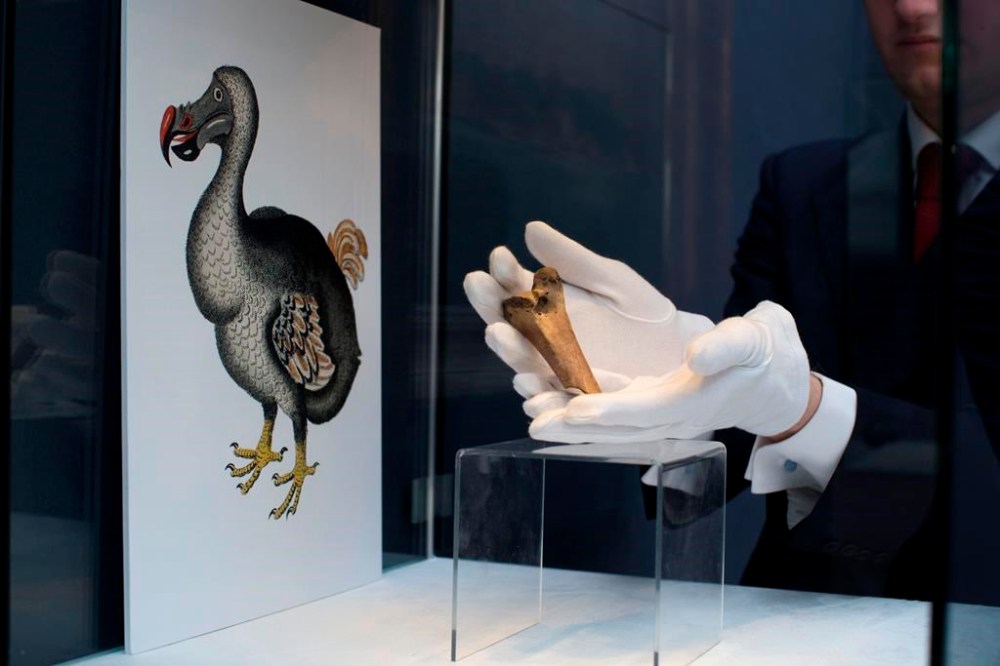
FILE - A rare fragment of a Dodo femur bone is displayed for photographs next to an image of a member of the extinct bird species at Christie's auction house's premises in London, March 27, 2013. Colossal Biosciences has raised an additional $150 million from investors to develop genetic technologies that the company claims will help to bring back some extinct species, including the dodo and the woolly mammoth. Other scientists are skeptical that such feats are really possible, or even advisable for conservation. (AP Photo/Matt Dunham, File)

The last dodo, a flightless bird about the size of a turkey, was killed in 1681 on the Indian Ocean island of Mauritius.

The Dallas company, which launched in 2021, also announced Tuesday it had raised an additional $150 million in funding. To date, it has raised $225 million from wide-ranging investors that include United States Innovative Technology Fund, Breyer Capital and In-Q-Tel, the CIA’s venture capital firm which invests in technology.

The prospect of bringing the dodo back isn’t expected to directly make money, said Lamm. But the genetic tools and equipment that the company develops to try to do it may have other uses, including for human health care, he said.

For example, Colossal is now testing tools to tweak several parts of the genome simultaneously. It’s also working on technologies for what is sometimes called an “artificial womb,” he said.

The dodo’s closest living relative is the Nicobar pigeon, said Beth Shapiro, a molecular biologist on Colossal’s scientific advisory board, who has been studying the dodo for two decades. Shapiro is paid by the Howard Hughes Medical Institute, which also supports The Associated Press’ Health and Science Department.

Her team plans to study DNA differences between the Nicobar pigeon and the dodo to understand “what are the genes that really make a dodo a dodo,” she said.

The team may then attempt to edit Nicobar pigeon cells to make them resemble dodo cells. It may be possible to put the tweaked cells into developing eggs of other birds, such as pigeons or chickens, to create offspring that may in turn naturally produce dodo eggs, said Shapiro. The concept is still in an early theoretical stage for dodos.

Because animals are a product of both their genetics and their environment — which has changed dramatically since the 1600s — Shapiro said that “it’s not possible to recreate a 100% identical copy of something that’s gone.”

Other scientists wonder if it’s even advisable to try, and question whether “de-extinction” diverts attention and money away from efforts to save species still on Earth.

“There’s a real hazard in saying that if we destroy nature, we can just put it back together again — because we can’t,” said Duke University ecologist Stuart Pimm, who has no connection to Colossal.

“And where on Earth would you put a woolly mammoth, other than in a cage?” asked Pimm, who noted that the ecosystems where mammoths lived disappeared long ago.

On a practical level, conservation biologists familiar with captive breeding programs say that it can be tricky for zoo-bred animals to ever adapt to the wild.

It helps if they can learn from other wild animals of their kind — an advantage that potential dodos and mammoths won’t have, said Boris Worm, a biologist at the University of Dalhousie in Halifax, Nova Scotia, who has no connection to Colossal.

“Preventing species from going extinct in the first place should be our priority, and in most cases, it’s a lot cheaper,” said Worm.

___

The Associated Press Health and Science Department receives support from the Howard Hughes Medical Institute’s Science and Educational Media Group. The AP is solely responsible for all content.
Report Error Submit a Tip

More Stories

A father and son arrested last month are accused of travelling across Canada — and using courier services and Canada Post — to supply their Winnipeg drug-trafficking operation, a recent court filing shows.

Pokemon thieves clear out collectibles shop

Scott Billeck 5 minute read Preview

Pokemon thieves clear out collectibles shop

Scott Billeck 5 minute read Friday, Sep. 11, 2026

Terri Settle loved watching children walk into her collectibles shop to hunt for their favourite Pokemon cards.

After the latest break in stripped her shelves of much of the inventory, she’s not sure she’ll get to see it again.

Thieves broke into Terri’s Trinkets and Toys on Tuesday evening, punching through a grate and then the store’s bathroom wall to reach the storefront.

They made off with about $6,000 worth of merchandise, including all of the store’s Pokemon cards — about 7,000 of them — along with toys, Lego, jewelry, video games, a debit machine and personal laptop. They even took her vacuum cleaner.

Read
Friday, Sep. 11, 2026

‘Kind and gentle giant’: man, 21, killed in animal attack on Manitoba First Nation

Chris Kitching 4 minute read Preview

‘Kind and gentle giant’: man, 21, killed in animal attack on Manitoba First Nation

Chris Kitching 4 minute read Updated: 2:43 PM CDT

The family of a 21-year-old man who was fatally attacked by an animal in western Manitoba is waiting for answers, after investigators ruled out a bear attack based on their preliminary findings.

Moses Campeau was walking on a road to a friend’s house in Sapotaweyak Cree Nation, about 600 kilometres northwest of Winnipeg, when he was fatally injured Sept. 9, his mother, Paula Campeau, said Monday.

“Moses was a kind and gentle giant,” she said. “He was a person who (people) would ask to come and help them, and he would go without even hesitating.”

Manitoba RCMP said officers from the Swan River detachment found the man on a community road after receiving a report of a suspicious death at about 3:10 a.m. The scene was held and the RCMP’s major crime services took over the investigation.

Read
Updated: 2:43 PM CDT

Menstruation, consent move up in sex-ed lesson plan

Maggie Macintosh 5 minute read Preview

Menstruation, consent move up in sex-ed lesson plan

Maggie Macintosh 5 minute read 6:00 AM CDT

Manitoba’s newest curriculum introduces the menstrual cycle earlier and repeatedly calls for explicit lessons on how students can give, seek, and decline to provide their consent.

The education department has released its sweeping proposal to overhaul how exercise, nutrition and sexuality are taught between kindergarten and Grade 12.

Grade 5 has long served as a key turning point for “the talk,” said J Fiedler, a sexual and reproductive health educator who provided input on the new curriculum.

“There’s no ‘the talk’ anymore. Now, there’s continuations of multiple ‘talks,’ which can hopefully reduce stress for students and stigma that people experience talking about sexuality.”

Read
6:00 AM CDT

Downtown no place to be after dark, huge majority of Winnipeggers say in survey

Joyanne Pursaga 8 minute read Preview

Downtown no place to be after dark, huge majority of Winnipeggers say in survey

Joyanne Pursaga 8 minute read Friday, Sep. 11, 2026

Most Winnipeggers are afraid to walk alone downtown and believe the city needs more police officers, a new survey finds.

Winnipeg Police Service released its 2026 citizen survey Friday.

Downtown safety appears to remain a major concern, with just 44 per cent saying they feel very or reasonably safe walking alone in the area during the day. The number plummets to eight per cent overall at night, down from nine per cent in 2024, the last time the survey was conducted.

This year, 14 per cent of men felt very or reasonably safe walking alone downtown at night, compared to just three per cent of women.

Read
Friday, Sep. 11, 2026

MMF walks away from bid to buy Fort Garry Hotel

Carol Sanders 3 minute read Preview

MMF walks away from bid to buy Fort Garry Hotel

Carol Sanders 3 minute read 3:03 PM CDT

The Manitoba Métis Federation won’t buy the historic Fort Garry Hotel, President David Chartrand said Monday.

“The price just went too high and we walked away from it,” he said in an interview from Toronto, where he’s attending the Canada investment summit.

The MMF and its Chinese investment partner “might build a new hotel together now,” Chartrand said.

“It’s just not that we don’t have the money with our partner. We definitely have the money, but we both see the same thing — that our return (on investment) would take too long versus what we’d like to see.”

Read
3:03 PM CDT