Don’t feed the bears! But birds OK, new Tahoe research shows

Advertisement

Advertise with us

RENO, Nev. (AP) — Don't feed the bears!

Read this article for free:


or

Already have an account? Log in here »

To continue reading, please subscribe:

Subscribe and receive a limited-edition Free Press branded hat or tote.

Digital Subscription

One year of digital access for only $205*

  • Enjoy unlimited reading on winnipegfreepress.com
  • Read the E-Edition, our digital replica newspaper
  • Access News Break, our award-winning app
  • Play interactive puzzles

*First annual payment billed as $205.00 + GST for one year. This annual subscription will automatically renew at $233.00 + GST every 52 weeks (10% off the regular annual price of $259.35). Offer available to new and qualified returning subscribers only. Cancel any time.

To continue reading, please subscribe:

Add Free Press access to your Brandon Sun subscription for only an additional

$1 for the first 4 weeks*

  • Enjoy unlimited reading on winnipegfreepress.com
  • Read the E-Edition, our digital replica newspaper
  • Access News Break, our award-winning app
  • Play interactive puzzles
Start now

*Your next Brandon Sun subscription payment will increase by $1.00 and you will be charged $17.95 plus GST for four weeks. After four weeks, your payment will increase to $24.95 plus GST every four weeks.

Hey there, time traveller!
This article was published 10/02/2023 (1330 days ago), so information in it may no longer be current.

RENO, Nev. (AP) — Don’t feed the bears!

Wildlife biologists and forest rangers have preached the mantra for nearly a century at national parks like Yellowstone and Yosemite, and for decades in areas where urban development increasingly invaded native wildlife habitat.

But don’t feed the birds? That may be a different story — at least for one bird species at Lake Tahoe.
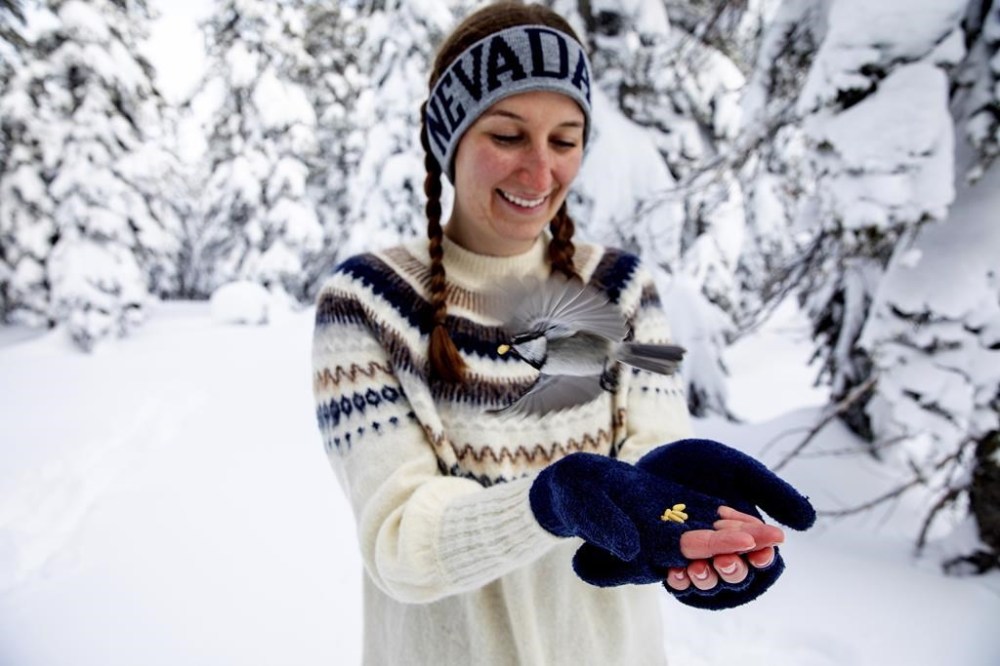
This photo provided by the University of Nevada, Reno shows University of Nevada, Reno student Michelle Werdann feeds a wild Mountain Chickadee pine nuts at Chickadee Ridge in Mount Rose Meadows, Nevada, Friday, Jan. 6, 2023.(Jennifer Kent/University of Nevada, Reno via AP)

Snowshoe and cross-country ski enthusiasts routinely feed the tiny mountain chickadees high above the north shore of the alpine lake on the California-Nevada border. The black-capped birds of Chickadee Ridge will even perch on extended hands to snatch offered seeds.

New research from University of Nevada scientists found that supplementing the chickadees’ natural food sources with food provided in feeders or by hand did not negatively impact them, as long as proper food is used and certain rules are followed.

“It’s a wonderful experience when the birds fly around and land on your hand to grab food. We call it ‘becoming a Disney princess,’” said Benjamin Sonnenberg, a biologist/behavioral ecologist who co-authored the six-year study.

But he also recognized “there’s always the question of when it is appropriate or not appropriate to feed birds in the wild.”

State wildlife officials said this week they generally frown on feeding wildlife. But Nevada Department of Wildlife spokeswoman Ashley Sanchez acknowledged concerns about potential harm are based on speculation, not scientific data.

The latest research project under the wings of Professor Vladimir Pravosudov’s Chickadee Cognition Lab established feeders in the Forest Service’s Mount Rose Wilderness and tracked populations of mountain chickadees at two elevations — both those that did and didn’t visit feeders.

“If we saw increases in the population size or decreases in the population size, that could mean we were hurting the animals by feeding them,” co-author Joseph Welklin said. “Our study shows that feeding these mountain chickadees in the wild during the winter has no effect on their population dynamics.”

Sonnenberg said he understood concerns about supplementing food for wild creatures at Tahoe, where bears attracted to garbage get into trouble that sometimes turns fatal, and not for humans. The bears may ultimately be killed because they no longer fear people. He grew up in Bozeman, Montana, and has fond memories of grizzly and black bears at Yellowstone National Park where he learned at an early age “not to intentionally or to accidentally feed them.”

“Feeding wildlife is context-specific and comes with nuance,” he said.

Bear-human conflicts were extremely rare at Tahoe when Ranger Smith started battling Yogi and Boo-Boo over “pic-a-nic” baskets at fictional Jellystone Park in the popular cartoon that debuted in 1960. But between 1960 and 1980 the human population around Lake Tahoe exploded from 10,000 to 50,000 — 90,000 in the summer. Peak days now approach 300,000 visitors.

The growth spurred more development encroaching on native bear habitat, which led some so-called “garbage bears” to become dependent on unsecured trash for food. In a few cases, wildlife officials have blamed resulting bear deaths on north Tahoe residents feeding bears in their backyards.

“Should you feed the bears? Of course not,” Sonnenberg said. “But given the millions of people that are feeding birds around the world, understanding the impact of this food on wild populations is important, especially in a changing world.”

Mountain chickadees are of particular interest because they’re among the few avian species that hunker down for the cold Sierra winters instead of migrating to a warmer climate. They stash away tens of thousands of food items every fall then return to the hidden treasure throughout the winter to survive.
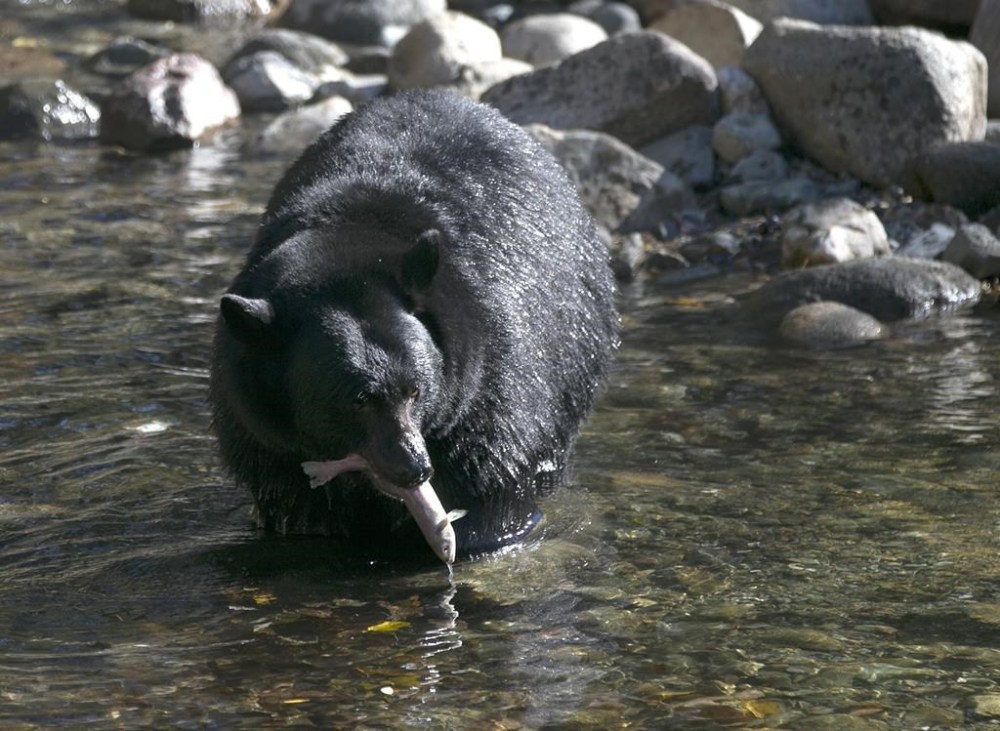
FILE - A Black Bear eats a Kokanee salmon it caught in the Taylor Creek Tuesday, Oct. 24, 2017, in South Lake Tahoe, Calif. Wildlife biologists and forest rangers at Lake Tahoe and across the West have been preaching the mantra for decades: Don't feed the bears! But a new study by scientists at the University of Nevada suggests it's okay to feed the birds at least the mountain chickadees on a ridge that bears their name on the north shore of a lake near the California-Nevada line. (AP Photo/Rich Pedroncelli, File)

They’re “prolific scatter hoarders and rely on specialized spatial memory abilities to recover cached food from their environment during harsh winter months,” according to the findings published last month in the journal Ornithology.

“When they come to your hand and grab a food item,” Sonnenberg said, “if they fly away into the woods and you can’t see them anymore, they are likely storing that food for later.”

Their visits to feeders instead of tapping their own stash, the study said, “may be partially driven by the seemingly compulsive-like nature of caching behavior, as chickadees will cache available resources until they are depleted.”

The project included scientists from Canada’s University of Western Ontario’s Department of Psychology, Kennesaw State University’s Department of Ecology, Evolution and Organismal Biology in Georgia and the University of Oklahoma’s Biological Survey.

Sanchez said the Nevada Department of Wildlife’s concerns include observations the chickadees are exhibiting a level of tameness around potential predators — humans — which could make them more susceptible to other predators in nature.

She also said in an email the number of people hand-feeding the birds at Chickadee Ridge has increased significantly in recent years, “which means the odds that somebody will feed them inappropriate food items or handle them inappropriately has also increased.”

Sonnenberg added in an email the researchers are “not directly advocating for or against the feeding of chickadees at Chickadee Ridge.”

But “what our results do show is that this extra food does not cause chickadee populations in the Sierra Nevada to boom (increase to densities that could be harmful) or bust (decrease dramatically due to harmful effects),” he wrote.

Anyone feeding the birds should only provide food similar to what is found in their natural environment such as unsalted pine nuts or black-oil sunflower seeds, never bread or other human food, he said.

“And always be respectful of the animal,” Sonnenberg said. “Behave like you’re in their house and you’re visiting them.”


Report Error Submit a Tip

More Stories

Thriller has steam to spare, but story slogs

Alison Gillmor 4 minute read Preview

Thriller has steam to spare, but story slogs

Alison Gillmor 4 minute read 2:01 AM CDT

Based on a 2018 book by hugely popular, wildly polarizing author Colleen Hoover (whose novels It Ends with Us, Regretting You and Reminders of Him have also been made into movies), this new adaptation is being billed as a sexy psychological thriller.

Read
2:01 AM CDT

Man who killed two Indigenous women, was accused of killing third, back in prison less than year after statutory release

Erik Pindera 4 minute read Preview

Man who killed two Indigenous women, was accused of killing third, back in prison less than year after statutory release

Erik Pindera 4 minute read Yesterday at 4:06 PM CDT

A Winnipeg man convicted of killing two First Nations women more than a decade ago — with charges stayed in a third slaying — has been sent back to prison less than a year after he left under conditions.

Parole Board of Canada officials revoked 67-year-old Shawn Lamb’s statutory release after a hearing last week.

“Your actions are not beyond your control, yet you continue to wilfully make poor decisions that place the public at risk,” board member Arun Kundu-Thomsen wrote in a decision released this week.

Lamb gained statutory release — a legislated conditional release most federal inmates automatically qualify for after serving two-thirds of their sentence — in November last year and lived in several Ontario facilities for federal offenders.

Read
Yesterday at 4:06 PM CDT

Netminder no stranger to heavy workload as Jets new No. 1 readies for regular-season start

Ken Wiebe 8 minute read Preview

Netminder no stranger to heavy workload as Jets new No. 1 readies for regular-season start

Ken Wiebe 8 minute read Wednesday, Sep. 30, 2026

Stuart Skinner is quick to admit that he wasn’t always wired this way.

As the Winnipeg Jets new starting goalie prepares for his fifth NHL season, Skinner conceded that the accountability aspect that is now synonymous with his character took some time to build up.

“As I grew up and got older, you go through certain things in life that either build character or make things worse for you. It depends on your choice and your decision,” Skinner said during a recent conversation with the Free Press. “I learned it through trial and error. I learned that, sometimes, it’s hard to get honest with yourself… For me, it’s definitely been a road for me to get to a place like this.

“It definitely is one of my pillars. Accountability is so important because that brings you into a spot of what you’re going to do next. It’s easy to let yourself off the hook. I’m more in the business of putting myself on the hook.”

Read
Wednesday, Sep. 30, 2026

Nearly four in 10 Manitobans hope Canada restarts trade talks after U.S. midterm elections, poll reveals

Gabrielle Piché 4 minute read Preview

Nearly four in 10 Manitobans hope Canada restarts trade talks after U.S. midterm elections, poll reveals

Gabrielle Piché 4 minute read 7:00 AM CDT

Disorganized — that’s what Marcus Langlois calls recent United States tariffs.

He expects suppliers’ prices to increase — on mugs, pens, hoodies — for his employer, Dreamcatcher Promotions, if the United States–Canada trade war persists.

Still, he’s not pining for a quick trade deal.

“I think it should wait,” said Langlois, Dreamcatcher Promotions’ vice-president. “Let’s hope that it’s later on with proper negotiations happening.”

Read
7:00 AM CDT

Port of Churchill signs agreement with Dutch port

Aaron Epp 2 minute read Preview

Port of Churchill signs agreement with Dutch port

Aaron Epp 2 minute read Tuesday, Sep. 29, 2026

Arctic Gateway Group, operator of the Port of Churchill, has signed an agreement with the Port of Rotterdam in the Netherlands to attract business and strengthen supply chains linking Western Canada and Europe.

The agreement enables the two ports to work together to develop new trade in critical minerals and energy products, connect Canadian producers with European buyers, and identify opportunities to improve the supply chain from Western Canadian resource projects through Churchill and into European markets.

The Port of Rotterdam is Europe’s largest port and home to more than 3,000 businesses across its industrial complex, serving as a major gateway for critical raw materials and energy.

Meanwhile, the Port of Churchill has been identified as a transformative national strategy for Canada and is emerging as a northern trade corridor connecting Western Canada’s resources to global markets.

Read
Tuesday, Sep. 29, 2026

Ferraro gets call-up to the Jets

Mike McIntyre 6 minute read Preview

Ferraro gets call-up to the Jets

Mike McIntyre 6 minute read Wednesday, Sep. 30, 2026

Landon Ferraro vividly recalls the moment his NHL career came to an extremely painful end — Oct. 20, 2017, in downtown Winnipeg.

“My last play was a breakaway on Connor Hellebuyck,” Ferraro told the Free Press this week.

“I tried to poke the puck past the first D. It was me and (Dustin) Byfuglien chasing it down. I thought he was going to throw me across the ice, so I tried to cut in on him, and he moved. I overextended, and I literally ripped my abductor off the bone and gave myself a hernia.”

Ferraro — at the time playing forward for the visiting Minnesota Wild — said he managed to get off a weak shot that hit the Jets goaltender square in the chest. But his 77th appearance in the big leagues would be his last following previous stops with Detroit (which drafted him 32nd overall in 2009) and Boston.

Read
Wednesday, Sep. 30, 2026