California eases water restrictions, but drought isn’t over

Advertisement

Advertise with us

DUNNIGAN, Calif. (AP) — California Gov. Gavin Newsom ended some of the state's water restrictions on Friday because a winter of relentless rain and snow has replenished the state's reservoirs and eased fears of a shortage after three years of severe drought.

Read this article for free:


or

Already have an account? Log in here »

To continue reading, please subscribe:

Subscribe and receive a limited-edition Free Press branded hat or tote.

Digital Subscription

One year of digital access for only $205*

  • Enjoy unlimited reading on winnipegfreepress.com
  • Read the E-Edition, our digital replica newspaper
  • Access News Break, our award-winning app
  • Play interactive puzzles

*First annual payment billed as $205.00 + GST for one year. This annual subscription will automatically renew at $233.00 + GST every 52 weeks (10% off the regular annual price of $259.35). Offer available to new and qualified returning subscribers only. Cancel any time.

To continue reading, please subscribe:

Add Free Press access to your Brandon Sun subscription for only an additional

$1 for the first 4 weeks*

  • Enjoy unlimited reading on winnipegfreepress.com
  • Read the E-Edition, our digital replica newspaper
  • Access News Break, our award-winning app
  • Play interactive puzzles
Start now

*Your next Brandon Sun subscription payment will increase by $1.00 and you will be charged $17.95 plus GST for four weeks. After four weeks, your payment will increase to $24.95 plus GST every four weeks.

Hey there, time traveller!
This article was published 24/03/2023 (1277 days ago), so information in it may no longer be current.

DUNNIGAN, Calif. (AP) — California Gov. Gavin Newsom ended some of the state’s water restrictions on Friday because a winter of relentless rain and snow has replenished the state’s reservoirs and eased fears of a shortage after three years of severe drought.

Newsom was careful not to declare the drought to be over, noting water shortages remain in the Klamath River basin along the California-Oregon line and in densely populated Southern California, which relies heavily on the struggling Colorado River system to supply millions of people.

But Newsom did say he would stop asking people to voluntarily cut their water use by 15%, a request he first made nearly two years ago while standing at the edge of a nearly dry Lopez Lake in the state’s Central Coast region — a lake that today is so full from recent storms it is almost spilling over.

FILE - Water levels are low at San Luis Reservoir, which stores irrigation water for San Joaquin Valley farms, Sept. 14, 2022, in Gustine, Calif. California Gov. Gavin Newsom announced an end to some drought restrictions and calls for water conservation on Friday, March 24, 2023, following a series of winter storms have dramatically improved the state's water supply outlook. (AP Photo/Terry Chea, File)

“None of us could have imagined … a few months ago that we’d be where we are today,” Newsom said Friday from a farm northwest of Sacramento that has flooded some of its fields with excess water so it will seep underground and refill groundwater basins. “Are we out of the drought? Mostly — but not completely.”

Newsom’s call for voluntary conservation had mixed results. Californians did reduce their water use, but only by 6.2% overall, according to data from the State Water Resources Control Board. Newsom never ordered statewide, mandatory water restrictions — but he did require water agencies to impose some limits on their customers.

Friday, Newsom said he was easing those rules. That change will impact people in different ways depending on where they live. For most people, it means they won’t be limited to watering their lawns on only certain days of the week or at certain times of the day. Other restrictions will remain in place indefinitely, including a ban on watering decorative grass for businesses.

“We’ve got to conserve as a way of life,” Newsom said.

Newsom could ease some restrictions in part because California’s reservoirs are now so full that cities will get more than double the amount of drinking water this year compared to a previous allocation announced last month. Now, water districts that serve 27 million people will get at least 75% of the water they requested from state supplies. Last year, they only got 5% as California endured three of the driest years ever since modern recordkeeping began in 1896.

“This wet winter, which has led to a large increase in our (water) allocation, is not a signal that we can relax,” said Adel Hagekhalil, general manager of the Metropolitan Water District of Southern California that supplies water to 19 million people. “It is an alarm to act and accelerate our efforts to respond to rapidly changing conditions, including conservation, storage, recycling and reuse.”
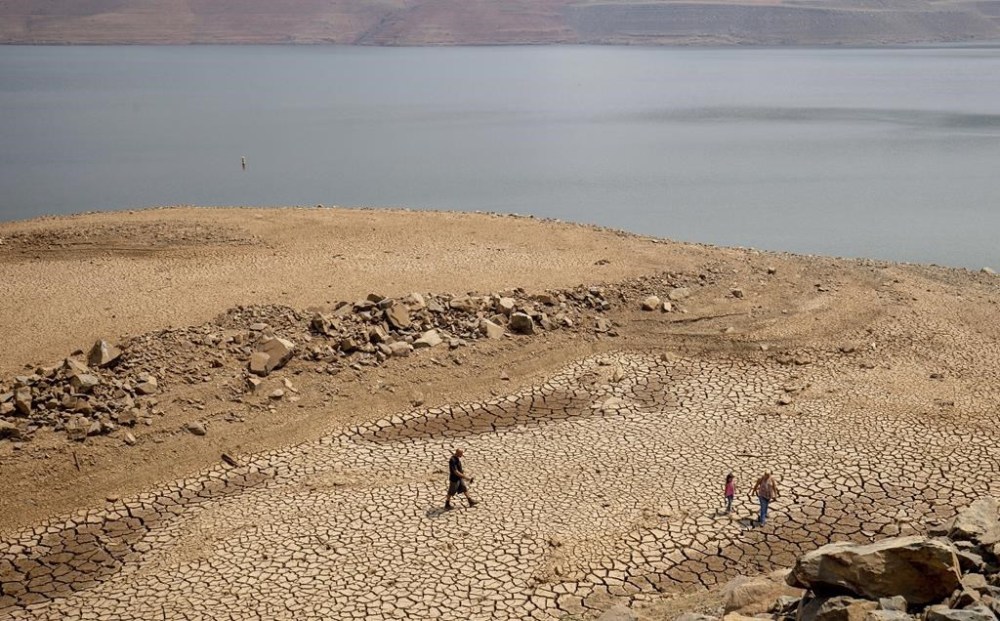
FILE - A family walks over cracked mud near Lake Oroville's shore as water levels remain low due to continuing drought conditions Sunday, Aug. 22, 2021, in Oroville, Calif. California Gov. Gavin Newsom announced, Friday, March 24, 2023, an end to some drought restrictions and calls for water conservation, following a series of winter storms have dramatically improved the state's water supply outlook. (AP Photo/Ethan Swope, File)

Last week the district ended mandatory drought restrictions for about 7 million people who rely almost exclusively on state supplies for their water.

California and the western United States have been in an extended drought for about two decades, a period of abnormal dryness punctuated by occasional intense seasons of storms. It would be tough for a governor “of a large, diverse state that has very diverse water supplies and water demands” to say when a drought has started or ended, said Jay Lund, vice director for the Center for Watershed Sciences at the University of California, Davis.

Lund said the drought is over from many perspectives in California, including urban water supply and reservoirs. But it’s not over for the state’s fragile ecosystems and the groundwater aquifers that were depleted during recent drought years.

“We might never recover them completely,” he said.

Three years of little rain or snow in California had depleted reservoirs to the point the state couldn’t generate electricity from hydroelectric power plants. It dried up wells in rural areas and state officials had to truck in water supplies for some communities. And it reduced the flow of the state’s major rivers and streams, killing off endangered fish and other species.

But since December, no less than 12 powerful storms have hit California, packing so much rain and snow that meteorologists call them “atmospheric rivers.” These storms have flooded homes, closed ski resorts and trapped people in mountain communities for days with no electricity, prompting emergency declarations from President Joe Biden.
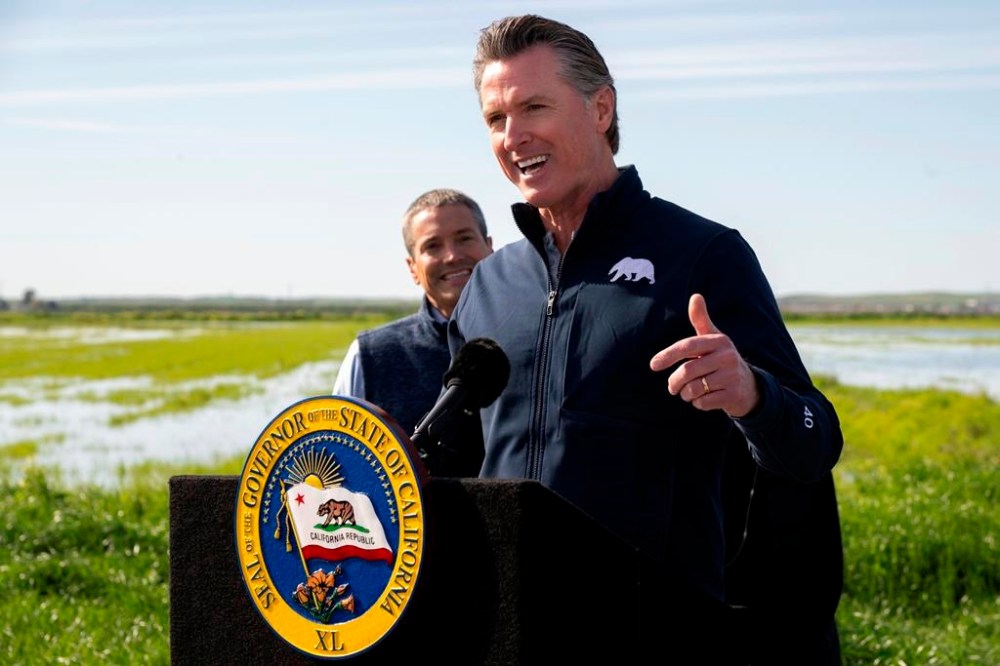
California Gov. Gavin Newsom talks during a news conference from a farm in Dunnigan, Calif., Friday, March 24, 2023. Newsom announced an end to some drought restrictions and calls for water conservation, following a series of winter storms have dramatically improved the state's water supply outlook. (Paul Kitagaki Jr./The Sacramento Bee via AP)

“That kind of whiplash is something that we’ve experienced in a very intense way in California that I think is unique across the western U.S.,” said Karla Nemeth, director of the California Department of Water Resources.

Water has been steadily pouring into the state’s reservoirs since December. Of California’s 17 major reservoirs, 12 of them are either at or above their historical averages for this time of year.

And more water is coming. Statewide, the amount of snow piled up in the mountains is already 223% above the April 1 average — the date when the snowpack is typically at its peak. Most of that snow will melt in the coming months, flowing into reservoirs and posing more flooding threats downstream.


Report Error Submit a Tip

More Stories

Serious crash at West Kildonan intersection known for collisions

Nicole Buffie 3 minute read Preview

Serious crash at West Kildonan intersection known for collisions

Nicole Buffie 3 minute read Updated: Yesterday at 6:09 PM CDT

Residents in West Kildonan say an intersection that was the site of a serious car crash Sunday morning is notoriously dangerous.

Rob Lick heard a loud bang around 7 a.m. and rushed out of his home on Leila to see what the commotion was. He saw two crushed SUVs, a white and black one, in the intersection. Police vehicles arrived shortly after.

“It sounded like when (garbage trucks) drop a big dumpster,” he said. “I heard somebody crying or wailing, they were standing by the vehicle so I don’t know who exactly it was or if someone was injured.”

The sound of sirens followed shortly after when emergency crews came to the scene. The intersection was immediately blocked off.

Read
Updated: Yesterday at 6:09 PM CDT

Cabernet Sauvignon star of wine festival

Ben Sigurdson 5 minute read Preview

Cabernet Sauvignon star of wine festival

Ben Sigurdson 5 minute read Saturday, Sep. 19, 2026

The Winnipeg Wine Festival will celebrate the king of red wine grapes next weekend — the theme of this year’s festival, which takes place Sept. 25 and 26 at the RBC Convention Centre, is Cabernet Sauvignon.

Cab Sauv, as it’s also known, is the world’s most widely planted wine grape of any colour, first coming to prominence in the 1800s in France’s Bordeaux region, where the grape is still popular. Rather than single-variety wines, Bordeaux reds tend to be blends, with those coming from the left bank of the Gironde estuary being Cabernet-dominant, while right-bank wines are Merlot-dominant, with Cabernet Sauvignon playing a supporting role. Cabernet and Merlot work well together and many other countries have followed suit in blending the two.

A team at University of California Davis put Cabernet Sauvignon through a DNA test in 1996 and discovered its parent grapes are Cabernet Franc and Sauvignon Blanc — it’s likely that at some point the two varieties, planted next to each other in some vineyard, crossed and mutated and became the grape we know today. (Someone growing grapes in the 19th century must have had an inkling of what was up, as the grape has been called Cabernet Sauvignon since long before the DNA test.)

Flavour-wise, most Cabernet Sauvignon wines are big and bold, with a core of deep dark berry flavours, some graphite and spice notes and relatively bright acidity. It’s a grape that is well-suited to barrel aging, with most examples seeing at least some time in wood.

Read
Saturday, Sep. 19, 2026

Puzzles Palace

1 minute read Monday, Jul. 27, 2026

To solve our puzzles, please subscribe with this special offer: |

National Black Canadians Summit celebrates culture, combats racism

Gabrielle Piché 4 minute read Preview

National Black Canadians Summit celebrates culture, combats racism

Gabrielle Piché 4 minute read Saturday, Sep. 19, 2026

Despite the event’s name — the National Black Canadians Summit — Bruce Miller felt he should attend.

He booked a ticket. And so, this weekend, the Indigenous Manitoban joined roughly 1,500 people flocking to the RBC Convention Centre.

It’s a full schedule — addresses from a former Canadian governor general, sessions on Black mental health and anti-Black racism.

The annual event draws politicians, artists and other professionals from across the country.

Read
Saturday, Sep. 19, 2026

Transportation Safety Board investigating after two pilots found dead near Regina

The Canadian Press 1 minute read Preview

Transportation Safety Board investigating after two pilots found dead near Regina

The Canadian Press 1 minute read Updated: Yesterday at 4:41 PM CDT

REGINA - A Manitoba-based flying school and air taxi provider says two of its pilots were found dead near Regina on Friday.

Adam Penner, president of Harv's Air, says in a statement that two people were aboard the Cessna 172 on a night flight from Regina to Steinbach, Man.

Penner says a search began after the aircraft did not arrive on schedule, and the plane was found along with its two occupants on Friday evening near Kisbey, southeast of Regina.

Harv's Air says it is shocked and saddened by the tragedy, and it is working with the Transportation Safety Board of Canada in determining the cause of the deaths.

Read
Updated: Yesterday at 4:41 PM CDT

American Hostage stars recall warmth of Winnipeggers during brutal winter

Randall King 7 minute read Preview

American Hostage stars recall warmth of Winnipeggers during brutal winter

Randall King 7 minute read Friday, Sep. 18, 2026

TORONTO — When you stream the eight-part series American Hostage, a sense of familiarity may strike.

That’s because the show was shot in Winnipeg — especially in the Exchange District — from November of last year to the beginning of February, with Winnipeg portraying Indianapolis circa 1977.

The whole world seemed to be watching that midwest American city that year as a hostage crisis unfolded involving one Tony Kiritsis, an angry man who goes ballistic when a mortgage brokerage was poised to foreclose on property he had dreamed of developing into a shopping centre.

Kiritsis kidnapped his mortgage broker, Richard Hall, wiring a shotgun to the back of his head, and demanded a public airing of his grievances, with the reluctant help of popular radio broadcaster Fred Heckman.

Read
Friday, Sep. 18, 2026