The cyber gulag: How Russia tracks, censors and controls its citizens
Advertisement
Read this article for free:
or
Already have an account? Log in here »
To continue reading, please subscribe:

Digital Subscription
One year of digital access for only $205*
- Enjoy unlimited reading on winnipegfreepress.com
- Read the E-Edition, our digital replica newspaper
- Access News Break, our award-winning app
- Play interactive puzzles
*First annual payment billed as $205.00 + GST for one year. This annual subscription will automatically renew at $233.00 + GST every 52 weeks (10% off the regular annual price of $259.35). Offer available to new and qualified returning subscribers only. Cancel any time.
To continue reading, please subscribe:
Add Free Press access to your Brandon Sun subscription for only an additional
$1 for the first 4 weeks*
- Enjoy unlimited reading on winnipegfreepress.com
- Read the E-Edition, our digital replica newspaper
- Access News Break, our award-winning app
- Play interactive puzzles
*Your next Brandon Sun subscription payment will increase by $1.00 and you will be charged $17.95 plus GST for four weeks. After four weeks, your payment will increase to $24.95 plus GST every four weeks.
Read unlimited articles for free today:
or
Already have an account? Log in here »
Hey there, time traveller!
This article was published 23/05/2023 (1225 days ago), so information in it may no longer be current.
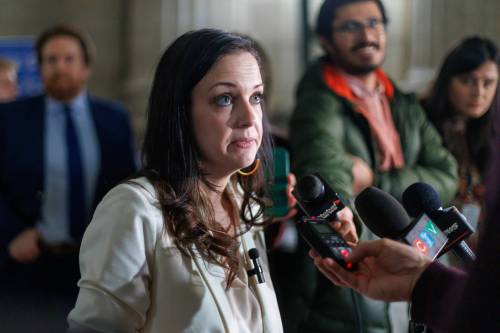
TALLINN, Estonia (AP) — When Yekaterina Maksimova can’t afford to be late, the journalist and activist avoids taking the Moscow subway, even though it’s probably the most efficient route.
That’s because she’s been detained five times in the past year, thanks to the system’s pervasive security cameras with facial recognition. She says police would tell her the cameras “reacted” to her — although they often seemed not to understand why, and would let her go after a few hours.
“It seems like I’m in some kind of a database,” says Maksimova, who was previously arrested twice: in 2019 after taking part in a demonstration in Moscow and in 2020 over her environmental activism.

For many Russians like her, it has become increasingly hard to evade the scrutiny of the authorities, with the government actively monitoring social media accounts and using surveillance cameras against activists.
Even an online platform once praised by users for easily navigating bureaucratic tasks is being used as a tool of control: Authorities plan to use it to serve military summonses, thus thwarting a popular tactic by draft evaders of avoiding being handed the military recruitment paperwork in person.
Rights advocates say that Russia under President Vladimir Putin has harnessed digital technology to track, censor and control the population, building what some call a “cyber gulag” — a dark reference to the labor camps that held political prisoners in Soviet times.
It’s new territory, even for a nation with a long history of spying on its citizens.
“The Kremlin has indeed become the beneficiary of digitalization and is using all opportunities for state propaganda, for surveilling people, for de-anonymizing internet users,” said Sarkis Darbinyan, head of legal practice at Roskomsvoboda, a Russian internet freedom group the Kremlin deems a “foreign agent.”
RISING ONLINE CENSORSHIP AND PROSECUTIONS
The Kremlin’s seeming indifference about digital monitoring appeared to change after 2011-12 mass protests were coordinated online, prompting authorities to tighten internet controls.
Some regulations allowed them to block websites; others mandated that cellphone operators and internet providers store call records and messages, sharing the information with security services if needed. Authorities pressured companies like Google, Apple and Facebook to store user data on Russian servers, to no avail, and announced plans to build a “sovereign internet” that could be cut off from the rest of the world.
Many experts initially dismissed these efforts as futile, and some still seem ineffective. Russia’s measures might amount to a picket fence compared to China’s Great Firewall, but the Kremlin online crackdown has gained momentum.
After Russia invaded Ukraine in February 2022, online censorship and prosecutions for social media posts and comments spiked so much that it broke all existing records.
According to Net Freedoms, a prominent internet rights group, more than 610,000 web pages were blocked or removed by authorities in 2022 -– the highest annual total in 15 years — and 779 people faced criminal charges over online comments and posts, also a record.
A major factor was a law, adopted a week after the invasion, that effectively criminalizes antiwar sentiment, said Net Freedoms head Damir Gainutdinov. It outlaws “spreading false information” about or “discrediting” the army.
Human Rights Watch cited another 2022 law allowing authorities “to extrajudicially close mass media outlets and block online content for disseminating ‘false information’ about the conduct of Russian Armed Forces or other state bodies abroad or for disseminating calls for sanctions on Russia.”
SOCIAL MEDIA USERS ‘SHOULDN’T FEEL SAFE’
Harsher anti-extremism laws adopted in 2014 targeted social media users and online speech, leading to hundreds of criminal cases over posts, likes and shares. Most involved users of the popular Russian social media platform VKontakte, which reportedly cooperates with authorities.
As the crackdown widened, authorities also targeted Facebook, Twitter, Instagram and Telegram. About a week after the invasion, Facebook, Instagram and Twitter were blocked in Russia, but users of the platforms were still prosecuted.
Marina Novikova, 65, was convicted this month in the Siberian city of Seversk of “spreading false information” about the army for antiwar Telegram posts, fining her the equivalent of over $12,400. A Moscow court last week sentenced opposition activist Mikhail Kriger to seven years in prison for Facebook comments in which he expressed a desire “to hang” Putin. Famous blogger Nika Belotserkovskaya, who lives in France, received a nine-year prison term in absentia for Instagram posts about the war that the authorities claimed spread “fakes” about the army.
“Users of any social media platform shouldn’t feel safe,” Gainutdinov said.
Rights advocates worry that online censorship is about to expand drastically via artificial intelligence systems to monitor social media and websites for content deemed illicit.
In February, the government’s media regulator Roskomnadzor said it was launching Oculus — an AI system that looks for banned content in online photos and videos, and can analyze more than 200,000 images a day, compared with about 200 a day by humans. Two other AI systems in the works will search text materials.
In February, the newspaper Vedomosti quoted an unidentified Roskomnadzor official as lamenting the “unprecedented amounts and speed of spreading of fakes” about the war. The official also cited extremist remarks, calls for protests and “LGBT propaganda” to be among banned content the new systems will identify.
Activists say it’s hard to know if the new systems are operating and their effectiveness. Darbinyan, of the internet freedom group, describes it as “horrible stuff,” leading to “more censorship,” amid a total lack of transparency as to how the systems would work and be regulated.
Authorities could also be working on a system of bots that collect information from social media pages, messenger apps and closed online communities, according to the Belarusian hacktivist group Cyberpartisans, which obtained documents of a subsidiary of Roskomnadzor.
Cyberpartisans coordinator Yuliana Shametavets told AP the bots are expected to infiltrate Russian-language social media groups for surveillance and propaganda.
“Now it’s common to laugh at the Russians, to say that they have old weapons and don’t know how to fight, but the Kremlin is great at disinformation campaigns and there are high-class IT experts who create extremely effective and very dangerous products,” she said.
Government regulator Roskomnadzor did not respond to a request for comment.
EYES ON — AND UNDER — THE STREETS
In 2017-18, Moscow authorities rolled out street cameras enabled by facial recognition technology.
During the COVID-19 pandemic, authorities were able to trace and fine those violating lockdowns.
Vedomosti reported in 2020 that schools would get cameras linked to a facial recognition system dubbed “Orwell,” for the British writer of the dystopian novel “1984,” with his all-seeing character, “Big Brother.”
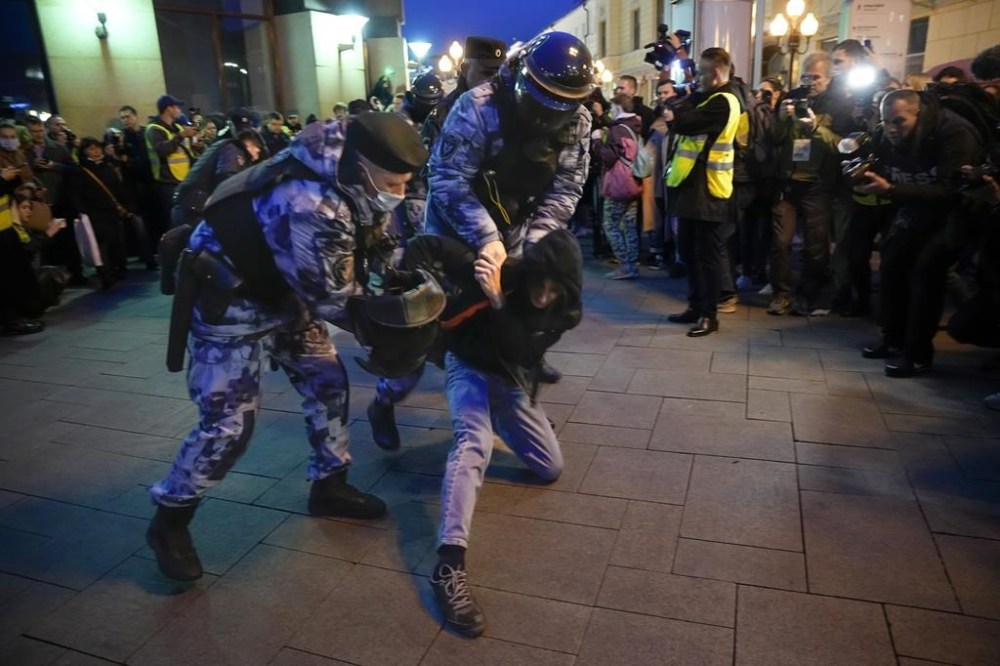
When protests over the imprisonment of opposition leader Alexei Navalny erupted in 2021, the system was used to find and detain those attending demonstrations, sometimes weeks later. After Putin announced a partial mobilization for Ukraine last year, it apparently helped officials round up draft evaders.
A man who was stopped on the Moscow subway after failing to comply with a mobilization summons said police told him the facial recognition system tracked him down, according to his wife, who spoke to AP on condition of anonymity because she feared retaliation.
In 2022, “Russian authorities expanded their control over people’s biometric data, including by collecting such data from banks, and using facial recognition technology to surveil and persecute activists,” Human Rights Watch reported this year.
Maksimova, the activist who repeatedly gets stopped on the subway, filed a lawsuit contesting the detentions, but lost. Authorities argued that because she had prior arrests, police had the right to detain her for a “cautionary conversation” — in which officers explain a citizen’s “moral and legal responsibilities.”
Maksimova says officials refused to explain why she was in their surveillance databases, calling it a state secret. She and her lawyer are appealing the court ruling.
There are 250,000 surveillance cameras in Moscow enabled by the software — at entrances to residential buildings, in public transportation and on the streets, Darbinyan said. Similar systems are in St. Petersburg and other large cities, like Novosibirsk and Kazan, he said.
He believed the authorities want to build “a web of cameras around the entire country. It sounds like a daunting task, but there are possibilities and funds there to do it.”
‘TOTAL DIGITAL SURVEILLANCE’
Russia’s efforts often draw comparisons with China, where authorities use digital surveillance on a vast scale. Chinese cities are blanketed by millions of cameras that recognize faces, body shapes and how people walk to identify them. Sensitive individuals are routinely tracked, either by cameras or via their cellphones, email and social media accounts to stifle any dissent.
The Kremlin seems to want to pursue a similar path. In November, Putin ordered the government to create an online register of those eligible for military service after efforts to mobilize 300,000 men to fight in Ukraine revealed that enlistment records were in serious disarray.
The register, promised to be ready by fall, will collect all kinds of data, “from outpatient clinics to courts to tax offices and election commissions,” political analyst Tatyana Stanovaya said in a commentary for the Carnegie Endowment for International Peace.

That will let authorities serve draft summonses electronically via a government website used to apply for official documents, like passports or deeds. Once a summons appears online, recipients cannot leave Russia. Other restrictions -– like suspension of a driver’s license or a ban on buying and selling property -– are imposed if they don’t comply with the summons within 20 days, whether they saw it or not.
Stanovaya believes these restrictions could spread to other aspects of Russian life, with the government “building a state system of total digital surveillance, coercion and punishment.” A December law mandates that taxi companies share their databases with the successor agency of the Soviet KGB, giving it access to travelers’ dates, destinations and payment.
“The cyber gulag, which was actively talked about during the pandemic, is now taking its real shape,” Stanovaya wrote.
___
Associated Press writers Yuras Karmanau in Tallinn, Estonia, and Joe McDonald and Beijing contributed.