Legacy of Canada’s ban on Chinese immigration lasted longer than the law
Advertisement
Read this article for free:
or
Already have an account? Log in here »
To continue reading, please subscribe:

Digital Subscription
One year of digital access for only $205*
- Enjoy unlimited reading on winnipegfreepress.com
- Read the E-Edition, our digital replica newspaper
- Access News Break, our award-winning app
- Play interactive puzzles
*First annual payment billed as $205.00 + GST for one year. This annual subscription will automatically renew at $233.00 + GST every 52 weeks (10% off the regular annual price of $259.35). Offer available to new and qualified returning subscribers only. Cancel any time.
To continue reading, please subscribe:
Add Free Press access to your Brandon Sun subscription for only an additional
$1 for the first 4 weeks*
- Enjoy unlimited reading on winnipegfreepress.com
- Read the E-Edition, our digital replica newspaper
- Access News Break, our award-winning app
- Play interactive puzzles
*Your next Brandon Sun subscription payment will increase by $1.00 and you will be charged $17.95 plus GST for four weeks. After four weeks, your payment will increase to $24.95 plus GST every four weeks.
Read unlimited articles for free today:
or
Already have an account? Log in here »
Hey there, time traveller!
This article was published 01/07/2023 (1194 days ago), so information in it may no longer be current.
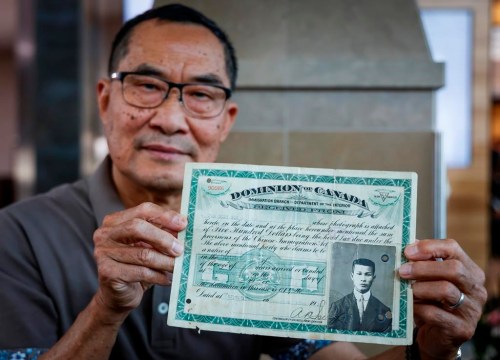
OTTAWA – When Matthew Yan looks at the stoic and determined expression on his father’s face in the black and white photo affixed to the identification papers he carried for decades, he mostly feels pity.
The photo features Bing Sun Jun in borrowed clothes: a grown man’s suit sagging on his adolescent shoulders, making him look far older than his 13 years.
The boy’s jaw is set and his eyes are focused, as if he’s trying to be the man he’s been dressed up to be.
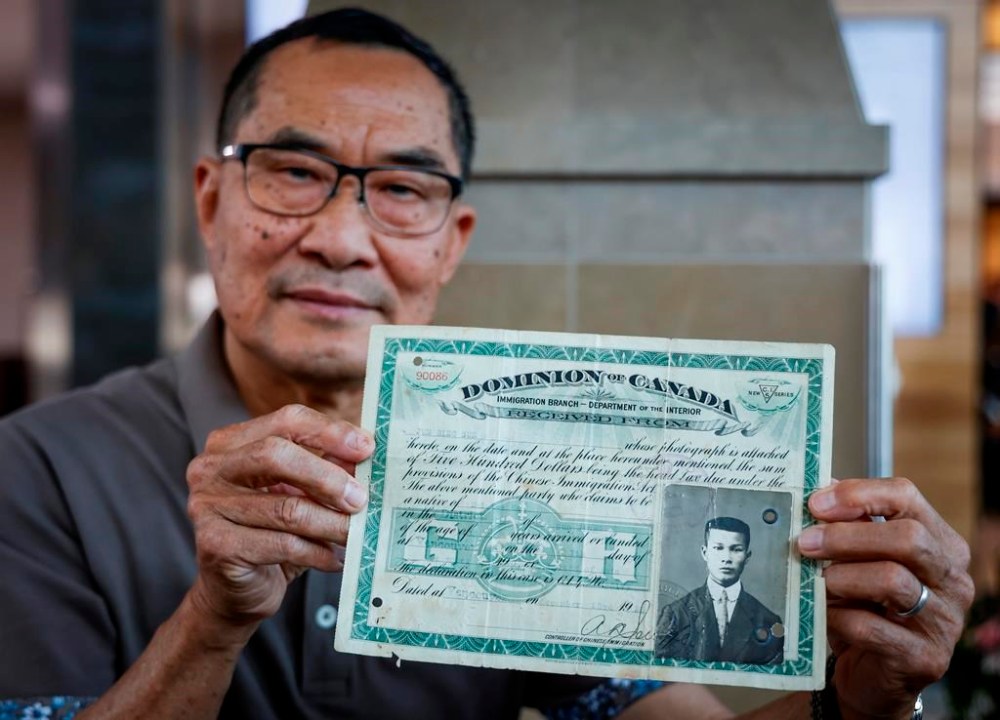
It’s the face of a person Yan scarcely got to know.
“My heart just feels sorry for him, alone all his life,” said Yan, now 74, reflecting on the photo more than a century after it was taken.
The date typed neatly on the bottom of the certificate reads Dec. 23, 1920, just three years before Chinese people would be banned from entering Canada.
This Canada Day, the country marks 100 years since the federal government introduced legislation to ban Chinese immigrants from Canada.
Thousands of Chinese workers arrived in Canada before that period, and were crucial in the construction of the western leg of the Canadian Pacific Railway. They were paid far less and given far more dangerous tasks than white workers. Hundreds died from accidents, illness, malnutrition and the cold.
When the railway was completed in 1885, they faced widespread discrimination from the government and the public.
The Chinese Immigration Act, which is sometimes known as the Chinese Exclusion Act, was the culmination of the racist anti-Chinese sentiment that followed.
It not only prevented migration, but forced those already in the country to be registered and carry identification, like the C.I. Certificate, or risk detainment or deportation.
The act was “really designed to limit the possibilities of Chinese migrants settling permanently in the country and, related to that, establishing families and therefore generations of descendants,” said historian Laura Madokoro, an associate professor of history at Carleton University.
“The impact of this is across the generations.”
As Canadians celebrate on July 1, many are also reflecting on the legacy of that law, which lives on in families, communities and policy.
A dutiful first-born son, Jun left his family at a young age, and immigrated to provide income for his family back home. He was subjected to a head tax, a fee to designed to dissuade Chinese migrants from coming to Canada.
“He told me that ‘They locked me in (a small house) over there until somebody bring $500 for the head tax, and then they let me out,'” Yan said.
“Five hundred dollars, at that time, is big, huge money.”
Jun first worked in kitchens as a dishwasher before becoming a cook. He lived in a hotel on Pender Street in Vancouver for 51 years, sending what money he made home to China to provide for the family he was separated from.
“I asked him, ‘How come you stay in the hotel for so long?'” Yan recalled during an interview from his home in Calgary. “He said, ‘Because I’m alone. I was alone.'”
The Canadian government largely believed Chinese immigrants to be bachelors, said Madokoro, but many like Jun had families in China.
His family relied on him. Over the years, he sent home enough money to build two houses for them in China.
He returned home periodically, and eventually married, but he wasn’t able to bring his wife to Canada. Because she could not write, sending letters was difficult.
Madokoro said the Canadian government displayed a sort of wilful ignorance about severing family ties through its immigration ban.
“It was going to sort of wreck any opportunity for families to be together,” she said.
Yan believes his father’s formative years were long and lonely, and that didn’t end when the legislation did.
When his first wife died, Jun married Yan’s mother in China. Their daughter was born in 1940.
He returned to China for the last time in 1948, the year after the Chinese Immigration Act was repealed. He stayed long enough to see Yan’s birth in December 1949, but by that point Communists had taken over the country.
Jun caught the last ship to Canada just two days after Yan was born.
“After that, I never ever met my dad until I came to Canada when I was 21,” Yan said wistfully. His sister never saw their father again.
It shouldn’t have taken that long — the Chinese diaspora in China had challenged the immigration ban and won. But the Communist revolution robbed many families of the ability to reunite after the Chinese Immigration Act was no longer in effect, Madokoro said.
“The combination of factors meant that the impact of this is across the generations, and for some people it’s because they got stranded in the People’s Republic of China and were unable to be reunited,” she said.
It’s impossible to know how many families were prevented from being together again — in most cases, there are no records of the spouses, children and parents who never made it to Canada.
Yan and his mother arrived in Hong Kong in 1961 when he was nearly 12, just a little younger than his father was when he first left for Canada.
Yan didn’t have a birth certificate, so he was interrogated in a Canadian immigration office to prove he was his father’s son before he was allowed to immigrate.
“To face a Canadian was so scary,” Yan recalled. He was grilled about how many houses there were in his village, which direction the window in his room faced and where they got their water.
When his answers didn’t match the ones his father gave, his immigration application was denied.
Jun and Yan lived apart another 10 years after that, and Yan never saw so much as a photo of his dad.
“The government was really mistrustful that people were who they said they were,” Madokoro said. “But of course, we know that bureaucracies aren’t perfect, and people got stuck.”
The two were finally united in 1971 after a blood test confirmed their family ties.
Yan got a first glimpse of his father at the airport. He was 68 years old, dressed up in a suit and hat.
He opened his mouth to greet his father as Dad, but he felt no bond between them. “I try, but I can’t,” Yan remembered. “I can’t call him ‘Dad.’ It was really hard.”
“I know he loved me so much. So I feel sorry. I’m sorry,” Yan said.
In the few years they spent together in Canada, Jun told his son about the discrimination he endured.
“I asked him ‘Why do you dress up in a two-piece suit and put the hat, put a tie on? You’re working in a kitchen,'” Yan said.
He remembered the answer all these years later: “I don’t want people to look down on me.”
Former prime minister Stephen Harper officially apologized in 2006 for the discriminatory laws and policies that tore families like Jun’s apart, after decades of community campaigns demanding redress.
Symbolic payments were made to surviving head-tax payers and to the spouses of those who had already died.
Still, the legacy of those policies isn’t over, Madokoro said.
Examples of anti-Asian hate, particularly anti-Chinese, flared up when the pandemic struck in 2020.
“To the best of my knowledge, there’s never been overt legislation since 1923 that says an entire group cannot stay permanently in the country,” Madokoro said. “We do, however, have different structures or different hierarchies when it comes to immigration.”
She pointed to the temporary foreign worker program as an example.
“We still have an immigration system that privileges and prioritizes certain people for permanent migration and accepts, without too much question, the idea that other people are only suitable for their temporary labour,” she said.
She said it’s important not to think of the Chinese Immigration Act as a “dark chapter” that has closed, but rather to understand the stories of Jun and Yan — and countless others — as a continuing part of Canada’s collective history.
It is still a part of the story of Yan’s family.

He said he has forgiven Canada and is thankful for the life he enjoys in Calgary, where he has two daughters of his own.
When he looks at photos of his father, he doesn’t see a man he knows well. But he does see a good man, who did what he could for a family he scarcely knew.
For that, Yan is grateful.
“That’s why I tell young people, ‘You take good care of your family,'” Yan said. “Nothing, nothing is more important than family.”
This report by The Canadian Press was first published July 1, 2023.