Lawmakers approve bill allowing French police to locate suspects by tapping their devices

Advertisement

Advertise with us

PARIS (AP) — French lawmakers on Tuesday adopted a sweeping justice reform bill that includes a provision to allow law enforcement agents to remotely tap into the cameras, microphones and location services of phones and other internet-connected devices of some suspected criminals.

Read this article for free:


or

Already have an account? Log in here »

To continue reading, please subscribe:

Subscribe and receive a limited-edition Free Press branded hat or tote.

Digital Subscription

One year of digital access for only $205*

  • Enjoy unlimited reading on winnipegfreepress.com
  • Read the E-Edition, our digital replica newspaper
  • Access News Break, our award-winning app
  • Play interactive puzzles

*First annual payment billed as $205.00 + GST for one year. This annual subscription will automatically renew at $233.00 + GST every 52 weeks (10% off the regular annual price of $259.35). Offer available to new and qualified returning subscribers only. Cancel any time.

To continue reading, please subscribe:

Add Free Press access to your Brandon Sun subscription for only an additional

$1 for the first 4 weeks*

  • Enjoy unlimited reading on winnipegfreepress.com
  • Read the E-Edition, our digital replica newspaper
  • Access News Break, our award-winning app
  • Play interactive puzzles
Start now

*Your next Brandon Sun subscription payment will increase by $1.00 and you will be charged $17.95 plus GST for four weeks. After four weeks, your payment will increase to $24.95 plus GST every four weeks.

Hey there, time traveller!
This article was published 18/07/2023 (1175 days ago), so information in it may no longer be current.

PARIS (AP) — French lawmakers on Tuesday adopted a sweeping justice reform bill that includes a provision to allow law enforcement agents to remotely tap into the cameras, microphones and location services of phones and other internet-connected devices of some suspected criminals.

The measure plainly stipulates that the procedure can be executed “without the knowledge or consent of its owner or possessor” but is limited to suspects involved in terrorism, organized crime and other illegal activities punishable by five or more years in prison.

The language authorizing eavesdropping was contained in a broader reform bill aimed at “modernizing” penal procedures. Reflecting what polls indicate is a public demand for more law and order, the National Assembly, the lower house of the French Parliament, adopted two ambitious bills Tuesday that are aimed at bolstering the country’s creaky judicial system.
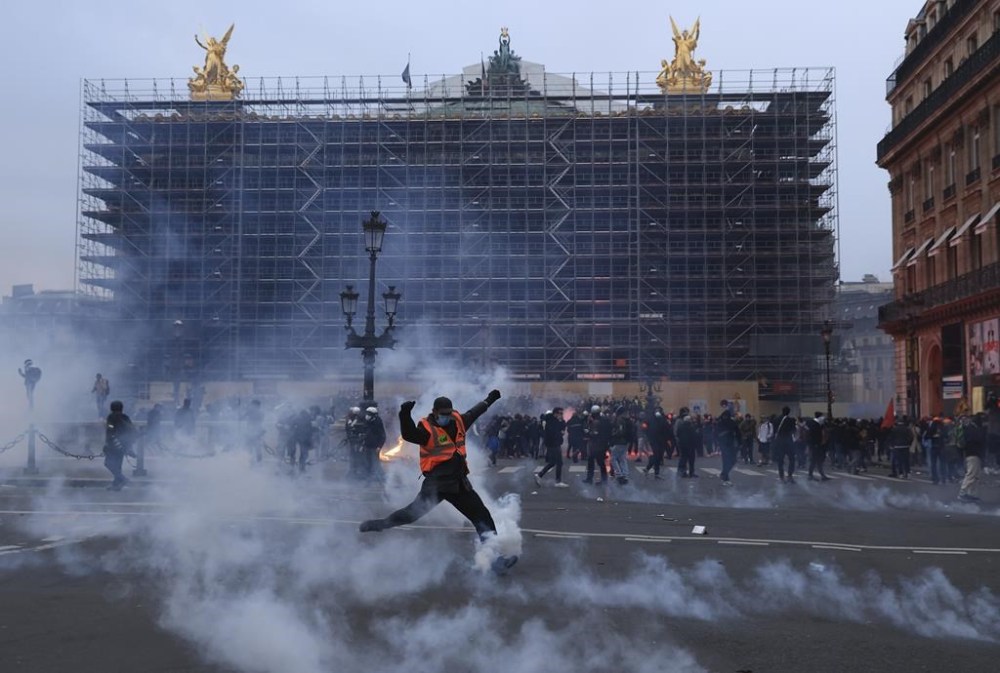
FILE - A protester kicks a tear gas canister in front of the Opera at the end of a rally against the pension reform in Paris, France, Thursday, March 23, 2023. French legislators are preparing to vote on a sweeping justice reform bill that would allow law enforcement agents to remotely tap into the camera, microphone, and location details from a suspect's phone and other connected devices. (AP Photo/Aurelien Morissard, File)

The Senate, controlled by the right, adopted both bills in May.

“The goal of this law is clear: a faster, clearer, modern justice,” French Justice Minister Eric Dupond-Moretti said when he presented the reform legislation in the spring.

The package includes a budget increase that would boost spending on the judicial system by nearly 11 billion euros by 2027. Before taking going into law, the bills must go to special commission to iron out any differences between the two chambers of Parliament.

Still, President Emmanuel Macron stands to gain from their passage amid a crisis that has gnawed at the fabric of French society.

The National Assembly passed the bill presented as the justice minister’s “action plan” on a 388-111 vote, with 45 abstentions. Lawmakers on the left and digital rights activists criticized the eavesdropping provision as an invasion of privacy.

“This arrangement is scary,” Socialist lawmaker Cecile Untermaier said ahead of the vote, describing the type of surveillance authorized as “liberticide.” Some Socialists planned to abstain for that reason.

The measure divided lawmakers on the right and left down the middle of the aisle.

“If we truly want to fight against organized crime, we need the means to do so and to give investigators the same means used by criminal groups,” Pascale Bordes, a lawmaker from the far-right National Rally party, said.

The justice minister proposed the high-tech hunt for suspects as an alternative to long-standing police surveillance practices, such as wiretapping a suspect’s vehicle and house, which he deemed no longer viable and increasingly dangerous for investigators.

“The technique today is faulty,” Dupond-Moretti told National Assembly lawmakers this month. “Why would we deprive ourselves of new technologies?” When some parliamentarians expressed concerns over privacy rights, the minister replied, “By crying wolf, you are no longer credible.”

Besides limiting use of high-tech spying on suspects to crimes punishable by at least five years in prison, the legislation contains other controls. The goal of tapping a connected device must be locating someone in real time, and the investigating judge in a case must give the green light. In addition to activating location services, the measure would also allow investigators to activate a suspect’s phone camera and microphone.

Critics claim the provision still would inevitably lead to abuses of power by French police, who in the past have faced allegations of misusing their authority, brutality and racism.
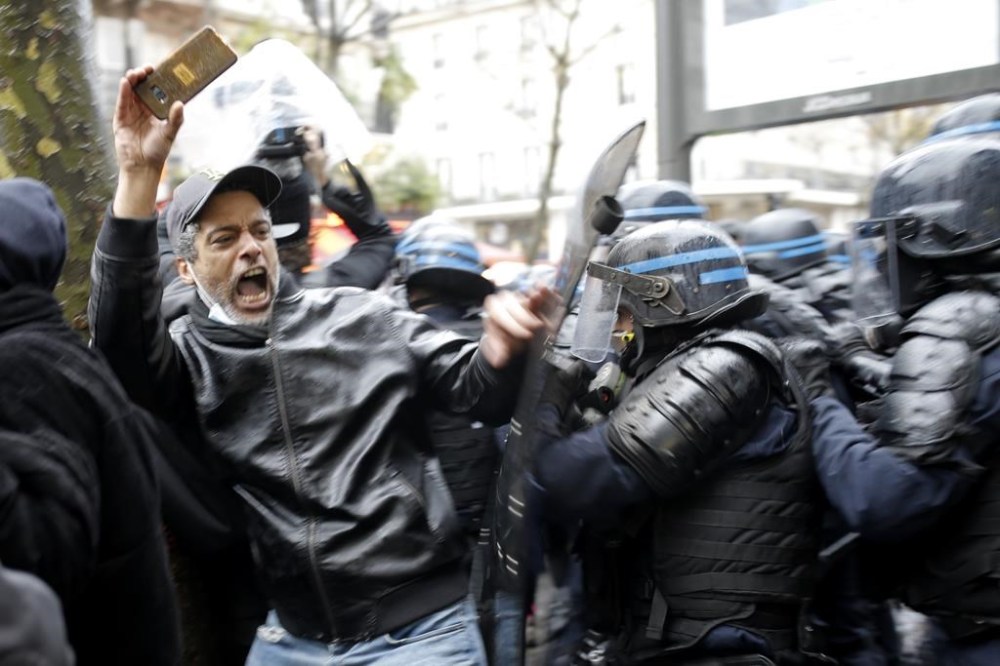
FILE - Riot police officers charge a man holding his phone during a protest rally in Paris, France, Saturday, Dec.12, 2020. French legislators are preparing to vote on a sweeping justice reform bill that would allow law enforcement agents to remotely tap into the camera, microphone, and location details from a suspect's phone and other connected devices. (AP Photo/Lewis Joly, File)

“We already see that there’s a lot of abuse in France today,” said Bastien Le Querrec, a lawyer with French digital rights group La Quadrature du Net. “In reality, who decides on the seriousness of an event in an investigation? It’s the police, the prosecutors, the investigating judge. Nothing in this bill will prevent abuse.”

In April, French lawmakers passed a law to allow the use of artificial intelligence and drones in mass video surveillance during the 2024 Summer Olympics and Paralympics in Paris.

Terrorist attacks in France over the past decade and recent riots triggered by the police killing of 17-year-old Nahel Merzouk in a Paris suburb last month have made security a government focus as the country prepares to host athletes and visitors from around the world next year.

Violence also erupted this year during numerous demonstrations protesting Macron’s decision to raise the French retirement age from 62 to 64. But rights advocates fear the government is capitalizing on safety concerns that many people see as reasonable to pursue draconian measures.

“The use of surveillance technologies cannot be the systematic response to security issues,” Katia Roux, an advocacy officer at Amnesty International France, said in an interview. “The impact on human rights of these technologies must be taken into account before any normalization of their use. Under the guise of legitimate objectives that are linked to security, these technologies also promote violations of human rights, the rights to privacy and freedom of expression.”

Police surveillance via a suspect’s phone and other connected devices could last for up to six months at a time, according to the bill. Certain professionals, including journalists, lawyers, and members of the parliament, would be exempt.

“Sadly, yet again, France is a leader in a security strategy where we approach security by surveilling everybody,” ” lawyer Le Querrec said. “It raises questions on the state of democracy and the state of French institutions.”

___

Elaine Ganley in Paris contributed.

Report Error Submit a Tip

More Stories

Lemonade stand brings in hundreds for West Broadway Youth Outreach

AV Kitching 9 minute read Preview

Lemonade stand brings in hundreds for West Broadway Youth Outreach

AV Kitching 9 minute read 6:00 AM CDT

Like most 12-year-olds, there’s nothing Ruby Barkley enjoys more than a tall glass of lemonade. So when she decided to set up a lemonade stand, Ruby’s Sips + Sweets, in her neighbourhood last month, her mom was only too happy to say yes.

Especially since Ruby had decided she was going to donate proceeds of the sales to West Broadway Youth Outreach (WBYO), a non-profit organization providing recreational and life-skills programming for children aged four and up.

Ruby had set up lemonade stands in the past and was accustomed to serving up glasses from a pitchers of drink she’d already pre-made, but this time round she chose to do something different.

“We got a muddler press and I hand-pressed the lemons and then added flavours. It’s a whole process. It’s hand squeezed right before your eyes and anybody can watch it. I loved doing it,” she says.

Read
6:00 AM CDT

Letters, Oct. 5

7 minute read 2:01 AM CDT

Fighting the good fight

Re: Transit, roads and city council’s priorities (Oct. 2)

Many thanks to Erna Buffie for once again speaking up for transit.

When will Winnipeg finally make the shift from a car-dependent culture to a greener and more efficient way?

Province looks to seize notorious drug den

Erik Pindera 5 minute read Preview

Province looks to seize notorious drug den

Erik Pindera 5 minute read Saturday, Oct. 3, 2026

Provincial justice officials are trying to seize a Dominion Street drug den that has been the source of trouble in the West End for years.

The owner of 982 Dominion St., 45-year-old Robert Edward Johnson, was most recently arrested in June along with several others after a lengthy Winnipeg Police investigation into thefts and illicit drug sales connected to the house.

“The residence has a reputation within the neighbourhood as being a location where individuals habitually attend for the purpose of purchasing and/or consuming controlled substances,” reads a statement of claim filed by the province’s director of civil forfeiture in the Court of King’s Bench last week.

“For several years, the residence has been associated with criminal activity, violence, and disorder, resulting in numerous police attendances and complaints from members of the surrounding community.”

Read
Saturday, Oct. 3, 2026

Winnipeggers witness unveiling of Japanese Canadian monument in B.C.

Morgan Modjeski 6 minute read Preview

Winnipeggers witness unveiling of Japanese Canadian monument in B.C.

Morgan Modjeski 6 minute read Saturday, Oct. 3, 2026

As Miki Stewart gathered with her family at the Japanese Cultural Association of Manitoba on Saturday afternoon, she was thinking of her parents, Yoshimaru and Yoshi Abe.

Both Stewart, 80, and her sister Yumi Falk, 81, alongside an older brother, were born in the Tashme internment camp in British Columbia. They were among more than 2,600 Japanese Canadians who were forcefully removed and interned at the camp following the bombing of Pearl Harbour and Canada’s declaration of war on Japan in 1941.

“They didn’t talk much about how they suffered,” Stewart said of her parents. “But they did.”

She was amongst a group of more than 150 people who gathered at the association’s McPhillips headquarters on Saturday afternoon to watch the unveiling of the Japanese Canadian Monument in Victoria B.C.

Read
Saturday, Oct. 3, 2026

Fentanyl, crack seized in traffic stop

1 minute read Yesterday at 12:13 PM CDT

Winnipeg police seized fentanyl and arrested three people after pulling over a vehicle with a smashed windshield in the city's north end Friday.

The incident happened at about 8:30 a.m. Oct. 2 on Powers Street near Flora Avenue. While they were speaking with the vehicle's occupants, police officers saw a weapon "in plain view," the Winnipeg Police Service stated in a news release Sunday.

Officers searched the vehicle, finding a machete, plastic brass knuckles with a functioning Taser, 73 grams of fentanyl worth about $3,725 nine grams of cocaine worth about $720, 13 grams of crack cocaine worth about $1,000, prescription pills, cell phones, scales and packaging materials, and $790 in cash.

Anthony Courchene, 41, is charged with seven weapons, drug trafficking and proceeds of crime-related offences. He was also arrested on two Powerview RCMP warrants related to assault and release order compliance charges.

Today’s horoscope

Georgia Nicols 4 minute read Preview

Today’s horoscope

Georgia Nicols 4 minute read Yesterday at 2:00 AM CDT

MOON ALERT: Caution! Avoid shopping (except food and gas) and important decisions until after 6:30 p.m. today. After that, the moon moves from Cancer into Leo.

ARIES (March 21-April 19)

Don’t expect much co-operation from partners, spouses and close friends. This is why you might feel cut off from others or a bit lonely. There’s the sense a gulf exists between you and everyone else. But this is temporary. Courage!

TAURUS (April 20-May 20)

Read
Yesterday at 2:00 AM CDT