Artificial intelligence is gaining state lawmakers’ attention, and they have a lot of questions
Advertisement
Read this article for free:
or
Already have an account? Log in here »
To continue reading, please subscribe:

Digital Subscription
One year of digital access for only $205*
- Enjoy unlimited reading on winnipegfreepress.com
- Read the E-Edition, our digital replica newspaper
- Access News Break, our award-winning app
- Play interactive puzzles
*First annual payment billed as $205.00 + GST for one year. This annual subscription will automatically renew at $233.00 + GST every 52 weeks (10% off the regular annual price of $259.35). Offer available to new and qualified returning subscribers only. Cancel any time.
To continue reading, please subscribe:
Add Free Press access to your Brandon Sun subscription for only an additional
$1 for the first 4 weeks*
- Enjoy unlimited reading on winnipegfreepress.com
- Read the E-Edition, our digital replica newspaper
- Access News Break, our award-winning app
- Play interactive puzzles
*Your next Brandon Sun subscription payment will increase by $1.00 and you will be charged $17.95 plus GST for four weeks. After four weeks, your payment will increase to $24.95 plus GST every four weeks.
Read unlimited articles for free today:
or
Already have an account? Log in here »
Hey there, time traveller!
This article was published 04/08/2023 (1140 days ago), so information in it may no longer be current.
HARTFORD, Conn. (AP) — As state lawmakers rush to get a handle on fast-evolving artificial intelligence technology, they’re often focusing first on their own state governments before imposing restrictions on the private sector.
Legislators are seeking ways to protect constituents from discrimination and other harms while not hindering cutting-edge advancements in medicine, science, business, education and more.
“We’re starting with the government. We’re trying to set a good example,” Connecticut state Sen. James Maroney said during a floor debate in May.
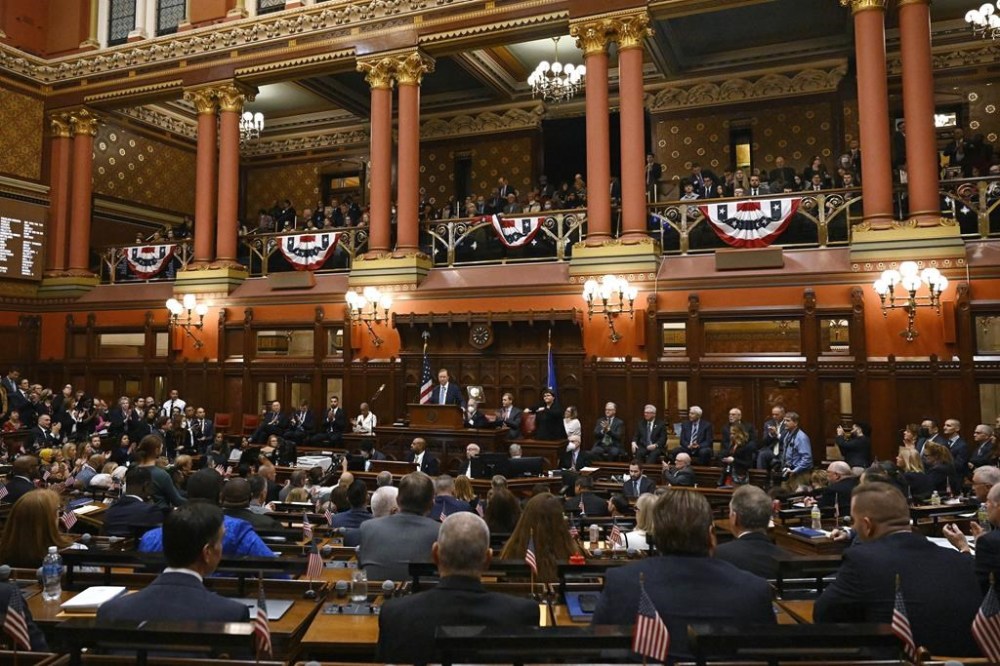
Connecticut plans to inventory all of its government systems using artificial intelligence by the end of 2023, posting the information online. And starting next year, state officials must regularly review these systems to ensure they won’t lead to unlawful discrimination.
Maroney, a Democrat who has become a go-to AI authority in the General Assembly, said Connecticut lawmakers will likely focus on private industry next year. He plans to work this fall on model AI legislation with lawmakers in Colorado, New York, Virginia, Minnesota and elsewhere that includes “broad guardrails” and focuses on matters like product liability and requiring impact assessments of AI systems.
“It’s rapidly changing and there’s a rapid adoption of people using it. So we need to get ahead of this,” he said in a later interview. “We’re actually already behind it, but we can’t really wait too much longer to put in some form of accountability.”
Overall, at least 25 states, Puerto Rico and the District of Columbia introduced artificial intelligence bills this year. As of late July, 14 states and Puerto Rico had adopted resolutions or enacted legislation, according to the National Conference of State Legislatures. The list doesn’t include bills focused on specific AI technologies, such as facial recognition or autonomous cars, something NCSL is tracking separately.
Legislatures in Texas, North Dakota, West Virginia and Puerto Rico have created advisory bodies to study and monitor AI systems their respective state agencies are using, while Louisiana formed a new technology and cyber security committee to study AI’s impact on state operations, procurement and policy. Other states took a similar approach last year.
Lawmakers want to know “Who’s using it? How are you using it? Just gathering that data to figure out what’s out there, who’s doing what,” said Heather Morton, a legislative analysist at NCSL who tracks artificial intelligence, cybersecurity, privacy and internet issues in state legislatures. “That is something that the states are trying to figure out within their own state borders.”
Connecticut’s new law, which requires AI systems used by state agencies to be regularly scrutinized for possible unlawful discrimination, comes after an investigation by the Media Freedom and Information Access Clinic at Yale Law School determined AI is already being used to assign students to magnet schools, set bail and distribute welfare benefits, among other tasks. However, details of the algorithms are mostly unknown to the public.
AI technology, the group said, “has spread throughout Connecticut’s government rapidly and largely unchecked, a development that’s not unique to this state.”
Richard Eppink, legal director of the American Civil Liberties Union of Idaho, testified before Congress in May about discovering, through a lawsuit, the “secret computerized algorithms” Idaho was using to assess people with developmental disabilities for federally funded health care services. The automated system, he said in written testimony, included corrupt data that relied on inputs the state hadn’t validated.
AI can be shorthand for many different technologies, ranging from algorithms recommending what to watch next on Netflix to generative AI systems such as ChatGPT that can aid in writing or create new images or other media. The surge of commercial investment in generative AI tools has generated public fascination and concerns about their ability to trick people and spread disinformation, among other dangers.
Some states haven’t attempted to tackle the issue yet. In Hawaii, state Sen. Chris Lee, a Democrat, said lawmakers didn’t pass any legislation this year governing AI “simply because I think at the time, we didn’t know what to do.”
Instead, the Hawaii House and Senate passed a resolution Lee proposed that urges Congress to adopt safety guidelines for the use of artificial intelligence and limit its application in the use of force by police and the military.
Lee, vice-chair of the Senate Labor and Technology Committee, said he hopes to introduce a bill in next year’s session that is similar to Connecticut’s new law. Lee also wants to create a permanent working group or department to address AI matters with the right expertise, something he admits is difficult to find.
“There aren’t a lot of people right now working within state governments or traditional institutions that have this kind of experience,” he said.
The European Union is leading the world in building guardrails around AI. There has been discussion of bipartisan AI legislation in Congress, which Senate Majority Leader Chuck Schumer said in June would maximize the technology’s benefits and mitigate significant risks.
Yet the New York senator did not commit to specific details. In July, President Joe Biden announced his administration had secured voluntary commitments from seven U.S. companies meant to ensure their AI products are safe before releasing them.
Maroney said ideally the federal government would lead the way in AI regulation. But he said the federal government can’t act at the same speed as a state legislature.
“And as we’ve seen with the data privacy, it’s really had to bubble up from the states,” Maroney said.
Some state-level bills proposed this year have been narrowly tailored to address specific AI-related concerns. Proposals in Massachusetts would place limitations on mental health providers using AI and prevent “dystopian work environments” where workers don’t have control over their personal data. A proposal in New York would place restrictions on employers using AI as an “automated employment decision tool” to filter job candidates.
North Dakota passed a bill defining what a person is, making it clear the term does not include artificial intelligence. Republican Gov. Doug Burgum, a long-shot presidential contender, has said such guardrails are needed for AI but the technology should still be embraced to make state government less redundant and more responsive to citizens.
In Arizona, Democratic Gov. Katie Hobbs vetoed legislation that would prohibit voting machines from having any artificial intelligence software. In her veto letter, Hobbs said the bill “attempts to solve challenges that do not currently face our state.”

In Washington, Democratic Sen. Lisa Wellman, a former systems analyst and programmer, said state lawmakers need to prepare for a world in which machine systems become ever more prevalent in our daily lives.
She plans to roll out legislation next year that would require students to take computer science to graduate high school.
“AI and computer science are now, in my mind, a foundational part of education,” Wellman said. “And we need to understand really how to incorporate it.”
___
Associated Press Writers Audrey McAvoy in Honolulu, Ed Komenda in Seattle and Matt O’Brien in Providence, Rhode Island, contributed to this report.