Historians race to find Great Lakes shipwrecks before quagga mussels destroy the sites
Advertisement
Read this article for free:
or
Already have an account? Log in here »
To continue reading, please subscribe:

Digital Subscription
One year of digital access for only $205*
- Enjoy unlimited reading on winnipegfreepress.com
- Read the E-Edition, our digital replica newspaper
- Access News Break, our award-winning app
- Play interactive puzzles
*First annual payment billed as $205.00 + GST for one year. This annual subscription will automatically renew at $233.00 + GST every 52 weeks (10% off the regular annual price of $259.35). Offer available to new and qualified returning subscribers only. Cancel any time.
To continue reading, please subscribe:
Add Free Press access to your Brandon Sun subscription for only an additional
$1 for the first 4 weeks*
- Enjoy unlimited reading on winnipegfreepress.com
- Read the E-Edition, our digital replica newspaper
- Access News Break, our award-winning app
- Play interactive puzzles
*Your next Brandon Sun subscription payment will increase by $1.00 and you will be charged $17.95 plus GST for four weeks. After four weeks, your payment will increase to $24.95 plus GST every four weeks.
Read unlimited articles for free today:
or
Already have an account? Log in here »
Hey there, time traveller!
This article was published 22/09/2023 (1108 days ago), so information in it may no longer be current.
MADISON, Wis. (AP) — The Great Lakes’ frigid fresh water used to keep shipwrecks so well preserved that divers could see dishes in the cupboards. Downed planes that spent decades underwater were left so pristine they could practically fly again when archaeologists finally discovered them.
Now, an invasive mussel is destroying shipwrecks deep in the depths of the lakes, forcing archeologists and amateur historians into a race against time to find as many sites as they can before the region touching eight U.S. states and the Canadian province of Ontario loses any physical trace of its centuries-long maritime history.
“What you need to understand is every shipwreck is covered with quagga mussels in the lower Great Lakes,” Wisconsin state maritime archaeologist Tamara Thomsen said. “Everything. If you drain the lakes, you’ll get a bowl of quagga mussels.”
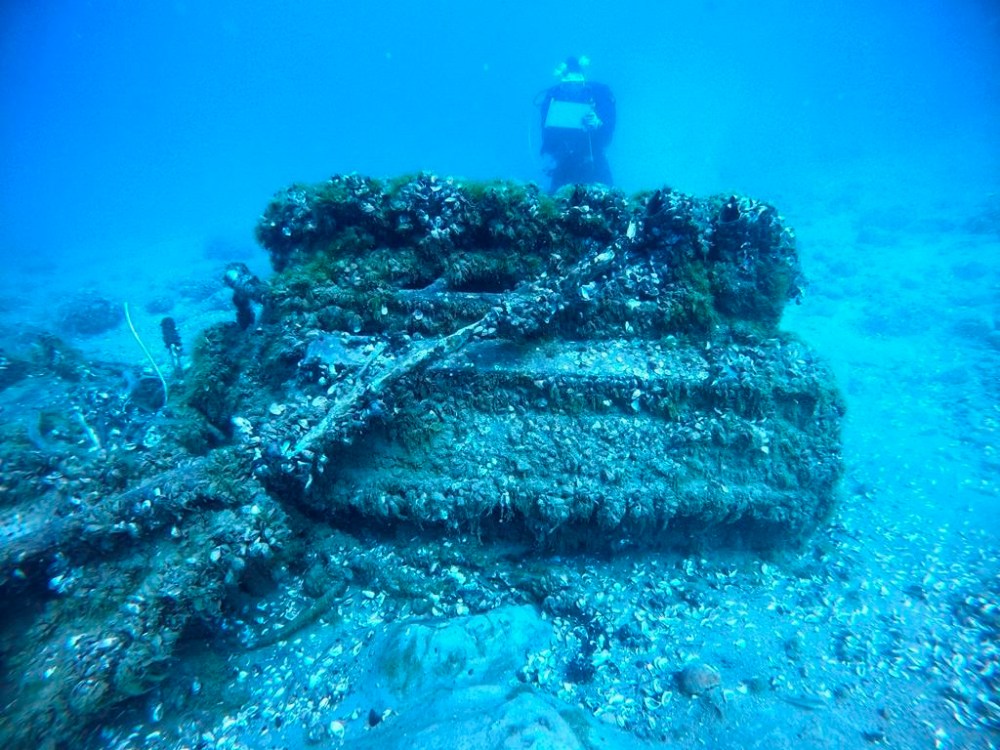
Quagga mussels, finger-sized mollusks with voracious appetites, have become the dominant invasive species in the lower Great Lakes over the past 30 years, according to biologists.
The creatures have covered virtually every shipwreck and downed plane in all of the lakes except Lake Superior, archaeologists say. The mussels burrow into wooden vessels, building upon themselves in layers so thick they will eventually crush walls and decks. They also produce acid that can corrode steel and iron ships. No one has found a viable way to stop them.
Wayne Lusardi, Michigan’s state maritime archaeologist, is pushing to raise more pieces of a World War II plane flown by a Tuskegee airman that crashed in Lake Huron in 1944.
“Divers started discovering (planes) in the 1960s and 1970s,” he said. “Some were so preserved they could fly again. (Now) when they’re removed the planes look like Swiss cheese. (Quaggas are) literally burning holes in them.”
Quagga mussels, native to Russia and Ukraine, were discovered in the Great Lakes in 1989, around the same time as their infamous cousin species, zebra mussels. Scientists believe the creatures arrived via ballast dumps from transoceanic freighters making their way to Great Lakes ports.
Unlike zebra mussels, quaggas are hungrier, hardier and more tolerant of colder temperatures. They devour plankton and other suspended nutrients, eliminating the base level of food chains. They consume so many nutrients at such high rates they can render portions of the murky Great Lakes as clear as tropical seas. And while zebra mussels prefer hard surfaces, quaggas can attach to soft surfaces at greater depths, enabling them to colonize even the lakes’ sandy bottoms.
After 30 years of colonization, quaggas have displaced zebra mussels as the dominant mussel in the Great Lakes. Zebras made up more than 98% of mussels in Lake Michigan in 2000, according to the University of California, Riverside’s Center for Invasive Species Research. Five years later, quaggas represented 97.7%.
For wooden and metal ships, the quaggas’ success has translated into overwhelming destruction.
The mussels can burrow into sunken wooden ships, stacking upon themselves until details such as name plates and carvings are completely obscured. Divers who try to brush them off inevitably peel away some wood. Quaggas also can create clouds of carbon dioxide, as well as feces that corrode iron and steel, accelerating metal shipwrecks’ decay.
Quaggas have yet to establish a foothold in Lake Superior. Biologists believe the water there contains less calcium, which quaggas need to make their shells, said Dr. Harvey Bootsma, a professor at the University of Wisconsin-Milwaukee’s School of Freshwater Sciences.
That means the remains of the Edmund Fitzgerald, a freighter that went down in that lake during a storm in 1975 and was immortalized in the Gordon Lightfoot song, “The Wreck of the Edmund Fitzgerald,” are safe, at least for now.
Lusardi, Michigan’s state maritime archaeologist, ticked off a long list of shipwreck sites in the lower Great Lakes consumed by quaggas.
His list included the Daniel J. Morrel, a freighter that sank during a storm on Lake Huron in 1966, killing all but one of the 29 crew members, and the Cedarville, a freighter that sank in the Straits of Mackinac in 1965, killing eight crew members. He also listed the Carl D. Bradley, another freighter that went down during a storm in northern Lake Michigan in 1958, killing 33 sailors.
The plane Lusardi is trying to recover is a Bell P-39 that went down in Lake Huron during a training exercise in 1944, killing Frank H. Moody, a Tuskegee airman. The Tuskegee Airmen were a group of Black military pilots who received training at Tuskegee Army Air Field in Alabama during World War II.
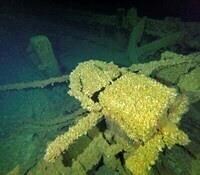
Brendon Baillod, a Great Lakes historian based in Madison, has spent the last five years searching for the Trinidad, a grain schooner that went down in Lake Michigan in 1881. He and fellow historian Bob Jaeck finally found the wreck in July off Algoma, Wisconsin.
The first photos of the site, taken by a robot vehicle, showed the ship was in unusually good shape, with intact rigging and dishes still in cabins. But the site was “fully carpeted” with quagga mussels, Baillod said.
“It has been completely colonized,” he said. “Twenty years ago, even 15 years ago, that site would have been clean. Now you can’t even recognize the bell. You can’t see the nameboard. If you brush those mussels off, it tears the wood off with it.”
Quagga management options could include treating them with toxic chemicals; covering them with tarps that restrict water flow and starve them of oxygen and food; introducing predator species; or suffocating them by adding carbon dioxide to the water.
So far nothing looks promising on a large scale, UW-Milwaukee’s Bootsma said.
“The only way they will disappear from a lake as large as Lake Michigan is through some disease, or possibly an introduced predator,” he said.

That leaves archaeologists and historians like Baillod scrambling to locate as many wrecks as possible to map and document before they disintegrate under the quaggas’ assaults.
At stake are the physical remnants of a maritime industry that helped settle the Great Lakes region and establish port cities such as Milwaukee, Detroit, Chicago and Toledo, Ohio.
“When we lose those tangible, preserved time capsules of our history, we lose our tangible connection to the past,” Baillod said. “Once they’re gone, it’s all just a memory. It’s all just stuff in books.”
___
This story was first published on Sept. 23. It was updated on Sept. 25 to correct the name of the Gordon Lightfoot song. It is “The Wreck of the Edmund Fitzgerald,” not “The Ballad of the Edmund Fitzgerald.”