Climate change is shrinking snowpack in many places, study shows. And it will get worse
Advertisement
Read this article for free:
or
Already have an account? Log in here »
To continue reading, please subscribe:

Digital Subscription
One year of digital access for only $205*
- Enjoy unlimited reading on winnipegfreepress.com
- Read the E-Edition, our digital replica newspaper
- Access News Break, our award-winning app
- Play interactive puzzles
*First annual payment billed as $205.00 + GST for one year. This annual subscription will automatically renew at $233.00 + GST every 52 weeks (10% off the regular annual price of $259.35). Offer available to new and qualified returning subscribers only. Cancel any time.
To continue reading, please subscribe:
Add Free Press access to your Brandon Sun subscription for only an additional
$1 for the first 4 weeks*
- Enjoy unlimited reading on winnipegfreepress.com
- Read the E-Edition, our digital replica newspaper
- Access News Break, our award-winning app
- Play interactive puzzles
*Your next Brandon Sun subscription payment will increase by $1.00 and you will be charged $17.95 plus GST for four weeks. After four weeks, your payment will increase to $24.95 plus GST every four weeks.
Read unlimited articles for free today:
or
Already have an account? Log in here »
Hey there, time traveller!
This article was published 10/01/2024 (1003 days ago), so information in it may no longer be current.
DENVER (AP) — River basins around the world that were once regularly snowbound are increasingly seeing their snowpack shrink and climate change is to blame, a new study found.
“Many of the world’s most populous basins are hovering on the precipice of rapid snow declines,” concluded the study of snow amounts since 1981 in Wednesday’s journal Nature.
That’s because the study found a key threshold for the future of snowpacks in the Northern Hemisphere: 17.6 degrees (-8 degrees Celsius). In places where the winter temperature average is colder than that, the snowpack often survives because it’s cold enough. But areas warmer than 17.6 degrees for a winter average tend to see their winter wonderland dreams melt like the wicked witch of the west. And it’s happening fast.
“You’re potentially in this regime of just really rapid and accelerating losses with warming,” said lead author Alexander Gottlieb, an Earth systems scientist at Dartmouth College.
Most past studies have looked at snow cover, which is a simple measurement of whether the ground has snow or not. This latest research examined snowpack, a more encompassing measurement that includes depth and amount, at its general peak in March. Spring snowpack is critical for delivering a steady supply of drinking and irrigation water to billions of people, with bigger and earlier melts causing problems.
University of New Hampshire Earth systems scientist Elizabeth Burakowski, who wasn’t part of the research, said the study shows “beyond a reasonable doubt that humans are responsible for the decline in snowpack in dozens of river basins across the Northern Hemisphere” and melting of the snow “will ratchet up with each degree.”
“The study demonstrates that our snow future depends on the path we take to act on climate,” Burakowski wrote in an email.
Gottlieb and Dartmouth climate scientist Justin Mankin examined 169 northern hemisphere river basins, finding a significant 40-year downward trend in 70 of the river basins, an increasing trend in a dozen and no trend in the others.
In 23 of those shrinking snowpacks, Mankin and Gottlieb, using variations on standard scientific techniques, were able to show that climate change clearly contributed to the melt. In eight river basins, all in chilly eastern Siberia, they found climate change helped build snowpack as precipitation increased but temperatures stayed cool enough to preserve it.
Europe and North America are getting some of the biggest spring snowpack losses, they found, including the Great Salt Lake, Merrimack, Connecticut, Susquehanna, Hudson, Delaware, Neva, Vistula, Dnieper, Don and Danube river basins.
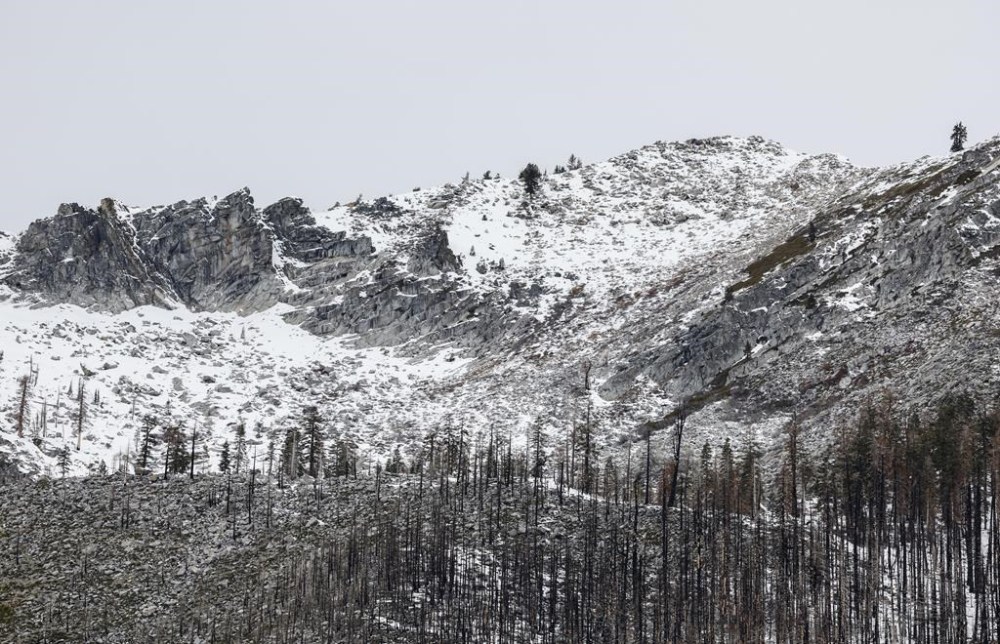
A good example of shrinking snowpack is the upper reaches of the Colorado River basin in Colorado and parts of Wyoming, Gottlieb said. There, the winter temperature averages around 23 degrees (-5 degrees Celsius), seemingly cold enough for snow because it’s below freezing, but not really, he said.
“This is a place where we’ve started to see these kinds of accelerating losses start to emerge,” Gottlieb said. “We see this really clear picture of anthropogenic forest snow loss over the last 40 years or so.”
Gottlieb and Mankin documented fingerprints of human-caused warming by using the standard climate attribution method of comparing what happened in the last 40 years of a real warming world to thousands of computer model runs showing what would happen to these river basins on a fictional planet with no climate change.
Places chillier than 17.6 degrees account for 81 percent of the Northern Hemisphere snowpack, but they don’t hold many people, only 570 million, Mankin said. More than 2 billion people live in areas where winter averages between 17.6 and 32 degrees (-8 and zero Celsius), he said.
What’s key, especially for water supply, is that “as warming accelerates, the snowpack change is going to accelerate much faster than it has,” said Daniel Scott, a scientist at the University of Waterloo who wasn’t involved in the study.
That’s because what’s happening is not gradual. Above a certain temperature, melt gets moving fast. Below that 17.6 degrees mark, it’s cold enough that the extra moisture in the air from climate change may result in more snow and increase snowpack, something Gottlieb and Mankin said they saw in eastern Siberia.
That 17.6-degree threshold “tells us more clearly how much risk there is and where,” said University of Colorado ice scientist Waleed Abdalati, a former NASA chief scientist who wasn’t part of the study.
The ski industry — with sometimes stark visuals of manufactured snow on an otherwise brown landscape for winter revelers to enjoy — has long been an easy to understand example of an economy that will suffer from the lack of snow.
Many ski areas wait anxiously every year for Mother Nature to bring enough powder to start running their lifts. Others have closed altogether after their seasons got too short.
Larger corporate-run mountains, such as Colorado’s Aspen Snowmass, are able to operate consistently despite less snow and shorter winters.
“Opening and closing days remain constant due to snowmaking, which shows how important that is,” said Auden Schendler, senior vice-president of sustainability at Aspen One, the parent company of Aspen Skiing Company.
They also invested in building new ski runs at higher elevations where snow is more reliable than at the base, insulating them from substantial economic loss — for now.
“That in no way reduces the urgency of the need to act with force and at scale,” Schendler said. Aspen Snowmass is among a growing handful of ski areas that are embracing climate activism as the new industry standard, recognizing an urgent need to lobby for climate-friendly policies if they want to exist well into a warming future.
—-
Peterson reported from Denver, Borenstein from Kensington, Maryland.
___
Read more of AP’s climate coverage at http://www.apnews.com/climate-and-environment
___
Follow Seth Borenstein on X at @borenbears
___
Associated Press climate and environmental coverage receives support from several private foundations. See more about AP’s climate initiative here. The AP is solely responsible for all content.
Related Articles
A winter storm brings wind, snow, rain to Atlantic Canada

Advertisement Advertise With Us
Advertisement Advertise With Us