California’s rainy season is here. What does it mean for water supply?

Advertisement

Advertise with us

LOS ANGELES (AP) — After a dry start to winter, California's rainy season is finally well under way.

Read this article for free:


or

Already have an account? Log in here »

To continue reading, please subscribe:

Subscribe and receive a limited-edition Free Press branded hat or tote.

Digital Subscription

One year of digital access for only $205*

  • Enjoy unlimited reading on winnipegfreepress.com
  • Read the E-Edition, our digital replica newspaper
  • Access News Break, our award-winning app
  • Play interactive puzzles

*First annual payment billed as $205.00 + GST for one year. This annual subscription will automatically renew at $233.00 + GST every 52 weeks (10% off the regular annual price of $259.35). Offer available to new and qualified returning subscribers only. Cancel any time.

To continue reading, please subscribe:

Add Free Press access to your Brandon Sun subscription for only an additional

$1 for the first 4 weeks*

  • Enjoy unlimited reading on winnipegfreepress.com
  • Read the E-Edition, our digital replica newspaper
  • Access News Break, our award-winning app
  • Play interactive puzzles
Start now

*Your next Brandon Sun subscription payment will increase by $1.00 and you will be charged $17.95 plus GST for four weeks. After four weeks, your payment will increase to $24.95 plus GST every four weeks.

Hey there, time traveller!
This article was published 21/02/2024 (950 days ago), so information in it may no longer be current.

LOS ANGELES (AP) — After a dry start to winter, California’s rainy season is finally well under way.

December downpours sent water racing through streets in coastal Ventura County and the city of Santa Barbara. Flash floods hit San Diego in late January, and back-to-back atmospheric river-fueled storms arrived earlier this month, causing wind damage in Northern California and hundreds of mudslides in Los Angeles. Yet another storm blew through over Presidents Day weekend.

The frequent deluges have fended off a return to the drought that has plagued the state over the past decade. Some parts of California are so wet these days that even Death Valley National Park has a lake big enough for kayakers. Still, the state is not on pace for a repeat of last year’s epic rain. And the mountains haven’t seen nearly as much snow.
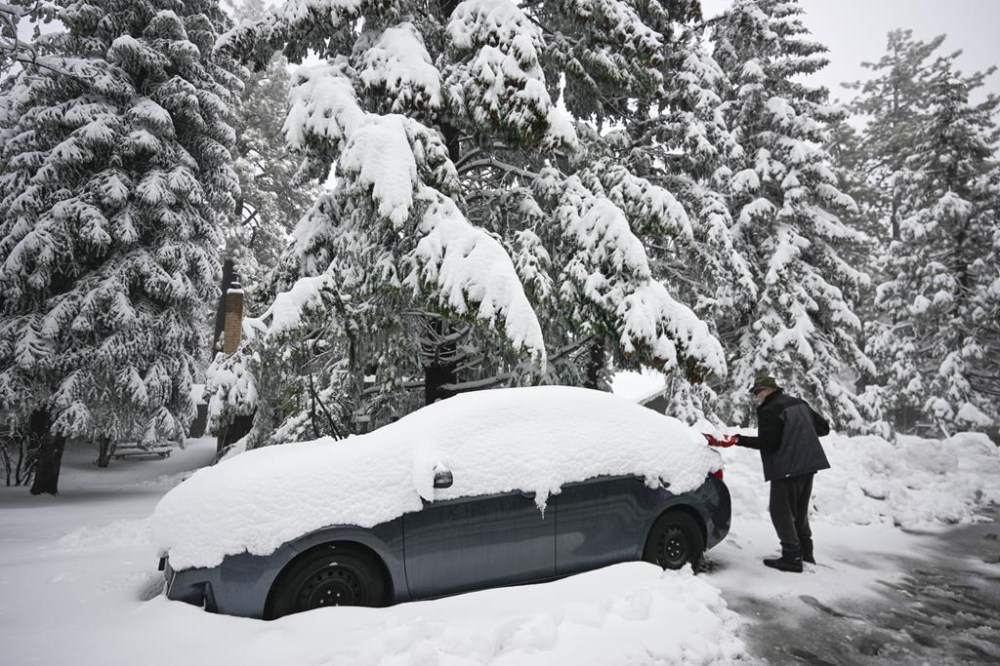
FILE - A man shovels snow off his car in the Cleveland National Forest, on Feb. 7, 2024, in eastern San Diego county, Calif. California's current rainy season got off to a slow start but has rebounded with recent storms that have covered mountains in snow and unleashed downpours, flooding and mudslides. The water content of the vital Sierra Nevada snowpack has topped 80% of normal to date while downtown Los Angeles has already received more than an entire year's average annual rainfall. (AP Photo/Denis Poroy, File)

Here’s a look at California’s winter so far:

HAS ALL THIS RAIN HELPED?

Downtown Los Angeles has received nearly 17.8 inches (45.2 centimeters) of rain, already more than an entire year’s worth of annual precipitation, which is measured from Oct. 1 to Sept. 30 of the following year. This is now the fourth-wettest February in downtown since since weather records began in 1877, according to the National Weather Service.

But while rainfall has reached historic levels in Southern California, it remains to be seen if the year will be regarded as very wet for the state overall.

Northern California is only just approaching its annual average, with about a month and a half to go for the wet season, which “makes it very hard to get ‘extremely wet,’ ” said Jay R. Lund, vice-director of the Center for Watershed Sciences at the University of California, Davis.

“We’re already wet enough that it’s not going to be a deep drought year, and the really wet years, they are already much wetter than this,” Lund said.

WHAT ABOUT SNOW?
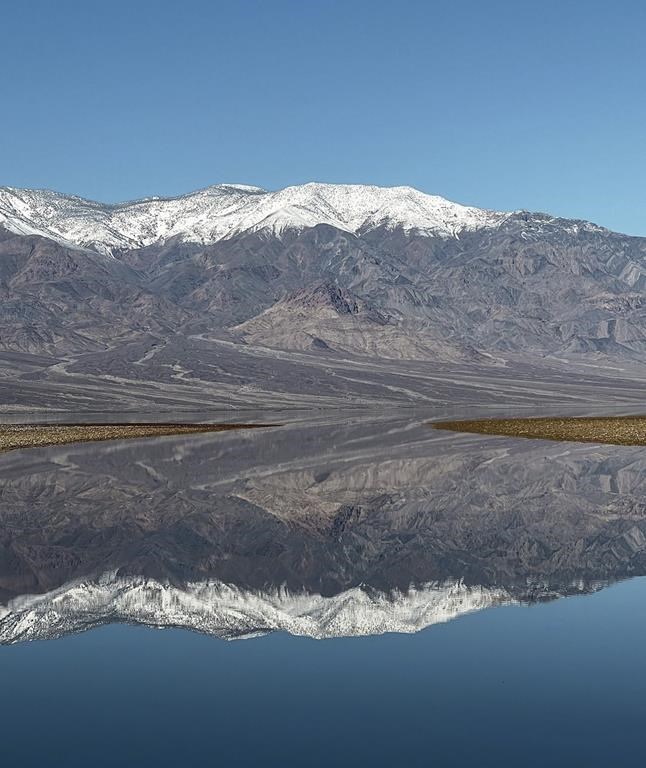
In this photo released by the National Park Service, is a lake created at Badwater Basin in Death Valley National Park, Calif., on Feb. 12, 2024. The lake was largely created by remnants of Hurricane Hilary in late August and a powerful atmospheric river early this month, according to the National Park Service. California's current rainy season got off to a slow start but has rebounded with recent storms that have covered mountains in snow and unleashed downpours, flooding and mudslides. (K. Skilling/National Park Service via AP)

The vital Sierra Nevada snowpack, which normally supplies about 30% of California’s water when it melts, has rebounded somewhat from a slow start.

The snowpack’s water content Wednesday was 86% of normal amounts to date and 69% of the April 1 average, when it is normally at its peak, according to the state Department of Water Resources.

On Jan. 30, the water content was just 52% of the average for that date — a far cry from a year earlier when it was around 200% of its average content, thanks to repeated atmospheric rivers that dramatically ended California’s driest three-year period on record.

WERE RESERVOIRS REPLENISHED?

Even with the laggard start to the current rainy season, water storage in California’s major reservoirs has been well above average thanks to runoff from last year’s historic snowpack.

Some reservoirs have been releasing water into rivers to make room for incoming storm runoff and maintain flood control protection for downstream areas.

The Department of Water Resources announced Wednesday that the State Water Project is forecasting that public water agencies serving 27 million people will receive 15% of requested supplies, up from December’s initial 10% allocation.
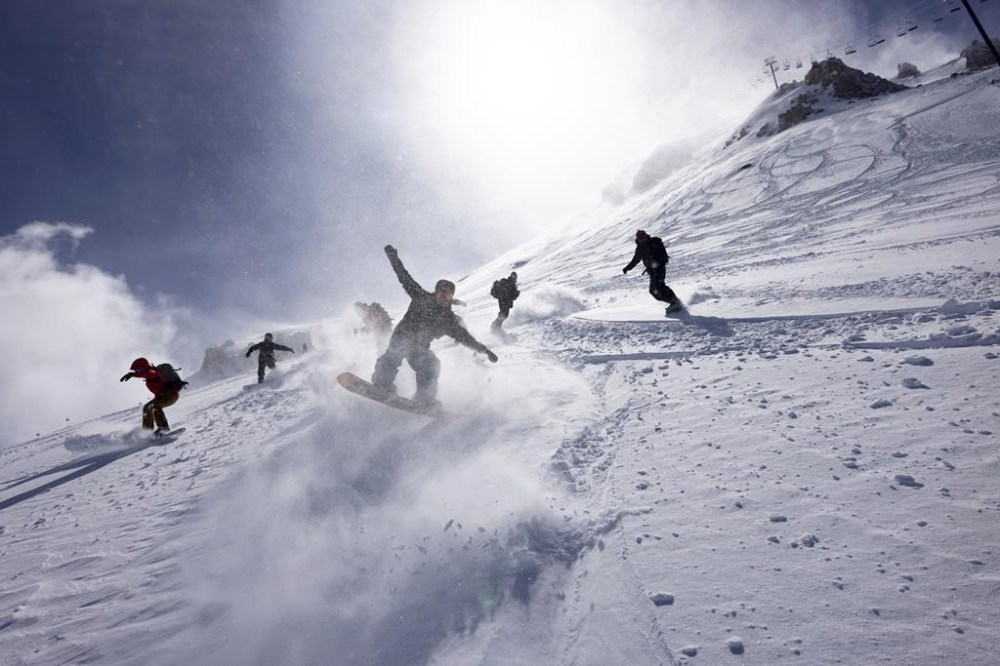
In this photo provided by Mammoth Lakes Tourism, people snowboard at the Mammoth Mountain Ski Area in Mammoth Lakes, Calif., Wednesday, Feb. 21, 2024. (Andrew Miller/Mammoth Mountain via AP)

The department said that the assessment doesn’t include the impact of storms this month, and the allocation could be further revised in mid-March.

Lake Oroville, the State Water Project’s largest reservoir, was at 134% of its average amount to date, but the department noted that the Northern California headwaters of the State Water Project saw below-average precipitation from storms over the past two months.

Contractors of the Central Valley Project, a federally run system that supplies major farming districts, will also receive 15% of their requested water supplies, federal authorities said Wednesday. That could change with more storms.

Report Error Submit a Tip

More Stories

Letters, Sept. 28

7 minute read 2:00 AM CDT

Other options are closer

Every Winnipeg driver learns this lesson eventually: keep your eyes on the horizon too long and the pothole gets you. Manitoba’s energy debate has the same problem. We keep looking far down the road for the next big project and missing what’s close at hand.

Scott Forbes (Time for 21st-century leadership at MB Hydro, Think Tank, Sept. 24) makes a strong case for more wind and storage. But much of this debate is still measured in thousands of megawatts, generated far from where the power is used.

The more immediate opportunity is close to home.

Saviour of the slopes

AV Kitching 5 minute read Preview

Saviour of the slopes

AV Kitching 5 minute read 2:00 AM CDT

It’s not yet winter but that hasn’t stopped Lori Natuik from preparing for when snow hits the ground.

Winter is her favourite season and she’s ready to strap on her skis, not only for pleasure but also as part of her duties as a Canadian Ski Patrol (CSP) volunteer.

Natuik, 69, is one of more than 4,500 CSP volunteers across the country.

CSP volunteers are often the first responders when skiiers get into difficulty on the slopes. The non-profit organization was established in 1941 to provide advanced first aid services for more than 200 alpine and Nordic ski areas nationally. In the off-season volunteers provide services at non-skiing events such as marathons, bike races, fundraising events, sporting tournaments and concerts.

Read
2:00 AM CDT

Puzzles Palace

1 minute read Monday, Jul. 27, 2026

To solve our puzzles, please subscribe with this special offer: |

Four Jets clear waivers to join Moose

Ken Wiebe 3 minute read Preview

Four Jets clear waivers to join Moose

Ken Wiebe 3 minute read Saturday, Sep. 26, 2026

The Winnipeg Jets organizational depth has yet to take a hit on the waiver wire.

On Saturday afternoon, all four players exposed to waivers — defenceman Isaak Phillips and forwards Nikita Chibrikov, Noah Gregor and Parker Ford — cleared, which means they can be assigned to the Manitoba Moose of the American Hockey League.

Owing to injuries to captain Adam Lowry and winger Cole Perfetti, both Chibrikov and Ford started last season on the NHL roster but spent the bulk of last season with the Moose.

Chibrikov, chosen in the second round of the 2021 NHL Draft, has dealt with multiple lower-body injuries during the prior two seasons and is still working his way back to peak form.

Read
Saturday, Sep. 26, 2026

Is a better Winnipeg on the horizon?

Tom Brodbeck, Rebecca Chambers, Niigaan Sinclair and Brent Bellamy 20 minute read Preview

Is a better Winnipeg on the horizon?

Tom Brodbeck, Rebecca Chambers, Niigaan Sinclair and Brent Bellamy 20 minute read Friday, Sep. 25, 2026

Four Free Press columnists weigh in on the challenges ahead and how the city can become better.

Read
Friday, Sep. 25, 2026

California’s rainy season is here. What does it mean for water supply?

John Antczak, The Associated Press 5 minute read Preview

California’s rainy season is here. What does it mean for water supply?

John Antczak, The Associated Press 5 minute read Thursday, Feb. 22, 2024

LOS ANGELES (AP) — After a dry start to winter, California's rainy season is finally well under way.

December downpours sent water racing through streets in coastal Ventura County and the city of Santa Barbara. Flash floods hit San Diego in late January, and back-to-back atmospheric river-fueled storms arrived earlier this month, causing wind damage in Northern California and hundreds of mudslides in Los Angeles. Yet another storm blew through over Presidents Day weekend.

The frequent deluges have fended off a return to the drought that has plagued the state over the past decade. Some parts of California are so wet these days that even Death Valley National Park has a lake big enough for kayakers. Still, the state is not on pace for a repeat of last year's epic rain. And the mountains haven't seen nearly as much snow.

Here's a look at California's winter so far:

Read
Thursday, Feb. 22, 2024