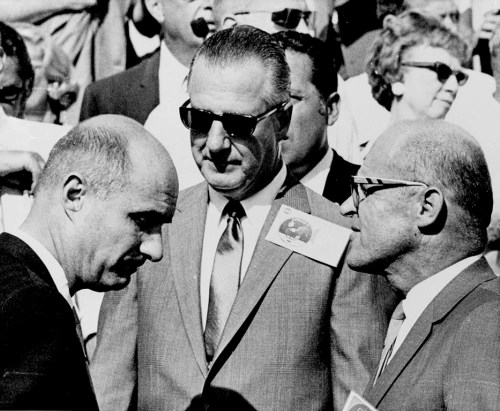
Astronaut Thomas Stafford, commander of Apollo 10, has died at age 93
Advertisement
Read this article for free:
or
Already have an account? Log in here »
To continue reading, please subscribe:

Digital Subscription
One year of digital access for only $205*
- Enjoy unlimited reading on winnipegfreepress.com
- Read the E-Edition, our digital replica newspaper
- Access News Break, our award-winning app
- Play interactive puzzles
*First annual payment billed as $205.00 + GST for one year. This annual subscription will automatically renew at $233.00 + GST every 52 weeks (10% off the regular annual price of $259.35). Offer available to new and qualified returning subscribers only. Cancel any time.
To continue reading, please subscribe:
Add Free Press access to your Brandon Sun subscription for only an additional
$1 for the first 4 weeks*
- Enjoy unlimited reading on winnipegfreepress.com
- Read the E-Edition, our digital replica newspaper
- Access News Break, our award-winning app
- Play interactive puzzles
*Your next Brandon Sun subscription payment will increase by $1.00 and you will be charged $17.95 plus GST for four weeks. After four weeks, your payment will increase to $24.95 plus GST every four weeks.
Read unlimited articles for free today:
or
Already have an account? Log in here »
Hey there, time traveller!
This article was published 18/03/2024 (913 days ago), so information in it may no longer be current.
WASHINGTON (AP) — Astronaut Thomas P. Stafford, who commanded a dress rehearsal flight for the 1969 moon landing and the first U.S.-Soviet space linkup, died Monday. He was 93.
Stafford, a retired Air Force three-star general, took part in four space missions. Before Apollo 10, he flew on two Gemini flights, including the first rendezvous of two U.S. capsules in orbit. He died in a hospital near his Space Coast Florida home, said Max Ary, director of the Stafford Air & Space Museum in Weatherford, Oklahoma.
Stafford was one of 24 NASA astronauts who flew to the moon, but he did not land on it. Only seven of them are still alive.

“Today General Tom Stafford went to the eternal heavens which he so courageously explored as a Gemini and Apollo astronaut as well as a peacemaker in Apollo Soyuz,” NASA Administrator Bill Nelson said via X, formerly known as Twitter. “Those of us privileged to know him are very sad but grateful we knew a giant.”
After he put away his flight suit, Stafford was the go-to guy for NASA when it sought independent advice on everything from human Mars missions to safety issues to returning to flight after the 2003 space shuttle Columbia accident. He chaired an oversight group that looked into how to fix the then-flawed Hubble Space Telescope, earning a NASA public service award.
“Tom was involved in so many things that most people were not aware of, such as being known as the ‘Father of Stealth’,” Ary said in an email. Stafford was in charge of the famous “Area 51” desert base that was the site of many UFO theories, but the home of testing of Air Force stealth technologies.
The Apollo 10 mission in May 1969 set the stage for Apollo 11’s historic mission two months later. Stafford and Gene Cernan took the lunar lander nicknamed Snoopy within 9 miles (14 kilometers) of the moon’s surface. Astronaut John Young stayed behind in the main spaceship dubbed Charlie Brown.
“The most impressive sight, I think, that really changed your view of things is when you first see Earth,” Stafford recalled in a 1997 oral history, talking about the view from lunar orbit.
Then came the moon’s far side: “The Earth disappears. There’s this big black void.”
Apollo 10’s return to Earth set the world’s record for fastest speed by a crewed vehicle at 24,791 mph (39,897 kph).
After the moon landings ended, NASA and the Soviet Union decided on a joint docking mission and Stafford, a one-star general at the time, was chosen to command the American side. It meant intensive language training, being followed by the KGB while in the Soviet Union, and lifelong friendships with cosmonauts. The two teams of space travelers even went to Disney World and rode Space Mountain together before going into orbit and joining ships.
“We have capture,” Stafford radioed in Russian as the Apollo and Soyuz spacecraft hooked up. His Russian counterpart, Alexei Leonov, responded in English: “Well done, Tom, it was a good show. I vote for you.”
The 1975 mission included two days during which the five men worked together on experiments. After, the two teams toured the world together, meeting President Gerald Ford and Soviet leader Leonid Brezhnev.
“It helped prove to the rest of the world that two completely opposite political systems could work together,” Stafford recalled at a 30th anniversary gathering in 2005.
The two crews became so close that years later Leonov arranged for Stafford to be able to adopt two Russian boys when Stafford was in his 70s.
“We are too old to adopt, but they were too old to be adopted,” Stafford told The Oklahoman in 2004. “They just added so much meaning to our life, and just because you’re retiring doesn’t mean you don’t have anything left to give.”
Later, Stafford was a central part of discussions in the 1990s that brought Russia into the partnership building and operating the International Space Station.
Growing up in Weatherford, Oklahoma, Stafford said he would look up and see giant DC-3 airplanes fly overhead on early transcontinental routes.

“I wanted to fly since I was 5 or 6 years old seeing those airplanes,” he told NASA historians.
Stafford went to the U.S. Naval Academy where he graduated in the top 1% of his class and flew in the backseat of some airplanes and loved it. He volunteered for the Air Force and had hoped to fly combat in the Korean War. But by the time he got his wings, the war ended. He went to the Air Force’s experimental test pilot school, graduated first in his class there and stayed on as an instructor.
In 1962, NASA selected Stafford for its second set of astronauts, which included Neil Armstrong, Frank Borman and Pete Conrad.
Stafford was assigned along with Wally Schirra to Gemini 6. Their original mission was to rendezvous with an empty spaceship. But their 1965 launch was scrubbed when the spaceship exploded soon after liftoff. NASA improvised and in December, Gemini 6 rendezvoused with but didn’t dock with two astronauts aboard Gemini 7.
Stafford’s next flight in 1966 was with Cernan on Gemini 9. Cernan’s spacewalk, connected to a jet-pack like device, didn’t go well. Cernan complained that the sun and machine made him extra hot and hurt his back. Then his visor fogged up and he couldn’t see.
“Call it quits, Gene. Get out of there,” Stafford, the commander, told Cernan. Stafford talked him back in, saying “move your hand over, start to float up … stick your hand up … just walk hand over hand.”

In all, Stafford logged 507 hours in space and flew four different types of spacecraft and 127 types of aircraft and helicopters.
After the Apollo-Soyuz mission, Stafford returned to the Air Force and worked in research and commanded the Air Force Flight Test Center before retiring in 1979 as a three-star general.
Stafford’s Air Force duties not only had him run the military’s top flight school and experimental plane testing base, but he was commanding general of Area 51. A biography from his museum said, that while Stafford was in charge of Area 51 and later as the development and acquisition chief at the Pentagon he “wrote the specs and established the program that led to the development of the F-117 Stealth Fighter, and later, the B-2 Stealth Bomber.”
Stafford became an executive for an Oklahoma-based transportation company and later moved to Florida, near Cape Canaveral.
He is survived by his wife. Linda, two sons, two daughters and two stepchildren, according to the museum.