Scientists say coral reefs around the world are experiencing mass bleaching in warming oceans

Advertisement

Advertise with us

Coral reefs around the world are experiencing global bleaching for the fourth time, top reef scientists declared Monday, a result of warming ocean waters amid human-caused climate change.

Read this article for free:


or

Already have an account? Log in here »

To continue reading, please subscribe:

Subscribe and receive a limited-edition Free Press branded hat or tote.

Digital Subscription

One year of digital access for only $205*

  • Enjoy unlimited reading on winnipegfreepress.com
  • Read the E-Edition, our digital replica newspaper
  • Access News Break, our award-winning app
  • Play interactive puzzles

*First annual payment billed as $205.00 + GST for one year. This annual subscription will automatically renew at $233.00 + GST every 52 weeks (10% off the regular annual price of $259.35). Offer available to new and qualified returning subscribers only. Cancel any time.

To continue reading, please subscribe:

Add Free Press access to your Brandon Sun subscription for only an additional

$1 for the first 4 weeks*

  • Enjoy unlimited reading on winnipegfreepress.com
  • Read the E-Edition, our digital replica newspaper
  • Access News Break, our award-winning app
  • Play interactive puzzles
Start now

*Your next Brandon Sun subscription payment will increase by $1.00 and you will be charged $17.95 plus GST for four weeks. After four weeks, your payment will increase to $24.95 plus GST every four weeks.

Hey there, time traveller!
This article was published 15/04/2024 (885 days ago), so information in it may no longer be current.

Coral reefs around the world are experiencing global bleaching for the fourth time, top reef scientists declared Monday, a result of warming ocean waters amid human-caused climate change.

Coral reef bleaching across at least 53 countries, territories or local economies has been confirmed from February 2023 to now, scientists from the National Oceanic and Atmospheric Administration and International Coral Reef Initiative said. It happens when stressed coral expel the algae that are their food source and give them their color. If the bleaching is severe and long-lasting, the coral can die.

Coral reefs are important ecosystems that sustain underwater life, protect biodiversity and slow erosion. They also support local economies through tourism.
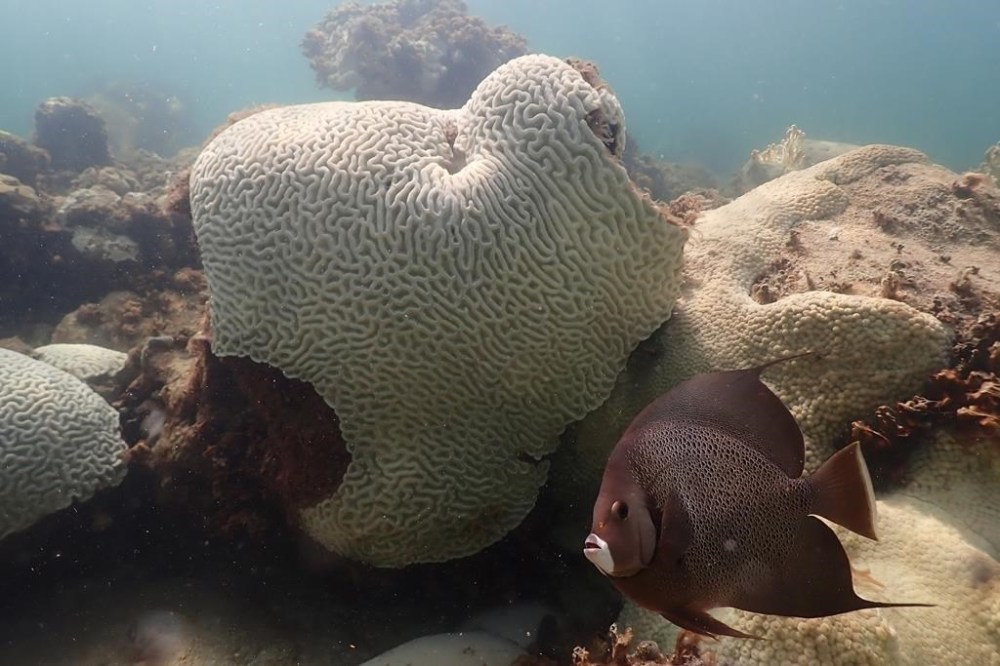
In this image provide by NOAA, a fish swims near coral showing signs of bleaching at Cheeca Rocks off the coast of Islamorada, Fla., on July 23, 2023. Reef scientists say coral reefs around the world are experiencing global bleaching for the fourth time due to prolonged warming of the oceans. (Andrew Ibarra/NOAA via AP)

Bleaching has been happening in various regions for some time. In the world’s largest coral reef ecosystem, Australia’s Great Barrier Reef, bleaching affected 90% of the coral assessed in 2022. The Florida Coral Reef, the third-largest, experienced significant bleaching last year.

But in order for bleaching to be declared on a global scale, significant bleaching had to be documented within each of the major ocean basins, including the Atlantic, Pacific, and Indian oceans, in both the Northern and Southern Hemispheres.

Monday’s news marks the second worldwide bleaching event in the last 10 years. The last one ended in May 2017. Brought on by a powerful El Nino climate pattern that heated the world’s oceans, it lasted three years and was determined to be worse than the prior two bleaching events in 2010 and 1998.

This year’s bleaching follows the declaration that 2023 was the hottest year on record.

“As the world’s oceans continue to warm, coral bleaching is becoming more frequent and severe,” Derek Manzello, NOAA Coral Reef Watch coordinator, said in a statement.

Selina Stead, a marine biologist and chief executive of the Australian Institute of Marine Science, called climate change “the biggest threat to coral reefs worldwide.” She said scientists are working to learn more about how coral responds to heat and to identify naturally heat-tolerant corals, but said it is “critical the world works to reduce carbon emissions.”

One reef that fared better than others last year was the Flower Garden Banks National Marine Sanctuary, which was afforded some protection by its location in deeper water in the Gulf of Mexico about 100 miles off the Texas coast. Sanctuary officials didn’t immediately respond to messages Monday seeking the latest on the health of the sanctuary’s corals.

___

Alexa St. John is an Associated Press climate solutions reporter. Follow her on X, formerly Twitter, @alexa_stjohn. Reach her at ast.john@ap.org.

___

The Associated Press’ climate and environmental coverage receives financial support from multiple private foundations. AP is solely responsible for all content. Find AP’s standards for working with philanthropies, a list of supporters and funded coverage areas at AP.org.

Report Error Submit a Tip

More Stories

Scientists say coral reefs around the world are experiencing mass bleaching in warming oceans

Alexa St. John, The Associated Press 3 minute read Preview

Scientists say coral reefs around the world are experiencing mass bleaching in warming oceans

Alexa St. John, The Associated Press 3 minute read Monday, Apr. 15, 2024

Coral reefs around the world are experiencing global bleaching for the fourth time, top reef scientists declared Monday, a result of warming ocean waters amid human-caused climate change.

Coral reef bleaching across at least 53 countries, territories or local economies has been confirmed from February 2023 to now, scientists from the National Oceanic and Atmospheric Administration and International Coral Reef Initiative said. It happens when stressed coral expel the algae that are their food source and give them their color. If the bleaching is severe and long-lasting, the coral can die.

Coral reefs are important ecosystems that sustain underwater life, protect biodiversity and slow erosion. They also support local economies through tourism.

Bleaching has been happening in various regions for some time. In the world's largest coral reef ecosystem, Australia's Great Barrier Reef, bleaching affected 90% of the coral assessed in 2022. The Florida Coral Reef, the third-largest, experienced significant bleaching last year.

Read
Monday, Apr. 15, 2024

Today’s horoscope

Georgia Nicols 4 minute read Preview

Today’s horoscope

Georgia Nicols 4 minute read Yesterday at 2:00 AM CDT

MOON ALERT: Avoid shopping (except food and gas) or important decisions until noon today. After that, the moon moves from Scorpio into Sagittarius.

ARIES (March 21-April 19)

Your idealism is aroused, perhaps because you feel sympathy for the suffering of someone far away. Because you are proactive by nature, you might do something to help in any way you can. Pay attention to what you say and do. Expect detours.

TAURUS (April 20-May 20)

Read
Yesterday at 2:00 AM CDT

City wants short-term rental unit property owners to report all emergency-service responses

Joyanne Pursaga 5 minute read Preview

City wants short-term rental unit property owners to report all emergency-service responses

Joyanne Pursaga 5 minute read Tuesday, Sep. 15, 2026

New rules could require the owners of short-term rental units, such as Airbnbs and VRBOs, to tell the city every time an emergency responder is called to their properties.

Read
Tuesday, Sep. 15, 2026

RCMP charge N.D. man after driver flees Emerson border crossing

Free Press staff 2 minute read Preview

RCMP charge N.D. man after driver flees Emerson border crossing

Free Press staff 2 minute read Yesterday at 1:57 PM CDT

A North Dakota man faces a string of charges after police say he fled the Emerson border crossing, leading RCMP on a pursuit along Highway 75.

Emerson RCMP were notified just before 6:30 p.m. Saturday that a man entering Canada from North Dakota had sped away from the port of entry after Canada Border Services Agency officers flagged him for a secondary screening.

Officers from several RCMP detachments and the Integrated Border Enforcement Team were sent to Highway 75.

Police said Morris RCMP tried unsuccessfully to stop the vehicle south of the town. Police later blocked Highway 75 at Provincial Road 210, but said the driver went around police vehicles, drove through a ditch and narrowly missed an officer before continuing north toward Winnipeg.

Read
Yesterday at 1:57 PM CDT

Today’s horoscope

Georgia Nicols 4 minute read Preview

Today’s horoscope

Georgia Nicols 4 minute read 2:00 AM CDT

MOON ALERT: There are no restrictions to shopping or important decisions today. The moon is in Sagittarius.

ARIES (March 21-April 19)

This day is full of playful opportunities! It’s a great day to travel. It’s also a wonderful day for learning and studying. Anything related to important papers or higher education will flourish. This is a good time to sort through the details of a vacation itinerary.

TAURUS (April 20-May 20)

Read
2:00 AM CDT

Man gets 18 year sentence for sex assault that impregnated teen girl

Tessa Adamski 4 minute read Yesterday at 2:01 AM CDT

BRANDON — A 29-year-old man has been sentenced to 18 years in prison for sexually abusing and impregnating a 14-year-old girl in 2024.

“Sexual abuse of a child is inherently a grave violation of the child’s bodily integrity, dignity, and security, and in this case, the consequences were compounded by the victim’s pregnancy and the need to undergo a termination,” Brandon provincial court Judge Patrick Sullivan said on Tuesday.

The accused had pleaded guilty to two counts of sexual interference and two counts of breaching a court order banning him from contacting anyone under 18.

A publication ban prohibits the publication of information that could identify the 14-year-old, who is from a western Manitoba First Nation, and two other minors with whom he communicated.