The first glow-in-the-dark animals may have been ancient corals deep in the ocean

Advertisement

Advertise with us

WASHINGTON (AP) — Many animals can glow in the dark. Fireflies famously blink on summer evenings. But most animals that light up are found in the depths of the ocean.

Read this article for free:


or

Already have an account? Log in here »

To continue reading, please subscribe:

Subscribe and receive a limited-edition Free Press branded hat or tote.

Digital Subscription

One year of digital access for only $205*

  • Enjoy unlimited reading on winnipegfreepress.com
  • Read the E-Edition, our digital replica newspaper
  • Access News Break, our award-winning app
  • Play interactive puzzles

*First annual payment billed as $205.00 + GST for one year. This annual subscription will automatically renew at $233.00 + GST every 52 weeks (10% off the regular annual price of $259.35). Offer available to new and qualified returning subscribers only. Cancel any time.

To continue reading, please subscribe:

Add Free Press access to your Brandon Sun subscription for only an additional

$1 for the first 4 weeks*

  • Enjoy unlimited reading on winnipegfreepress.com
  • Read the E-Edition, our digital replica newspaper
  • Access News Break, our award-winning app
  • Play interactive puzzles
Start now

*Your next Brandon Sun subscription payment will increase by $1.00 and you will be charged $17.95 plus GST for four weeks. After four weeks, your payment will increase to $24.95 plus GST every four weeks.

Hey there, time traveller!
This article was published 23/04/2024 (879 days ago), so information in it may no longer be current.

WASHINGTON (AP) — Many animals can glow in the dark. Fireflies famously blink on summer evenings. But most animals that light up are found in the depths of the ocean.

In a new study, scientists report that deep-sea corals that lived 540 million years ago may have been the first animals to glow, far earlier than previously thought.

“Light signaling is one of the earliest forms of communication that we know of — it’s very important in deep waters,” said Andrea Quattrini, a co-author of the study published Tuesday in the journal Proceedings of the Royal Society B.
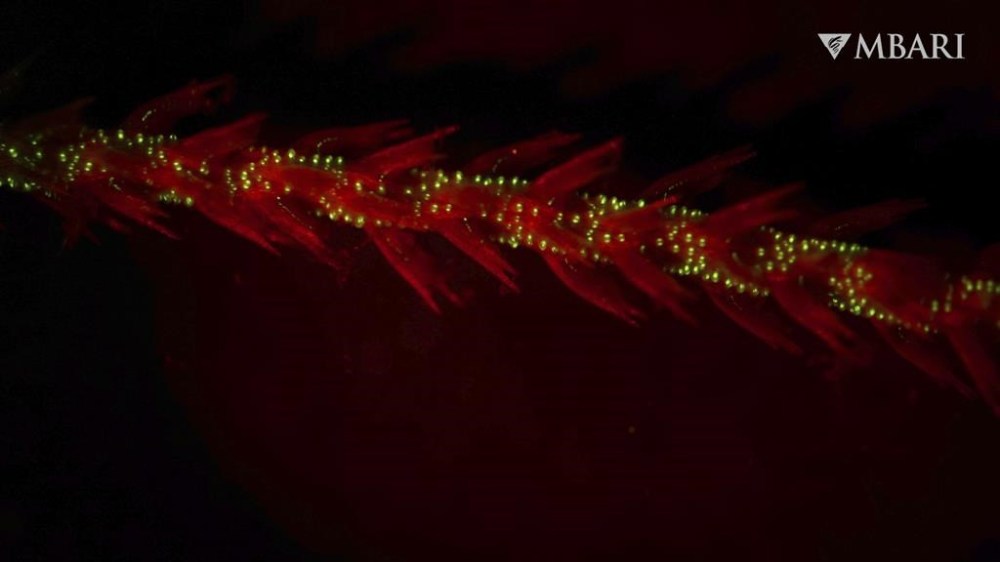
This image provided by the Monterey Bay Aquarium Research Institute in April 2024 shows bioluminescence in the sea whip coral Funiculina sp. observed under red light in a laboratory. Most animals that light up are found in the depths of the ocean and they might have been doing it longer than thought. In a study published in the journal Proceedings of the Royal Society B on Tuesday, April 23, 2024, scientists report that the first animals that glowed may have been coral that lived 540 million years ago. “Light signaling is one of the earliest forms of communication that we know of _ it’s very important in deep waters,” said Andrea Quattrini, a co-author of the study. (Manabu Bessho-Uehara/MBARI via AP)

Today, marine creatures that glimmer include some fish, squid, octopuses, jellyfish, even sharks — all the result of chemical reactions.

Some use light to startle predators, “like a burglar alarm,” and others use it to lure prey, as anglerfish do, said Quattrini, who is curator of corals at the Smithsonian National Museum of Natural History.

Still other animals use light as a beacon to find mates.

Many deep-sea soft coral species light up briefly when bumped — or when stroked with a paintbrush. That’s what scientists used, attached to a remote-controlled underwater rover, to identify and study luminous species, said Steven Haddock, a study co-author and marine biologist at the Monterey Bay Aquarium Research Institute.

Soft coral may look like waving reeds, skeleton fingers or stalks of bamboo — and glow pink, orange, white, blue and purple under the researchers’ spotlight, he said.

“For some species, the whole body glows — for others, only parts of their branches will glow,” said Danielle DeLeo, a study co-author and evolutionary marine biologist at the Smithsonian.

For corals, scientists aren’t sure if this luminous reaction is meant to attract or repel other organisms, or perhaps both. But its frequency suggests that it serves a crucial function in many coral species, she said.

But how long have some coral species had the ability to glow?

To answer this question, the researchers used genetic data from 185 species of luminous coral to construct a detailed evolutionary tree. They found that the common ancestor of all soft corals today lived 540 million years ago and very likely could glow — or bioluminescence.

That date is around 270 million years before the previously earliest known example: a glowing prehistoric shrimp. It also places the origin of light production to around the time of the Cambrian explosion, when life on Earth evolved and diversified rapidly — giving rise to many major animal groups that exist today.

“If an animal had a novel trait that made it really special and helped it survive, its descendants were more likely to endure and pass it down,” said Stuart Sandin, a marine biologist at the Scripps Institution of Oceanography, who was not involved in the study.

___

The Associated Press Health and Science Department receives support from the Howard Hughes Medical Institute’s Science and Educational Media Group. The AP is solely responsible for all content.


Report Error Submit a Tip

More Stories

Day 1 of Jets training camp in the books with pairings essentially cemented

Ken Wiebe 7 minute read Preview

Day 1 of Jets training camp in the books with pairings essentially cemented

Ken Wiebe 7 minute read Thursday, Sep. 17, 2026

Nearly six minutes into his question-and-answer session, Scott Arniel took a welcome detour from the news of the day.

After exhausting the discussion around the goalie who wasn’t in training camp, the head coach of the Winnipeg Jets finally got a query about the line combinations and defensive pairings that were unveiled in training camp.

And unlike past years, when exhibition games were more frequent and the training camp wasn’t this condensed, Arniel conceded these groupings were intentional and were likely staying together for some time.

The expansion to an 84-game regular season brings with it a reduction to four pre-season games and a much shorter training camp, which could limit the amount of experimentation that Arniel can do during the next two weeks.

Read
Thursday, Sep. 17, 2026

Siloam Mission, WFPS discussing on-site paramedic to reduce staggering number of emergency calls

Scott Billeck 4 minute read Preview

Siloam Mission, WFPS discussing on-site paramedic to reduce staggering number of emergency calls

Scott Billeck 4 minute read Yesterday at 2:00 AM CDT

Winnipeg’s fire-paramedic service and its largest homeless-serving organization are discussing what it would look like to station at least one paramedic at Siloam Mission, as emergency calls to the downtown facility surge.

The ongoing discussions come as Winnipeg Fire Paramedic Service crews were dispatched 1,771 times during the first eight months of the year to the two adjacent Siloam properties at 303 Stanley St. and 300 Princess St.

WFPS said most of the calls were related to overdoses or other consequences of substance use, with the total nearly double the 854 calls recorded over the same period last year. By comparison, there were 831 calls during the same span in 2024, and 591 in 2023.

“The number of emergency calls isn’t sustainable for us as a service, but it’s certainly not sustainable for them as an agency trying to provide services,” WFPS chief Ryan Sneath told the Free Press. “And they recognize that they’re impacting emergency services, not them specifically, but the site in a significant way.”

Read
Yesterday at 2:00 AM CDT

Jets GM insists club’s not working under any deadline in netminder’s trade request

Mike McIntyre 7 minute read Preview

Jets GM insists club’s not working under any deadline in netminder’s trade request

Mike McIntyre 7 minute read Thursday, Sep. 17, 2026

Connor Hellebuyck and his family were subject to so much post-Olympic vitriol that both the Winnipeg Jets security team and even police had to get involved.

Read
Thursday, Sep. 17, 2026

A life’s story: activist, educator, organizer knew the true meaning of community

Janine LeGal 7 minute read Preview

A life’s story: activist, educator, organizer knew the true meaning of community

Janine LeGal 7 minute read 3:00 AM CDT

Somewhere between a love for sharing stories and a love of community connections, Michael (Mike) Maunder lived his life. Giving voice to people and neighbourhoods was a passion for the natural-born community organizer.

An author, teacher and principal, Maunder lived in a one-bedroom apartment in West Broadway and devoted himself to community development, education and neighbourhood renewal.

He maintained a connection with Augustine United Church, whose commitment to social justice he appreciated, volunteered at the Sandy-Saulteaux Spiritual Centre, and found comfort in a Buddhist prayer community.

Maunder died on July 15 at the age of 80.

Read
3:00 AM CDT

Canada-U.S. trade relationship is broken, but the damage can — and will — be repaired

Tom Brodbeck 5 minute read Preview

Canada-U.S. trade relationship is broken, but the damage can — and will — be repaired

Tom Brodbeck 5 minute read Thursday, Sep. 17, 2026

Canada needs to get serious about diversifying its trade beyond the United States. But at the same time, Canadians should expect relations with the U.S. to normalize after Donald Trump is no longer in the White House.

For generations, Canada-U.S. trade was considered almost a fact of geography. The two countries share the world’s longest undefended border, deeply integrated supply chains and a century of commercial relationships.

Canadian manufacturers depend on American customers. American manufacturers depend on Canadian suppliers. Energy, agriculture, automotive production and countless other industries operate across the border as though it barely exists.

That isn’t going to change dramatically, even in the midst of a bitter trade war unleashed by the U.S. president.

Read
Thursday, Sep. 17, 2026

‘She was looking to destroy me’: convicted harasser faces new charges

Dean Pritchard 6 minute read Preview

‘She was looking to destroy me’: convicted harasser faces new charges

Dean Pritchard 6 minute read Thursday, Sep. 17, 2026

When Agnieszka Ciochon-Newton moved into the 55-plus apartment building on Stradbrook Avenue last year, she came across as “timid, soft-spoken and sensitive,” said building manager Tanya Owen.

Little did Owen know the meek-looking 58-year-old woman would soon turn her life and the lives of many of her tenants upside down and threaten her career and family.

“She was looking to destroy me for a simple tenant disagreement,” Owen said Thursday.

Court records show Ciochon-Newton was arrested earlier this month and charged with seven counts of criminal harassment, two counts of uttering threats and one count each of fraud, breaking and entering, attempting to obstruct justice, intimidation of a justice official, mischief and defamatory libel.

Read
Thursday, Sep. 17, 2026