A wild orangutan used a medicinal plant to treat a wound, scientists say

Advertisement

Advertise with us

WASHINGTON (AP) — An orangutan appeared to treat a wound with medicine from a tropical plant— the latest example of how some animals attempt to soothe their own ills with remedies found in the wild, scientists reported Thursday.

Read this article for free:


or

Already have an account? Log in here »

To continue reading, please subscribe:

Subscribe and receive a limited-edition Free Press branded hat or tote.

Digital Subscription

One year of digital access for only $205*

  • Enjoy unlimited reading on winnipegfreepress.com
  • Read the E-Edition, our digital replica newspaper
  • Access News Break, our award-winning app
  • Play interactive puzzles

*First annual payment billed as $205.00 + GST for one year. This annual subscription will automatically renew at $233.00 + GST every 52 weeks (10% off the regular annual price of $259.35). Offer available to new and qualified returning subscribers only. Cancel any time.

To continue reading, please subscribe:

Add Free Press access to your Brandon Sun subscription for only an additional

$1 for the first 4 weeks*

  • Enjoy unlimited reading on winnipegfreepress.com
  • Read the E-Edition, our digital replica newspaper
  • Access News Break, our award-winning app
  • Play interactive puzzles
Start now

*Your next Brandon Sun subscription payment will increase by $1.00 and you will be charged $17.95 plus GST for four weeks. After four weeks, your payment will increase to $24.95 plus GST every four weeks.

Hey there, time traveller!
This article was published 02/05/2024 (882 days ago), so information in it may no longer be current.

WASHINGTON (AP) — An orangutan appeared to treat a wound with medicine from a tropical plant— the latest example of how some animals attempt to soothe their own ills with remedies found in the wild, scientists reported Thursday.

Scientists observed Rakus pluck and chew up leaves of a medicinal plant used by people throughout Southeast Asia to treat pain and inflammation. The adult male orangutan then used his fingers to apply the plant juices to an injury on the right cheek. Afterward, he pressed the chewed plant to cover the open wound like a makeshift bandage, according to a new study in Scientific Reports.

Previous research has documented several species of great apes foraging for medicines in forests to heal themselves, but scientists hadn’t yet seen an animal treat itself in this way.
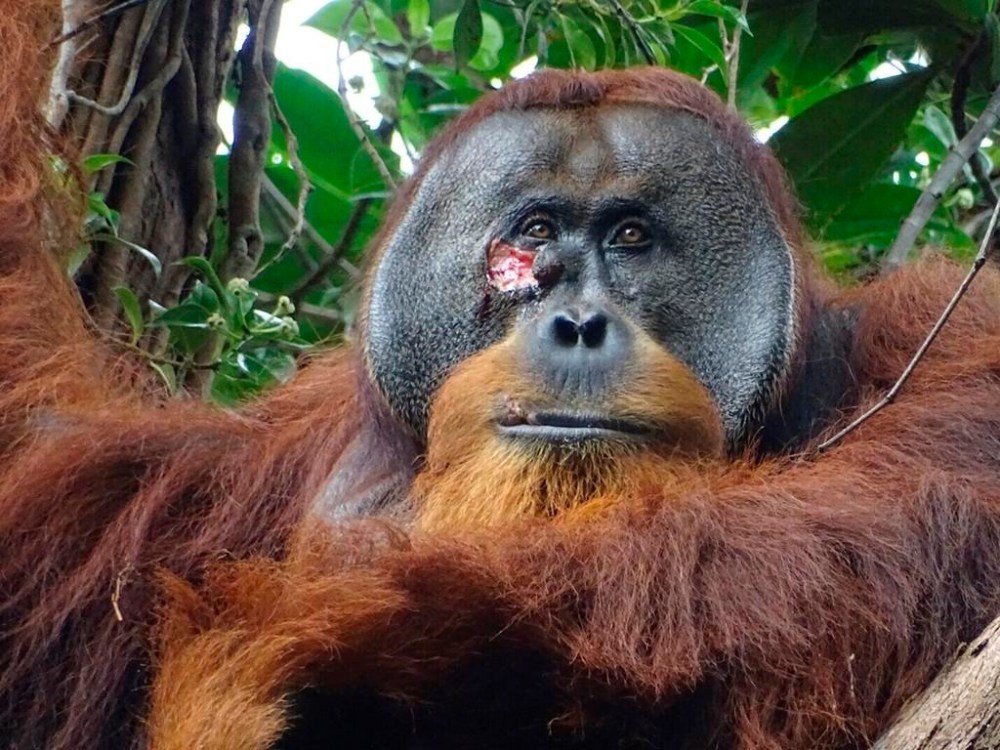
This photo provided by the Suaq foundation shows a facial wound on Rakus, a wild male Sumatran orangutan in Gunung Leuser National Park, Indonesia, on June 23, 2022, two days before he applied chewed leaves from a plant, used throughout Southeast Asia to treat pain and inflammation and to kill bacteria, to the wound. (Armas/Suaq foundation via AP)

“This is the first time that we have observed a wild animal applying a quite potent medicinal plant directly to a wound,” said co-author Isabelle Laumer, a biologist at the Max Planck Institute of Animal Behavior in Konstanz, Germany.

The orangutan’s intriguing behavior was recorded in 2022 by Ulil Azhari, a co-author and field researcher at the Suaq Project in Medan, Indonesia. Photographs show the animal’s wound closed within a month without any problems.

Scientists have been observing orangutans in Indonesia’s Gunung Leuser National Park since 1994, but they hadn’t previously seen this behavior.

“It’s a single observation,” said Emory University biologist Jacobus de Roode, who was not involved in the study. “But often we learn about new behaviors by starting with a single observation.”

“Very likely it’s self-medication,” said de Roode, adding that the orangutan applied the plant only to the wound and no other body part.

It’s possible Rakus learned the technique from other orangutans living outside the park and away from scientists’ daily scrutiny, said co-author Caroline Schuppli at Max Planck.

Rakus was born and lived as a juvenile outside the study area. Researchers believe the orangutan got hurt in a fight with another animal. It’s not known whether Rakus earlier treated other injuries.

Scientists have previously recorded other primates using plants to treat themselves.

This combination of photos provided by the Suaq foundation shows a facial wound on Rakus, a wild male Sumatran orangutan in Gunung Leuser National Park, Indonesia, on June 23, 2022, two days before he applied chewed leaves from a medicinal plant, left, and on Aug. 25, 2022, after his facial wound was barely visible. (Armas, Safruddin/Suaq foundation via AP)

Bornean orangutans rubbed themselves with juices from a medicinal plant, possibly to reduce body pains or chase away parasites.

Chimpanzees in multiple locations have been observed chewing on the shoots of bitter-tasting plants to soothe their stomachs. Gorillas, chimpanzees and bonobos swallow certain rough leaves whole to get rid of stomach parasites.

“If this behavior exists in some of our closest living relatives, what could that tell us about how medicine first evolved?” said Tara Stoinski, president and chief scientific officer of the nonprofit Dian Fossey Gorilla Fund, who had no role in the study.

___

The Associated Press Health and Science Department receives support from the Howard Hughes Medical Institute’s Science and Educational Media Group. The AP is solely responsible for all content.

Report Error Submit a Tip

More Stories

Port of Churchill signs agreement with Dutch port

Aaron Epp 2 minute read Preview

Port of Churchill signs agreement with Dutch port

Aaron Epp 2 minute read Tuesday, Sep. 29, 2026

Arctic Gateway Group, operator of the Port of Churchill, has signed an agreement with the Port of Rotterdam in the Netherlands to attract business and strengthen supply chains linking Western Canada and Europe.

The agreement enables the two ports to work together to develop new trade in critical minerals and energy products, connect Canadian producers with European buyers, and identify opportunities to improve the supply chain from Western Canadian resource projects through Churchill and into European markets.

The Port of Rotterdam is Europe’s largest port and home to more than 3,000 businesses across its industrial complex, serving as a major gateway for critical raw materials and energy.

Meanwhile, the Port of Churchill has been identified as a transformative national strategy for Canada and is emerging as a northern trade corridor connecting Western Canada’s resources to global markets.

Read
Tuesday, Sep. 29, 2026

Obsessed stalker who shot, killed young woman at bus stop in 1993 dies behind bars at age 74

Erik Pindera 3 minute read Preview

Obsessed stalker who shot, killed young woman at bus stop in 1993 dies behind bars at age 74

Erik Pindera 3 minute read Tuesday, Sep. 29, 2026

A Winnipeg man who stalked a woman for several years before shooting her dead in the street in 1993 has died in Stony Mountain prison.

On Monday, 74-year-old Ronald Edd Bell died of apparent natural causes at the federal prison just north of Winnipeg, the Correctional Service of Canada said.

Bell had been in prison since May 30, 1994, when he was given a life sentence with no chance of parole for 18 years for killing Terry-Lyn Babb, 25, on Jan. 21, 1993.

Bell walked up behind an unsuspecting Babb, who was waiting at a bus stop at Sherbrook Street and Wolseley Avenue, and shot her in the head with a pistol in front of horrified witnesses, says the Free Press report of his sentencing hearing.

Read
Tuesday, Sep. 29, 2026

Jets new backup Stevenson ‘stoked’ to be in tandem with Skinner

Mike McIntyre 6 minute read Preview

Jets new backup Stevenson ‘stoked’ to be in tandem with Skinner

Mike McIntyre 6 minute read Yesterday at 4:23 PM CDT

It didn’t take long to get the dirt on the newest member of the Winnipeg Jets.

Meet Clay Stevenson, who has no problem if you prefer to refer to him by his long-standing nickname of “Mud.”

“You know, Clay is in the mud, and there you go. That’s it, right there,” Stevenson said Wednesday with a laugh. “I got it in juniors when I was playing in Coquitlam, and kind of stuck ever since.”

Stevenson is now hoping to make a name for himself in a city that, quite fittingly, translates to “muddy water” in Cree. The 27-year-old from Alberta was placed on waivers by the Washington Capitals and claimed by the Jets, who were looking to clarify a goaltending situation which was as murky as the Red River.

Read
Yesterday at 4:23 PM CDT

Who has been invited to the table?

Stephen Borys 6 minute read Preview

Who has been invited to the table?

Stephen Borys 6 minute read 2:01 AM CDT

Last Friday, I spoke at Booth University College’s inaugural Honour and Hope Harvest Dinner in support of Shelter U. I had been asked to speak about the power of art in the community, a subject I have spent much of my professional life thinking about — as a museum director, writer and teacher, and now through my consulting work with Civic Muse.

What continues to interest me is not simply what museums, universities and other public institutions do, but whether their work actually matters — whether they make a difference in the lives of the people and communities around them.

Preparing for the evening brought me back to an even more fundamental question: Who has been invited in?

One of my museum mentors used to remind me that institutions often begin the conversation about public engagement too late. Before engagement comes the welcome, and before the welcome comes the invitation. We can create extraordinary buildings, exhibitions and programs and say that everyone is welcome. But unless people believe that these places are also meant for them, many will never cross the threshold.

Read
2:01 AM CDT

Puzzles Palace

1 minute read Monday, Jul. 27, 2026

To solve our puzzles, please subscribe with this special offer: |

What’s open, what’s closed, what’s up in Winnipeg on National Day for Truth and Reconciliation Sept. 30, 2026

Free Press staff 4 minute read Preview

What’s open, what’s closed, what’s up in Winnipeg on National Day for Truth and Reconciliation Sept. 30, 2026

Free Press staff 4 minute read Sunday, Sep. 27, 2026

The National Day of Truth and Reconciliation, or Orange Shirt Day, as it's known in Manitoba, happens Sept. 30 with many commemorative community events scheduled.

Read
Sunday, Sep. 27, 2026