Collecting sex-crazed zombie cicadas on speed: Scientists track a bug-controlling super-sized fungus

Advertisement

Advertise with us

LISLE, Illinois (AP) — With their bulging red eyes and their alien-like mating sound, periodical cicadas can seem scary and weird enough. But some of them really are sex-crazed zombies on speed, hijacked by a super-sized fungus.

Read this article for free:


By clicking the button above, an account will be created and you will begin to receive some of our recommended newsletters. You may opt out of any newsletter by visiting your Email and Communication Preferences page or by clicking "unsubscribe" at the bottom of any email.

or

Already have an account? Log in here »

To continue reading, please subscribe:

Digital Subscription

One year of digital access for only $1.44 a week*

  • Enjoy unlimited reading on winnipegfreepress.com
  • Read the E-Edition, our digital replica newspaper
  • Access News Break, our award-winning app
  • Play interactive puzzles

*Billed as $5.77 plus GST every four weeks. After 52 weeks, price increases to the regular rate of $19.95 plus GST every four weeks. Offer available to new and qualified returning subscribers only. Cancel any time.

To continue reading, please subscribe:

Add Free Press access to your Brandon Sun subscription for only an additional

$1 for the first 4 weeks*

  • Enjoy unlimited reading on winnipegfreepress.com
  • Read the E-Edition, our digital replica newspaper
  • Access News Break, our award-winning app
  • Play interactive puzzles
Start now

*Your next Brandon Sun subscription payment will increase by $1.00 and you will be charged $17.95 plus GST for four weeks. After four weeks, your payment will increase to $24.95 plus GST every four weeks.

Hey there, time traveller!
This article was published 19/06/2024 (856 days ago), so information in it may no longer be current.

LISLE, Illinois (AP) — With their bulging red eyes and their alien-like mating sound, periodical cicadas can seem scary and weird enough. But some of them really are sex-crazed zombies on speed, hijacked by a super-sized fungus.

West Virginia University mycology professor Matt Kasson, his 9-year-old son Oliver, and graduate student Angie Macias are tracking the nasty fungus, called Massospora cicadina. It is the only one on Earth that makes amphetamine — the drug called speed — in a critter when it takes over. And yes, the fungus takes control over the cicada, makes them hypersexual, looking to spread the parasite as a sexually transmitted disease.

“They’re zombies, completely at the mercy of the fungus,” said University of Connecticut cicada researcher John Cooley.
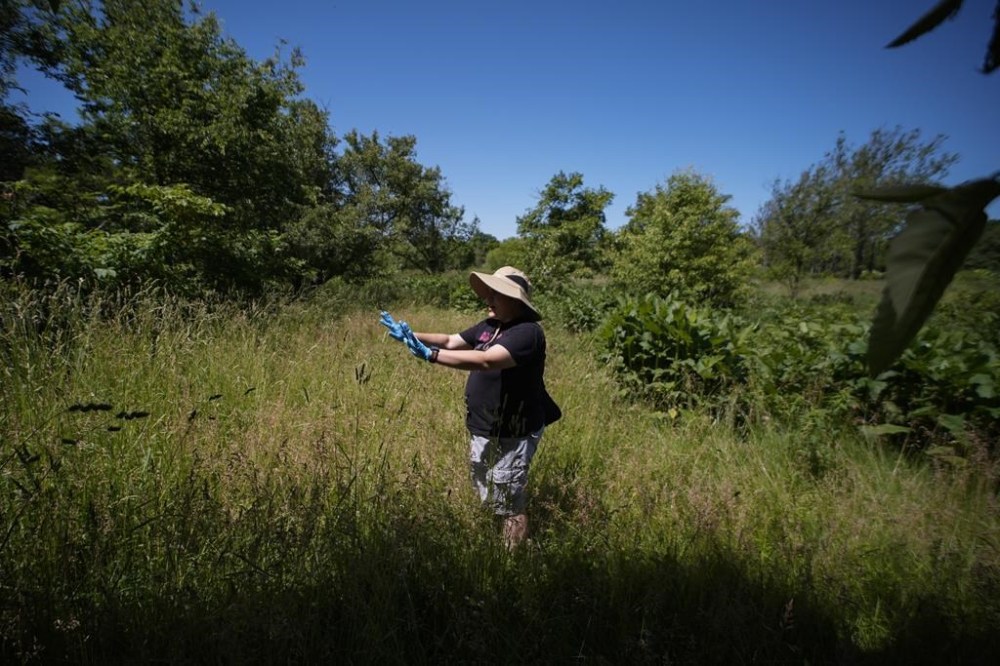
West Virginia University mycology research assistant Angie Macias searches for periodical cicadas infected with the Massospora cicadina fungus at Morton Arboretum on Thursday, June 6, 2024, in Lisle, Ill. Massospora cicadina is the only fungus on Earth that makes amphetamine. It takes control over the cicada, makes them hypersexual, looking to spread the parasite as a sexually transmitted disease. (AP Photo/Carolyn Kaster)

This particular fungus has the largest known genome of any fungus. It has about 1.5 billion base pairs, about 30 times longer than many of the more common fungi we know, Kasson said. And when these periodical cicadas live underground for 17 years (or 13 years in the U.S. South), the spores generally stay down there with them.

“This was a mycological oddity for a long time,” Kasson said. “It’s got the biggest genome. It produces wild compounds. It keeps the host active — all these quirks to it.”

Kasson decided to ask people from around the country to send in infected cicadas this year. And despite an injured leg, Kasson, his son and Macias travelled from West Virginia to the Morton Arboretum outside Chicago, where others have reported the fungus that takes over a cicada’s nether parts, dumping the genitalia and replacing it with a white, gummy yet flaky plug that’s pretty noticeable. The spores then fall out like salt from a shaker.

Infected cicadas are supposed to be hard to find.

Ten seconds after she hops off the golf cart, Macias is in the trees, looking. She emerges victorious, hand in the air with a cicada, yelling “I got one.”

“That was just lucky,” Oliver whines.

“Luck, huh? Let’s see you get one,” Macias replies.

Ten seconds later at a neighboring bush, Oliver finds another. And just a bit after that a photographer finds a third.

Kasson and his small team collected 36 infected cicadas in his brief Chicago area jaunt with people sending him another 200 or so from all over. He’s still waiting for an RNA analysis of the fungus.

Some cicada experts have estimated maybe one in 1,000 of the periodical cicadas are infected with this fungus, but it’s not much more than a guess. Mount St. Joseph University’s Gene Kritsky, a biologist who wrote the book on this year’s unique dual emergence, said it might be skewed because the healthy cicadas stay higher up in the trees.

This year “the fungus is about how it always is,” Cooley said in an email. “It’s not super common.”

There’s debate among scientists if the fungus infects more cicadas deep in the soil coming out of the ground after 13 or 17 years or if it infects the newly hatched nymphs on the way underground for more than a decade.

This fungus isn’t the type of parasite that kills its host, but instead it needs to keep it alive, Kasson said. Then the infected cicadas attempt to mate with others, spreading the spores to its mate/victim. The males even pretend in their hypersexualized state to be females to entice and infect other males, he said.

The cousin to this fungus which infects annual cicadas out west also makes a psychoactive compound in the cicadas but it is more akin to psychedelics like magic mushrooms, Kasson said. So sometimes people, even experts, mix up the amphetamine that the infected 17- and 13-year cicadas produce with the more trippy compounds of the annual bugs, he said.

Either way, don’t try it at home. Even though cicadas themselves are edible, not so much the infected ones.

In the interest of science, Kasson tried one during this emergence, making sure they were from the inside of a female so more antiseptic.

“Man, it was so bitter,” Kasson said, explaining that he immediately rinsed his mouth out. “It tasted like something you would consider poisonous.”

___

Read more of AP’s climate coverage at http://www.apnews.com/climate-and-environment

___

Follow Seth Borenstein on X at @borenbears

___

The Associated Press’ climate and environmental coverage receives financial support from multiple private foundations. AP is solely responsible for all content. Find AP’s standards for working with philanthropies, a list of supporters and funded coverage areas at AP.org.


Report Error Submit a Tip

More Stories

Hydro is getting ahead of itself

Tim Sale 5 minute read 2:00 AM CDT

Manitoba Hydro is pressing ahead with its proposed $3-billion gas-turbine project in Brandon as though approval was a foregone conclusion. Six weeks of Public Utilities Board hearings exposed serious doubts about the need for three turbines, their escalating cost and whether more affordable alternatives have been adequately examined. Yet before the PUB has delivered its recommendations and the government has authorized the investment, Hydro applied for an environmental license on Oct. 8.

Starting the environmental review early may save time but proceeding before the premier and his cabinet have made a decision risks reducing regulatory scrutiny and political approval to mere formalities. Has the government already given Hydro the green light?

Few dispute that Manitoba will need more capacity as demand grows. Daymark Energy Advisors, the PUB’s independent consultant, concluded that Hydro had established a need for additional capacity by 2030. However, Daymark questioned the size of the projected shortfall, Hydro’s load forecasts and its turbine cost assumptions. Hydro itself acknowledged that its planning costs were based on 2024 information, and that surging North American demand for gas turbines has since put significant upward pressure on prices. Then there’s the impact of Trump’s trade war. These are not minor details, but updated costs have not been obtained.

The bigger problem is how Hydro has framed the alternatives. Interim CEO Hal Turner recently argued that wind and battery storage alone cannot reliably carry Manitoba through prolonged extreme cold. Fair enough. However, critics are not proposing wind and batteries alone.

Outbreak should never have happened

Editorial 4 minute read Preview

Outbreak should never have happened

Editorial 4 minute read Yesterday at 2:00 AM CDT

The headline offered a vague sense that something had been accomplished, but it most certainly did not describe anything worth celebrating:

“Manitoba declares measles outbreak over.”

The news item in the Oct. 17 Free Press noted provincial public health officials had confirmed Manitoba’s last laboratory-confirmed case of measles was identified in August, and that the absence of any new cases since had allowed for the aforementioned declaration.

The end of the outbreak — which began in February 2025 and included a significant stretch this year during which Manitoba experienced more measles cases than any other province — is certainly worth noting. But it bears reminding that the real story here is that this province, and others across Canada, experienced a resurgence of this highly communicable but successfully eradicated disease in the first place.

Read
Yesterday at 2:00 AM CDT

Henderson crosswalk has glaring safety gap, say researchers months after pedestrian killed

Maggie Macintosh 5 minute read Preview

Henderson crosswalk has glaring safety gap, say researchers months after pedestrian killed

Maggie Macintosh 5 minute read Yesterday at 2:00 AM CDT

Six months after a fatal collision at a crosswalk on Henderson Highway, two traffic safety researchers question why the intersection remains an outlier that is missing key flashing lights.

The City of Winnipeg is being urged to install “backflashers” to better protect road users moving in all directions at the intersection where a 32-year-old father died in the spring.

“It’s these little, mundane, non-sexy engineering problems that can cause everything right up to fatality,” said Curt Pankratz, an associate professor at the University of Winnipeg who studies traffic engineering and policymaking.

On April 19, shortly before sunrise, Gabe Beardy was struck when he was crossing the six-lane thoroughfare at Neil Avenue.

Read
Yesterday at 2:00 AM CDT

Movie preview: Winnipeg-shot biopic on Arthur Rimbaud as daring as its subject

Randall King 4 minute read Preview

Movie preview: Winnipeg-shot biopic on Arthur Rimbaud as daring as its subject

Randall King 4 minute read Yesterday at 2:01 AM CDT

Simultaneously huge in its biographical breadth and intimate in its scale, Patrick Wang’s film A. Rimbaud is a portrait of the 19th-century poet Arthur Rimbaud, a grand, 175-minute biopic that eschews the genre’s convention with the adventurous spirit Rimbaud applied to the written word.

Read
Yesterday at 2:01 AM CDT

U of W, former professor sued over alleged sex assault

Erik Pindera 4 minute read Preview

U of W, former professor sued over alleged sex assault

Erik Pindera 4 minute read Wednesday, Oct. 21, 2026

A woman who studied and worked at the University of Winnipeg has filed a lawsuit against the post-secondary institution and her former professor — a convicted sex offender — who she alleges drugged and sexually assaulted her.

Read
Wednesday, Oct. 21, 2026

Bibi, the ‘anti-Bibi’ and the ‘wanna-Bibis’

Gwynne Dyer 5 minute read Preview

Bibi, the ‘anti-Bibi’ and the ‘wanna-Bibis’

Gwynne Dyer 5 minute read 2:00 AM CDT

According to the 1970s anarchist slogan, “No matter who you vote for, the government always gets in.”

That’s certainly true for the election in Israel on Tuesday, even if the winner is not Prime Minister Benjamin (Bibi) Netanyahu himself. All the other party leaders, says Israeli journalist Anshel Pfeffer, are just “wanna-Bibis.”

Or rather, all the rest except one. Former general Gadi Eisenkot, the main opposition candidate, is the “anti-Bibi,” Pfeffer says. He’s a working-class hero who joined the army as a private and worked his way up to chief of staff of the Israel Defence Forces (IDF). He retired and went into politics only four years ago, he’s modest and honest, what’s not to love?

Eisenkot certainly stands out among the party leaders in terms of style, but not so much in terms of actual policies. He was realistic enough to know that “total victory’ over Hamas was not likely, but his “Dahiya” strategy of causing “immense damage and destruction” (in Lebanon in the 2006 war) foreshadowed the cataclysm that the IDF has inflicted on Gaza since 2023.

Read
2:00 AM CDT