One year after news ban, Facebook important source for weather updates in disasters
Advertisement
Read this article for free:
or
Already have an account? Log in here »
To continue reading, please subscribe:

Digital Subscription
One year of digital access for only $205*
- Enjoy unlimited reading on winnipegfreepress.com
- Read the E-Edition, our digital replica newspaper
- Access News Break, our award-winning app
- Play interactive puzzles
*First annual payment billed as $205.00 + GST for one year. This annual subscription will automatically renew at $233.00 + GST every 52 weeks (10% off the regular annual price of $259.35). Offer available to new and qualified returning subscribers only. Cancel any time.
To continue reading, please subscribe:
Add Free Press access to your Brandon Sun subscription for only an additional
$1 for the first 4 weeks*
- Enjoy unlimited reading on winnipegfreepress.com
- Read the E-Edition, our digital replica newspaper
- Access News Break, our award-winning app
- Play interactive puzzles
*Your next Brandon Sun subscription payment will increase by $1.00 and you will be charged $17.95 plus GST for four weeks. After four weeks, your payment will increase to $24.95 plus GST every four weeks.
Read unlimited articles for free today:
or
Already have an account? Log in here »
Hey there, time traveller!
This article was published 08/08/2024 (790 days ago), so information in it may no longer be current.
HALIFAX – Residents of small communities across Canada are finding creative ways of getting around Facebook’s news blackout to share updates about dangerous weather events, but they say it’s still tough to get information to people quickly on the platform.
One year after Meta, Facebook’s parent company, banned all links to Canadian news on its platforms — a reaction to the federal government’s legislation requiring tech giants to compensate news companies for linking to their content — the site remains a critical tool for people to stay informed about events such as flash floods.
In the fall of 2021, Amanda Dunfield helped launch a Facebook page dedicated to informing residents of Windsor, N.S., about repeated sewer overflows after heavy rainfalls, and to organize them to do something about it.

Three years later, the group boasts nearly 3,000 members. But Dunfield said that Meta’s news ban, which went into effect in August 2023, is “tough to work around” to provide fast and accurate information to the community.
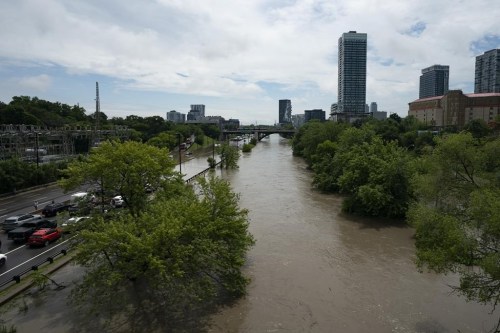
When the Meta news blackout began, Nova Scotia was reeling from two weather emergencies. In late May, an unprecedented wildfire consumed 900 hectares in the Halifax suburb of Upper Tantallon forcing more than 16,000 people to evacuate and destroying 151 homes. In July, flash flooding swept through the province, devastating townships in the Annapolis Valley, where four people, including two children, were killed.
Windsor was hit especially hard by last year’s flash flooding. Dunfield said that during that time, Facebook was the easiest place for her to get information. “We were pretty swamped here, and our only true access to information was what we got off Facebook,” she said.
By Aug. 9, 2023, while the cleanup was nearing its end in Windsor, Canadian news links completely disappeared from Facebook. Since then, Dunfield said she and members of her group have had to get creative.
Dunfield said she will often find news articles through Google searches, then take screenshots of the stories, and copy-paste images of the articles onto the Facebook page. Other times she’ll type directly to group members about where they can find news.
“Quite a bit of time gets invested into creating the posts,” she said.
Her Facebook page — Flood Zone, Windsor, NS — is filled with photos and videos of flash flooding shared by locals, or of the aftermath of flooding. Other pages include questions from group members about the municipality’s flood preparation and response to extreme weather events.
One post on Wednesday by an anonymous group member asks whether water is safe for consumption. One response says, “I’m pretty sure the municipality just mentioned not too long ago that the water is tested weekly, at various sites.”
Flood-weary Windsor isn’t the only community where people rely on Facebook to get information despite the news ban. Ollie Williams, editor of Cabin Radio in the Northwest Territories, said that before the Meta ban, Facebook functioned as a “utility” for many in the territory, adding that the platform was the first place where people would go to get news.
The Meta ban came down about two weeks before Yellowknife and surrounding areas were evacuated because of a wildfire. The timing of Meta’s decision incited a chorus of criticism from people, Williams included, who recognized the absence of news could be dangerous for those trying to evacuate.
Williams said there was no way for Cabin Radio to share news on Facebook or Instagram when Yellowknife was evacuated, but that didn’t stop its audience from finding alternative ways to share information.
“People reading our coverage were very quick to find ways around the Meta news ban such as screenshotting articles or sharing them privately,” he said in an interview.
“Our audience took on the burden of figuring out, ‘How are we going to share this information on Facebook and Instagram?’”
Trish Audette-Longo, a journalism professor at Carleton University, says residents will “always” find ways to let their neighbours know what’s happening.
She said Facebook is unique because of its community-oriented interface. In comparison, the X platform allows for a more chronological presentation of news, where stories are shared through short, fast posts. Facebook, meanwhile, is better suited to invite a conversation with a particular community on a single post.
The Liberal government’s Online News Act required Meta and Google to enter into negotiation with news publishers for licensing agreements to their content. In response, Meta removed news links from its platform and Google was granted an exemption to the law by agreeing to pay Canadian news outlets $100 million a year.
One year after the news ban, a study released Aug. 1 by the Media Ecosystem Observatory found that news consumption on social media is down across all platforms by 43 per cent. However, the study said most users logging onto Meta platforms still use them to read, listen to, or watch news. The study found 70 per cent of Facebook users and 65 per cent of Instagram users access news media on those platforms.
Audette-Longo said the ban is concerning because it makes sourcing verified and accurate information more difficult, and could potentially reducethe scope of news content that would otherwise be accessible. “(News) empowers the audience in that it literally gives them information that they can use to make decisions,” she said.
“It provides more sourcing, more perspectives, information about folks that aren’t your immediate neighbours.”
Dunfield said she hopes to be able to get timely information back on her newsfeed in the future. “It would be lovely to share news links on Facebook. I think we’d all be the better for it.”
This report by The Canadian Press was first published Aug. 8, 2024.
Related Articles
Ottawa says Meta may still see Online News Act regulation — but CRTC wants more proof






Advertisement Advertise With Us
Advertisement Advertise With Us