OceanGate co-founder says he hopes submersible tragedy yields renewed interest in exploration

Advertisement

Advertise with us

The co-founder of the company that owned the experimental submersible that imploded en route to the wreckage of the Titanic told a Coast Guard panel Monday he hoped the silver lining of the disaster would be that it inspires a renewed interest in exploration, including the deepest waters of the world's oceans.

Read this article for free:


or

Already have an account? Log in here »

To continue reading, please subscribe:

Subscribe and receive a limited-edition Free Press branded hat or tote.

Digital Subscription

One year of digital access for only $205*

  • Enjoy unlimited reading on winnipegfreepress.com
  • Read the E-Edition, our digital replica newspaper
  • Access News Break, our award-winning app
  • Play interactive puzzles

*First annual payment billed as $205.00 + GST for one year. This annual subscription will automatically renew at $233.00 + GST every 52 weeks (10% off the regular annual price of $259.35). Offer available to new and qualified returning subscribers only. Cancel any time.

To continue reading, please subscribe:

Add Free Press access to your Brandon Sun subscription for only an additional

$1 for the first 4 weeks*

  • Enjoy unlimited reading on winnipegfreepress.com
  • Read the E-Edition, our digital replica newspaper
  • Access News Break, our award-winning app
  • Play interactive puzzles
Start now

*Your next Brandon Sun subscription payment will increase by $1.00 and you will be charged $17.95 plus GST for four weeks. After four weeks, your payment will increase to $24.95 plus GST every four weeks.

Hey there, time traveller!
This article was published 22/09/2024 (738 days ago), so information in it may no longer be current.

The co-founder of the company that owned the experimental submersible that imploded en route to the wreckage of the Titanic told a Coast Guard panel Monday he hoped the silver lining of the disaster would be that it inspires a renewed interest in exploration, including the deepest waters of the world’s oceans.

“This can’t be the end of deep ocean exploration. This can’t be the end of deep-diving submersibles and I don’t believe that it will be,” said businessman Guillermo Sohnlein, who helped found OceanGate with Stockton Rush.

Sohnlein ultimately left the company before the Titan disaster in June 2023. Rush was among the five people who died when the submersible imploded. Though Sohnlein left the Washington company years ago, he spoke in defense of its efforts in the aftermath of the submersible’s implosion.

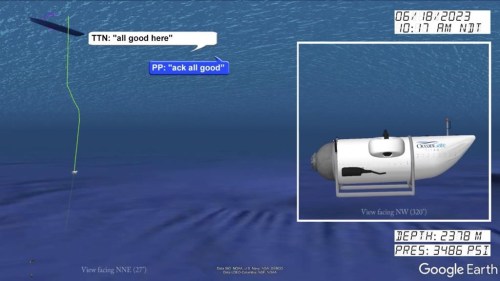
In a still from from a video animation provided by the United States Coast Guard an illustration of the Titan submersible, right, is shown near the ocean floor of the Atlantic Ocean, as June 18, 2023 communications between the submersible and the support vessel Polar Prince, not shown, are represented at left. (United States Coast Guard via AP)

On Monday, he testified that the company wanted to create a fleet of four or five deep-diving submersibles capable of carrying five people to 6,000 meters (6,500 yards) deep. The plan for the company was to have no dedicated mothership — which would’ve lowered costs substantially, he said.

“We wanted to give humanity greater access to the ocean, specifically the deep ocean,” Sohnlein said.

Sohnlein testified that the company zeroed in on the use of carbon fiber for the doomed vessel because the company wanted a lightweight, less costly submersible that did not need to be tethered to a specific mother ship. He testified that the use of carbon fiber as “not a novel idea” and said “people have looked at that before.”

No existing submersible builders could meet the company’s requirements, necessitating the pivot to building its own subs, Sohnlein said. And he said the company worked closely with the Coast Guard during development.

Sohnlein said he had the opportunity to dive in Titan “many times” and he declined. He said his reasons included not wanting to take space away from potential customers. He said when Rush reached a point when it was “time to put a human in there,” he wanted to do it himself. Rush felt it was his design and said “if anything happens, I want it to impact me,” Sohnlein said.

The Coast Guard opened a public hearing earlier this month that is part of a high level investigation into the cause of the implosion. Some of the testimony has focused on the troubled nature of the company.

Earlier in the hearing, former OceanGate operations director David Lochridge said he frequently clashed with Rush and felt the company was committed only to making money. “The whole idea behind the company was to make money,” Lochridge testified. “There was very little in the way of science.”

Sohnlein said Monday that neither he nor Rush was ever “driven by tourism” and the idea of visiting the Titanic, which had already been explored by others, was not exciting to either of them.
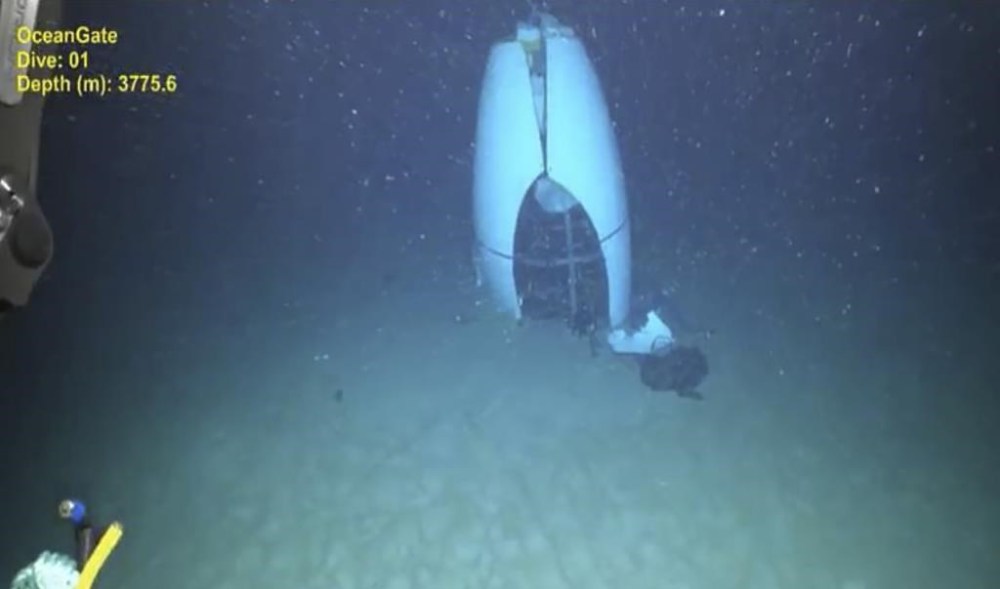
This June 2023 image provided by Pelagic Research Services shows remains of the Titan submersible on the floor of the Atlantic Ocean. (Pelagic Research Services via AP)

But Lochridge and other witnesses painted a picture of a troubled company that was impatient to get its unconventionally designed craft into the water. The accident set off a worldwide debate about the future of private undersea exploration.

Phil Brooks, a former OceanGate engineering director who testified Monday, said economic issues with the company included that it was asking workers to forego paychecks for periods of time with the promises that they would be caught up in the future. The financial problems with the company seemed to affect safety decisions, he said.

“It was clear that the company was economically very stressed and as a result that they were making decisions and doing things that resulted in, I felt, that the safety was just being compromised way too much,” he said.

An earlier engineering director with the company testified last week that he felt pressured to get the vessel ready to dive and refused to pilot it for a journey several years earlier. Tony Nissen said Rush could be difficult to work for and was often very concerned with costs and project schedules.

Sohlein also testified Monday that he left the company in 2013 as the company transitioned to engineering, which he described as a bigger strength of Rush’s than his. He said it was a “fairly easy decision” for Rush to take over the company, but it was more difficult to decide whether to stay on at all.

The hearing is expected to run through Friday and include more witnesses. Roy Thomas of the American Bureau of Shipping also testified Monday and detailed the challenges associated with carbon fiber as a material for submersibles. He said carbon fiber is “susceptible to fatigue failure under repeated external pressurization.”

Coast Guard officials noted at the start of the hearing that the submersible had not been independently reviewed, as is standard practice. That and Titan’s unusual design subjected it to scrutiny in the undersea exploration community.

OceanGate, based in Washington state, suspended its operations after the implosion. The company has no full-time employees currently, but has been represented by an attorney during the hearing.
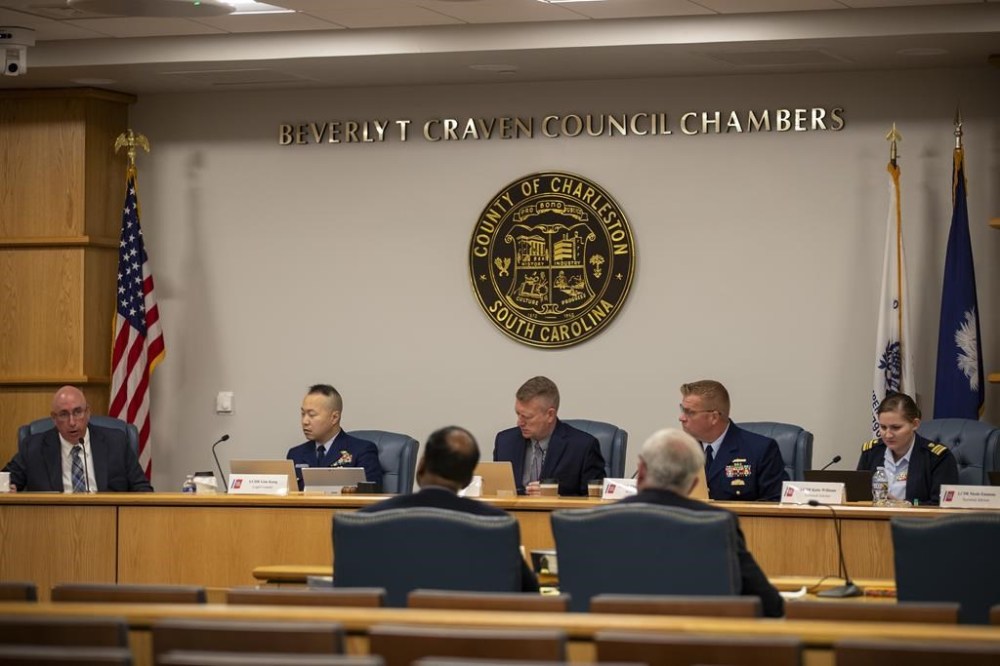
Members of the Coast Guard's Titan Submersible Marine Board of Investigation listen during the formal hearing inside the Charleston County Council Chambers, Monday, Sept. 23, 2024, in North Charleston, S.C. (Laura Bilson/The Post And Courier via AP, Pool)

During the submersible’s final dive on June 18, 2023, the crew lost contact after an exchange of texts about Titan’s depth and weight as it descended. The support ship Polar Prince then sent repeated messages asking if Titan could still see the ship on its onboard display.

One of the last messages from Titan’s crew to Polar Prince before the submersible imploded stated, “all good here,” according to a visual re-creation presented earlier in the hearing.

When the submersible was reported overdue, rescuers rushed ships, planes and other equipment to an area about 435 miles (700 kilometers) south of St. John’s, Newfoundland. Wreckage of the Titan was subsequently found on the ocean floor about 330 yards (300 meters) off the bow of the Titanic, Coast Guard officials said. No one on board survived.

OceanGate said it has been fully cooperating with the Coast Guard and NTSB investigations since they began. Titan had been making voyages to the Titanic wreckage site going back to 2021.

Report Error Submit a Tip

More Stories

In a smart-device world, some families keep phone jacked into the wall

Sheldon Birnie 8 minute read Preview

In a smart-device world, some families keep phone jacked into the wall

Sheldon Birnie 8 minute read Yesterday at 4:20 PM CDT

When the phone rings in Kristin Shiach and Jordan Sobkowicz’s Riverview home, their three daughters race to see who can be the first to answer.

“It depends who is closest,” says 13-year-old Emily. “If I’m sitting in my room, I can get to it quickest.”

“That’s because it’s always in your room,” Anna, 10, replies. “You never put it back!”

“Usually, when the phone rings,” explains Sobkowicz, “someone yells really loudly —”

Read
Yesterday at 4:20 PM CDT

Province to acquire campground near former residential school

Morgan Modjeski 3 minute read Preview

Province to acquire campground near former residential school

Morgan Modjeski 3 minute read Yesterday at 6:00 AM CDT

A burial site for dozens of children who died while attending the Brandon Indian Residential School will be acquired by the province, the Free Press has learned.

Premier Wab Kinew will announce the province’s plan to protect Turtle Crossing Campground at a news conference in Brandon Wednesday to mark National Day for Truth and Reconciliation. The move is in partnership with the City of Brandon.

The graves of at least 56 children are located at the campground, the Sioux Valley Dakota Nation has said, pointing to a geophysical study conducted by an archaeology firm in 2018.

There have been longstanding concerns from Indigenous leaders and community members that people were camping on the resting place of children victimized by colonialism.

Read
Yesterday at 6:00 AM CDT

Klein vows to freeze water, sewer rate for next two years

Joyanne Pursaga 5 minute read Preview

Klein vows to freeze water, sewer rate for next two years

Joyanne Pursaga 5 minute read Yesterday at 6:09 PM CDT

Mayoral candidate Kevin Klein is promising to cancel a water and sewer rate hike proposed for next year and freeze the fee for two years.

Klein said Winnipeggers are simply paying far too much for the utility.

“I think we have to freeze them right now because we’ve seen (a substantial increase) in the last four years. We are facing some of the most difficult financial times for families right now,” he said.

He would also ask the provincial Public Utilities Board to set Winnipeg’s future water and sewer rates, a power currently held by city council.

Read
Yesterday at 6:09 PM CDT

OceanGate co-founder says he hopes submersible tragedy yields renewed interest in exploration

Patrick Whittle, The Associated Press 6 minute read Preview

OceanGate co-founder says he hopes submersible tragedy yields renewed interest in exploration

Patrick Whittle, The Associated Press 6 minute read Monday, Sep. 23, 2024

The co-founder of the company that owned the experimental submersible that imploded en route to the wreckage of the Titanic told a Coast Guard panel Monday he hoped the silver lining of the disaster would be that it inspires a renewed interest in exploration, including the deepest waters of the world's oceans.

“This can’t be the end of deep ocean exploration. This can’t be the end of deep-diving submersibles and I don’t believe that it will be,” said businessman Guillermo Sohnlein, who helped found OceanGate with Stockton Rush.

Sohnlein ultimately left the company before the Titan disaster in June 2023. Rush was among the five people who died when the submersible imploded. Though Sohnlein left the Washington company years ago, he spoke in defense of its efforts in the aftermath of the submersible’s implosion.

On Monday, he testified that the company wanted to create a fleet of four or five deep-diving submersibles capable of carrying five people to 6,000 meters (6,500 yards) deep. The plan for the company was to have no dedicated mothership — which would've lowered costs substantially, he said.

Read
Monday, Sep. 23, 2024

Port of Churchill signs agreement with Dutch port

Aaron Epp 2 minute read Preview

Port of Churchill signs agreement with Dutch port

Aaron Epp 2 minute read Yesterday at 4:40 PM CDT

Arctic Gateway Group, operator of the Port of Churchill, has signed an agreement with the Port of Rotterdam in the Netherlands to attract business and strengthen supply chains linking Western Canada and Europe.

The agreement enables the two ports to work together to develop new trade in critical minerals and energy products, connect Canadian producers with European buyers, and identify opportunities to improve the supply chain from Western Canadian resource projects through Churchill and into European markets.

The Port of Rotterdam is Europe’s largest port and home to more than 3,000 businesses across its industrial complex, serving as a major gateway for critical raw materials and energy.

Meanwhile, the Port of Churchill has been identified as a transformative national strategy for Canada and is emerging as a northern trade corridor connecting Western Canada’s resources to global markets.

Read
Yesterday at 4:40 PM CDT

Teacher barred for ‘repeated boundary-crossing conduct’

Maggie Macintosh 3 minute read Monday, Sep. 28, 2026

A disciplinary panel has ordered the cancellation of a Chinese-Canadian teacher’s certificate because of her “repeated boundary-crossing with a student” during her tenure at an international school with local ties.

Janice Wen Ying Ma is permanently barred from teaching on Manitoba soil or at a Manitoba-accredited institution as of Sept. 14.

The new ruling concludes that Ma engaged in inappropriate physical interaction and “emotionally intimate online messages” with a girl who attended Clifford International School in Guangzhou, China in 2024-25.

“This conduct represents a fundamental departure from the standards expected of a teacher,” the panel, chaired by public representative Gordon Schumacher, wrote in its 22-page decision.