Control the path and power of hurricanes like Milton? Forget it, scientists say
Advertisement
Read this article for free:
or
Already have an account? Log in here »
To continue reading, please subscribe:

Digital Subscription
One year of digital access for only $205*
- Enjoy unlimited reading on winnipegfreepress.com
- Read the E-Edition, our digital replica newspaper
- Access News Break, our award-winning app
- Play interactive puzzles
*First annual payment billed as $205.00 + GST for one year. This annual subscription will automatically renew at $233.00 + GST every 52 weeks (10% off the regular annual price of $259.35). Offer available to new and qualified returning subscribers only. Cancel any time.
To continue reading, please subscribe:
Add Free Press access to your Brandon Sun subscription for only an additional
$1 for the first 4 weeks*
- Enjoy unlimited reading on winnipegfreepress.com
- Read the E-Edition, our digital replica newspaper
- Access News Break, our award-winning app
- Play interactive puzzles
*Your next Brandon Sun subscription payment will increase by $1.00 and you will be charged $17.95 plus GST for four weeks. After four weeks, your payment will increase to $24.95 plus GST every four weeks.
Read unlimited articles for free today:
or
Already have an account? Log in here »
Hey there, time traveller!
This article was published 07/10/2024 (709 days ago), so information in it may no longer be current.
Hurricanes are humanity’s reminder of the uncontrollable, chaotic power of Earth’s weather.
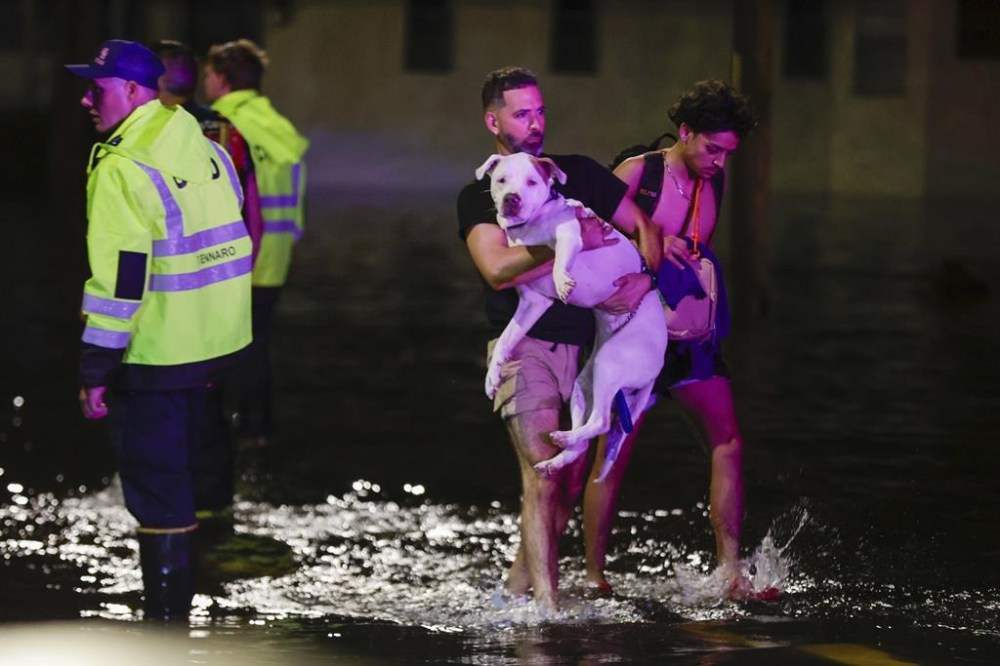
Milton’s powerful push toward Florida just days after Helene devastated large parts of the Southeast likely has some in the region wondering if they are being targeted. In some corners of the internet, Helene has already sparked conspiracy theories and disinformation suggesting the government somehow aimed the hurricane at Republican voters.
Besides discounting common sense, such theories disregard weather history that shows the hurricanes are hitting many of the same areas they have for centuries. They also presume an ability for humans to quickly reshape the weather far beyond relatively puny efforts such as cloud-seeding.
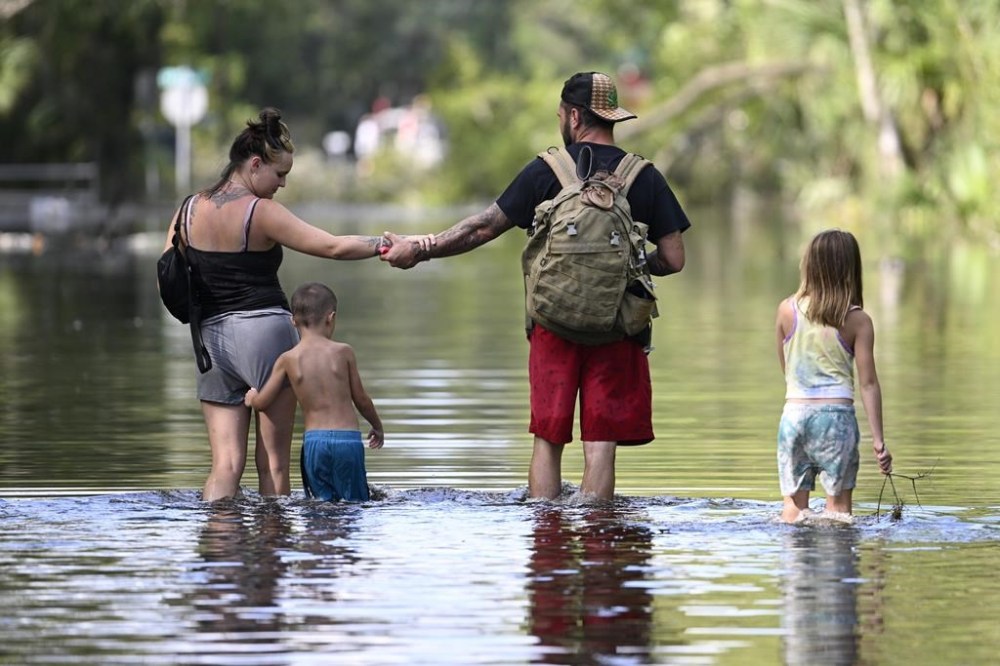
“If meteorologists could stop hurricanes, we would stop hurricanes,” said Kristen Corbosiero, a professor of atmospheric and environmental sciences at the University at Albany. “If we could control the weather, we would not want the kind of death and destruction that’s happened.”
Here’s a look at what humans can and can’t do when it comes to weather:
The power of hurricanes, heightened by climate change
A fully developed hurricane releases heat energy that is the equivalent of a 10-megaton nuclear bomb every 20 minutes — more than all the energy used at a given time by humanity, according to National Hurricane Center tropical analysis chief Chris Landsea.
And scientists are now finding many ways climate change is making hurricanes worse, with warmer oceans that add energy and more water in the warming atmosphere to fall as rain, said Chris Field, director of the Stanford Woods Institute for the Environment.
“The amount of energy a hurricane generates is insane,” said Colorado State University hurricane researcher Phil Klotzbach. It’s the height of human arrogance to think people have the power to change them, he said.
But that hasn’t stopped people from trying, or at least thinking about trying.
Historical efforts to control hurricanes have failed
Jim Fleming of Colby College has studied historical efforts to control the weather and thinks humans have nowhere near the practical technology to get there. He described an attempt in 1947 in which General Electric partnered with the U.S. military to drop dry ice from Air Force jets into the path of a hurricane in an attempt to weaken it. It didn’t work.
“The typical science goes like understanding, prediction and then possibly control,” Fleming said, noting that the atmosphere is far more powerful and complex than most proposals to control it. “It goes back into Greek mythology to think you can control the powers of the heavens, but also it’s a failed idea.”
In the 1960s, 1970s and 1980s, the federal government briefly tried Project STORMFURY. The idea was to seed a hurricane to replace its eyewall with a larger one that would make the storm bigger in size but weaker in intensity. Tests were inconclusive and researchers realized if they made the storm larger, people who wouldn’t have been hurt by the storm would now be in danger, which is an ethical and liability problem, the project director once said.
For decades, the National Hurricane Center and its parent agency, the National Oceanic and Atmospheric Administration, have been asked about nuclear-bombing a hurricane. But the bombs aren’t powerful enough, and it would add the problem of radioactive fallout, Corbosiero said.
Bringing cooling icebergs or seeding or adding water-absorbing substances also are ideas that just don’t work, NOAA scientists said.
Climate change begets engineering — and lots of questions
Failed historical attempts to control hurricanes differ somewhat from some scientists’ futuristic ideas to combat climate change and extreme weather. That’s because instead of targeting individual weather events, modern geoengineers would operate on a larger scale — thinking about how to reverse the broad-scale damage humans have already done to the global climate by emitting greenhouse gases.
Scientists in the field say one of the most promising ideas they see based on computer models is solar geoengineering. The method would involve lofting aerosol particles into the upper atmosphere to bounce a tiny bit of sunlight back into space, cooling the planet slightly.
Supporters acknowledge the risks and challenges. But it also “might have quite large benefits, especially for the world’s poorest,” said David Keith, a professor at the University of Chicago and founding faculty director of the Climate Systems Engineering Initiative.
Two years ago, the largest society of scientists who work on climate issues, the American Geophysical Union, announced it was forming an ethics framework for “climate intervention.”
Some scientists warn that tinkering with Earth’s atmosphere to fix climate change is likely to create cascading new problems. University of Pennsylvania climate scientist Michael Mann expressed worries on the ethics framework that just talking about guidelines will make the tinkering more likely to occur in the real world, something that could have harmful side effects.
Field, of Stanford, agreed that the modeling strongly encourages that geoengineering could be effective, including at mitigating the worst threats of hurricanes, even if that’s decades away. But he emphasized that it’s just one piece of the best solution, which is to stop climate change by cutting greenhouse gas emissions.
“Whatever else we do, that needs to be the core set of activities,” he said.
___

This story has corrected Michael Mann’s affiliation to the University of Pennsylvania, not Penn State.
___
Follow Melina Walling on X: @MelinaWalling.
___
The Associated Press’ climate and environmental coverage receives financial support from multiple private foundations. AP is solely responsible for all content. Find AP’s standards for working with philanthropies, a list of supporters and funded coverage areas at AP.org.
Related Articles
Fearful residents flee Tampa Bay region as Hurricane Milton takes aim at Florida coast
Advertisement Advertise With Us
Advertisement Advertise With Us