Climate change gave significant boost to Milton’s destructive rain, winds, scientists say

Advertisement

Advertise with us

Human-caused climate change intensified deadly Hurricane Milton 's rainfall by 20 to 30% and strengthened its winds by about 10%, scientists said in a new flash study. The analysis comes just two weeks after Hurricane Helene devastated the southeastern United States, a storm also fueled by climate change.

Read this article for free:


or

Already have an account? Log in here »

To continue reading, please subscribe:

Subscribe and receive a limited-edition Free Press branded hat or tote.

Digital Subscription

One year of digital access for only $205*

  • Enjoy unlimited reading on winnipegfreepress.com
  • Read the E-Edition, our digital replica newspaper
  • Access News Break, our award-winning app
  • Play interactive puzzles

*First annual payment billed as $205.00 + GST for one year. This annual subscription will automatically renew at $233.00 + GST every 52 weeks (10% off the regular annual price of $259.35). Offer available to new and qualified returning subscribers only. Cancel any time.

To continue reading, please subscribe:

Add Free Press access to your Brandon Sun subscription for only an additional

$1 for the first 4 weeks*

  • Enjoy unlimited reading on winnipegfreepress.com
  • Read the E-Edition, our digital replica newspaper
  • Access News Break, our award-winning app
  • Play interactive puzzles
Start now

*Your next Brandon Sun subscription payment will increase by $1.00 and you will be charged $17.95 plus GST for four weeks. After four weeks, your payment will increase to $24.95 plus GST every four weeks.

Hey there, time traveller!
This article was published 11/10/2024 (670 days ago), so information in it may no longer be current.

Human-caused climate change intensified deadly Hurricane Milton ‘s rainfall by 20 to 30% and strengthened its winds by about 10%, scientists said in a new flash study. The analysis comes just two weeks after Hurricane Helene devastated the southeastern United States, a storm also fueled by climate change.

World Weather Attribution researchers said Friday that without climate change, a hurricane like Milton would make landfall as a weaker Category 2, not considered a “major” storm, instead of a Category 3.

WWA’s rapid studies aren’t peer-reviewed but use peer-reviewed methods. The WWA compares a weather event with what might have been expected in a world that hasn’t warmed about 1.3 degree Celsius since pre-industrial times.

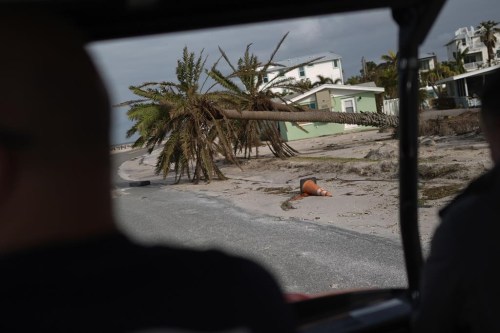
FILE - Toppled palm tress lie alongside a road in Bradenton Beach on Anna Maria Island, Fla., Oct. 10, 2024. (AP Photo/Rebecca Blackwell, File)

The team of scientists test the influence of climate change on storms by analyzing weather data and climate models, but in the case of Milton — which followed so shortly after Helene — the researchers used only weather observations data. WWA said despite using different approaches, the results are compatible with studies of other hurricanes in the area that show a similar hurricane intensity increase of between 10 and 50% due to climate change, and about a doubling in likelihood.

“We are therefore confident that such changes in heavy rainfall are attributable to human-caused climate change,” said WWA, an international scientist collaborative that launched in 2015 and conducts rapid climate attribution studies.

At least eight people died in Milton, which spread damage far and wide even though it didn’t directly strike Tampa as feared. Roadways flooded and dozens of tornadoes tore through coastal areas. At one point power was out to some 3.4 million customers, and more than 2.4 million remained without power Friday morning.

Milton made landfall Wednesday evening as a Category 3 hurricane on the west coast of Florida near Siesta Key, about 70 miles (112 kilometers) south of the Tampa Bay area, driven by warmer waters near record levels.

Climate scientist Michael Mann said he agrees with the thrust of the analysis that climate change substantially worsened the hurricane. But if anything, Mann said, the study might “vastly understate the impact that it actually had” with what he called “the fairly simple approach” of its estimates.

He cited other attribution studies after Helene that calculated significantly larger rainfall due to warming.

“It’s the difference between a modest effect and a major effect,” Mann, of the University of Pennsylvania, told The Associated Press. “I would argue that the catastrophic flooding we saw over large parts of the southeastern U.S. with Helene was indeed a major effect of human-caused warming.”

Jeff Masters, a meteorologist who co-founded the commercial weather service Weather Underground, said the study looked solid to him.

“I support their conclusion that without climate change, Hurricane Milton would have hit as a Cat 2, not a Cat 3,” he said.

Another analysis, done by research organization Climate Central, said earlier this week that climate change made possible the warmed water temperatures that amplified Milton. Andrew Pershing, the group’s vice president for science, said those waters were made up to 200 times more likely with climate change. The group said waters were more than 1.8 degrees F (1 degrees C) warmer than the 1991 to 2020 average.

___

Read more of AP’s climate coverage at http://www.apnews.com/climate-and-environment

___

The Associated Press’ climate and environmental coverage receives financial support from multiple private foundations. AP is solely responsible for all content. Find AP’s standards for working with philanthropies, a list of supporters and funded coverage areas at AP.org.


Report Error Submit a Tip

More Stories

Student union coalition scrutinized, accused of providing minimal benefit for fees paid

Maggie Macintosh 5 minute read Preview

Student union coalition scrutinized, accused of providing minimal benefit for fees paid

Maggie Macintosh 5 minute read Updated: Yesterday at 8:36 AM CDT

Despite being labelled as “permanently closed” online and maintaining a website filled with outdated information, a coalition of student unions is defending itself as an active entity deserving of fees in spite of its low profile.

The Canadian Federation of Students and its local chapter, better known as CFS-MB, collect annual membership dues from campuses across the province to support their advocacy work.

Alan Saji Koshy’s advice to new and returning students to the University of Winnipeg? “Start asking questions.”

“We pay hundreds of thousands of dollars for practically no benefit and students don’t even know (CFS-MB resources) exist,” the recent graduate and former student association president said.

Read
Updated: Yesterday at 8:36 AM CDT

A new chapter: Renamed Winnipeg Book Festival takes to The Forks this fall

Ben Sigurdson 5 minute read Preview

A new chapter: Renamed Winnipeg Book Festival takes to The Forks this fall

Ben Sigurdson 5 minute read Yesterday at 4:22 PM CDT

Winnipeg’s long-running annual literary festival returns this fall, once again featuring a slate of authors, local and beyond, ready to engage with readers.

New this year is pretty much everything else, including a new name, executive director and team of staff — as well as a shift to a tight, condensed timeline and a move to hold all events under one roof.

The festival formerly known as Thin Air/Livres en fête is now the Winnipeg Book Festival; the event takes place Oct. 1-4 at The Forks Market, with most events offering free admission.

It’s a lot of changes for the stalwart literary festival, which was run for more than two decades by Charlene Diehl, who stepped away in late 2025.

Read
Yesterday at 4:22 PM CDT

Climate change gave significant boost to Milton’s destructive rain, winds, scientists say

Alexa St. John, The Associated Press 3 minute read Preview

Climate change gave significant boost to Milton’s destructive rain, winds, scientists say

Alexa St. John, The Associated Press 3 minute read Friday, Oct. 11, 2024

Human-caused climate change intensified deadly Hurricane Milton 's rainfall by 20 to 30% and strengthened its winds by about 10%, scientists said in a new flash study. The analysis comes just two weeks after Hurricane Helene devastated the southeastern United States, a storm also fueled by climate change.

World Weather Attribution researchers said Friday that without climate change, a hurricane like Milton would make landfall as a weaker Category 2, not considered a “major” storm, instead of a Category 3.

WWA’s rapid studies aren’t peer-reviewed but use peer-reviewed methods. The WWA compares a weather event with what might have been expected in a world that hasn’t warmed about 1.3 degree Celsius since pre-industrial times.

The team of scientists test the influence of climate change on storms by analyzing weather data and climate models, but in the case of Milton — which followed so shortly after Helene — the researchers used only weather observations data. WWA said despite using different approaches, the results are compatible with studies of other hurricanes in the area that show a similar hurricane intensity increase of between 10 and 50% due to climate change, and about a doubling in likelihood.

Read
Friday, Oct. 11, 2024

A mission to make hearing care easier to access

Aaron Epp 5 minute read Preview

A mission to make hearing care easier to access

Aaron Epp 5 minute read 2:00 AM CDT

Armando Di Lello was four years old when he was diagnosed with hearing loss in both ears and received his first hearing aids. He doesn’t remember that moment, but he recalls moments that followed.

“Going through elementary, middle school, high school — it was definitely something that was not a positive experience for me,” he said.

Di Lello’s hearing aids were big, bulky and noisy, and he chose not to wear them much of the time.

“I didn’t perceive the benefit as a kid,” he said. “No kid wants to appear different.”

Read
2:00 AM CDT

Transcona councillor faces new sex assault charge

Erik Pindera 5 minute read Preview

Transcona councillor faces new sex assault charge

Erik Pindera 5 minute read Updated: Yesterday at 6:40 PM CDT

A city councillor charged with sex assault earlier this year faces new sex charges in a separate incident, in a case Winnipeg’s mayor called “deeply concerning.”

Transcona Coun. Russ Wyatt, 56, was charged Monday with sexual assault and administering a noxious thing with intent to aggrieve or annoy over an October 2023 incident.

Allegations of a 2023 assault were reported to the Winnipeg Police Service in April, a month after Wyatt was charged with sex assault in relation to a 2025 incident.

In the 2023 incident, a man told police he become acquainted with Wyatt through a website in July of that year and said they met in person on more than one occasion.

Read
Updated: Yesterday at 6:40 PM CDT

Long-awaited supervised drug consumption site opens quietly after months of loud opposition

Malak Abas 11 minute read Preview

Long-awaited supervised drug consumption site opens quietly after months of loud opposition

Malak Abas 11 minute read Updated: Yesterday at 5:57 PM CDT

After three years of planning, delays and constant controversy, Manitoba’s first supervised drug consumption site quietly opened its doors Tuesday morning.

Read
Updated: Yesterday at 5:57 PM CDT