Judge hears closing arguments on whether Google’s advertising tech constitutes a monopoly
Advertisement
Read this article for free:
or
Already have an account? Log in here »
To continue reading, please subscribe:

Digital Subscription
One year of digital access for only $205*
- Enjoy unlimited reading on winnipegfreepress.com
- Read the E-Edition, our digital replica newspaper
- Access News Break, our award-winning app
- Play interactive puzzles
*First annual payment billed as $205.00 + GST for one year. This annual subscription will automatically renew at $233.00 + GST every 52 weeks (10% off the regular annual price of $259.35). Offer available to new and qualified returning subscribers only. Cancel any time.
To continue reading, please subscribe:
Add Free Press access to your Brandon Sun subscription for only an additional
$1 for the first 4 weeks*
- Enjoy unlimited reading on winnipegfreepress.com
- Read the E-Edition, our digital replica newspaper
- Access News Break, our award-winning app
- Play interactive puzzles
*Your next Brandon Sun subscription payment will increase by $1.00 and you will be charged $17.95 plus GST for four weeks. After four weeks, your payment will increase to $24.95 plus GST every four weeks.
Read unlimited articles for free today:
or
Already have an account? Log in here »
Hey there, time traveller!
This article was published 25/11/2024 (664 days ago), so information in it may no longer be current.
ALEXANDRIA, Va. (AP) — Google, already facing a possible breakup of the company over its ubiquitous search engine, is fighting to beat back another attack by the U.S. Department of Justice alleging monopolistic conduct, this time over technology that puts online advertising in front of consumers.
The Justice Department and Google made closing arguments Monday in a trial alleging Google’s advertising technology constitutes an illegal monopoly.
U.S. District Judge Leonie Brinkema in Alexandria, Virginia, will decide the case and is expected to issue a written ruling by the end of the year. If Brinkema finds Google has engaged in illegal, monopolistic conduct, she will then hold further hearings to explore what remedies should be imposed.
The Justice Department, along with a coalition of states, has already said it believes Google should be forced to sell off parts of its ad tech business, which generates tens of billions of dollars annually for the Mountain View, California-based company.
After roughly a month of trial testimony earlier this year, the arguments in the case remain the same.
During three hours of arguments Monday, Brinkema, who sometimes tips her hand during legal arguments, did little to indicate how she might rule. She did, though, question the applicability of a key antitrust case Google cites in its defense.
The Justice Department contends Google built and maintained a monopoly in “open-web display advertising,” essentially the rectangular ads that appear on the top and right-hand side of the page when one browses websites.
Google dominates all facets of the market. A technology called DoubleClick is used pervasively by news sites and other online publishers, while Google Ads maintains a cache of advertisers large and small looking to place their ads on the right webpage in front of the right consumer.
In between is another Google product, AdExchange, that conducts nearly instantaneous auctions matching advertisers to publishers.
In court papers, Justice Department lawyers say Google “is more concerned with acquiring and preserving its trifecta of monopolies than serving its own publisher and advertiser customers or winning on the merits.”
As a result, content providers and news organizations have never been able to generate the online revenue they should due to Google’s excessive fees for brokering transactions between advertisers and publishers, the government says.
Google argues the government’s case improperly focuses on a narrow niche of online advertising. If one looks more broadly at online advertising to include social media, streaming TV services, and app-based advertising, Google says it controls as little as 10% of the market, a share that is dwindling as it faces increased and evolving competition.
Google alleges in court papers that the government’s lawsuit “boil(s) down to the persistent complaints of a handful of Google’s rivals and several mammoth publishers.”
Google also says it has invested billions in technology that facilitates the efficient match of advertisers to interested consumers and it should not be forced to share its technology and success with competitors.
“Requiring a company to do further engineering work to make its technology and customers accessible by all of its competitors on their preferred terms has never been compelled by U.S. antitrust law,” the company wrote.
Brinkema, during Monday’s arguments, also sought clarity on Google’s market share, a number the two sides dispute, depending on how broadly the market is defined.
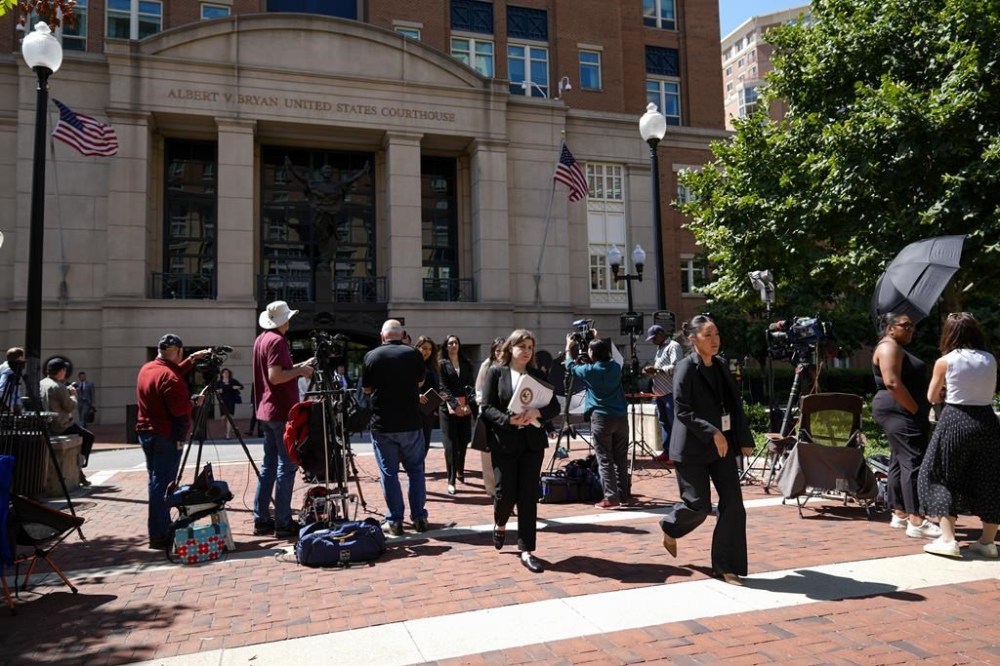
Historically, courts have been unwilling to declare an illegal monopoly in markets in which a company holds less than a 70% market share. Google says that when online display advertising is viewed as a whole, it holds only a 10% market share, and dwindling.
The Justice Department contends, though, that when focusing on open-web display advertising, Google controls 91% of the market for publisher ad servers and 87% of the market for advertiser ad networks.
Google says that the “open web display advertising” market is gerrymandered by the Justice Department to make Google look bad, and that nobody in the industry looks at that category of ads without considering the ability of advertisers to switch to other forms of advertising, like in mobile apps.
The Justice Department also contends that the public is harmed by the excessive rates Google charges to facilitate ad purchases, saying the company takes 36 cents on the dollar when it facilitates the transaction end to end.
Google says its “take rate” has dropped to 31% and continues to decrease, and it says that rate is lower than that of its competitors.

“When you have an integrated system, one of the benefits is lower prices,” Google lawyer Karen Dunn said Monday.
The Virginia case is separate from an ongoing lawsuit brought against Google in the District of Columbia over its namesake search engine. In that case, the judge determined it constitutes an illegal monopoly but has not decided what remedy to impose.
The Justice Department said last week it will seek to force Google to sell its Chrome web browser, among a host of other penalties. Google has said the department’s request is overkill and unhinged from legitimate regulation.
In Monday’s arguments, Justice Department lawyer Aaron Teitelbaum cited the search engine case when he highlighted an email from a Google executive, David Rosenblatt, who said in a 2009 email that Google’s goal was to “do to display what Google did to search,” which Teitelbaum said showed the company’s intent to achieve market dominance.
“Google did not achieve its trifecta of monopolies by accident,” Teitelbaum said.