Are we all aliens? NASA’s returned asteroid samples hold the ingredients of life from a watery world

Advertisement

Advertise with us

CAPE CANAVERAL, Fla. (AP) — Asteroid samples fetched by NASA hold not only the pristine building blocks for life but also the salty remains of an ancient water world, scientists reported Wednesday.

Read this article for free:


or

Already have an account? Log in here »

To continue reading, please subscribe:

Subscribe and receive a limited-edition Free Press branded hat or tote.

Digital Subscription

One year of digital access for only $205*

  • Enjoy unlimited reading on winnipegfreepress.com
  • Read the E-Edition, our digital replica newspaper
  • Access News Break, our award-winning app
  • Play interactive puzzles

*First annual payment billed as $205.00 + GST for one year. This annual subscription will automatically renew at $233.00 + GST every 52 weeks (10% off the regular annual price of $259.35). Offer available to new and qualified returning subscribers only. Cancel any time.

To continue reading, please subscribe:

Add Free Press access to your Brandon Sun subscription for only an additional

$1 for the first 4 weeks*

  • Enjoy unlimited reading on winnipegfreepress.com
  • Read the E-Edition, our digital replica newspaper
  • Access News Break, our award-winning app
  • Play interactive puzzles
Start now

*Your next Brandon Sun subscription payment will increase by $1.00 and you will be charged $17.95 plus GST for four weeks. After four weeks, your payment will increase to $24.95 plus GST every four weeks.

Hey there, time traveller!
This article was published 29/01/2025 (612 days ago), so information in it may no longer be current.

CAPE CANAVERAL, Fla. (AP) — Asteroid samples fetched by NASA hold not only the pristine building blocks for life but also the salty remains of an ancient water world, scientists reported Wednesday.

The findings provide the strongest evidence yet that asteroids may have planted the seeds of life on Earth and that these ingredients were mingling with water almost right from the start.

“That’s the kind of environment that could have been essential to the steps that lead from elements to life,” said the Smithsonian Institution’s Tim McCoy, one of the lead study authors.

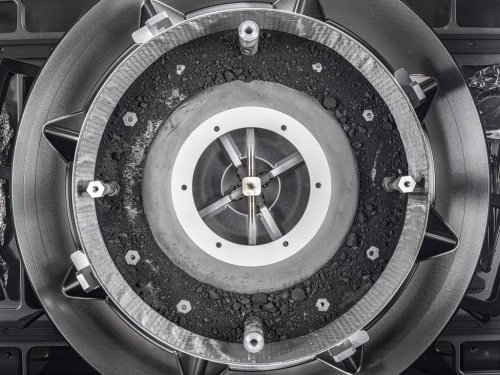
This image provided by NASA shows a top-down view of the OSIRIS-REx Touch-and-Go-Sample-Acquisition-Mechanism (TAGSAM) head with the lid removed, revealing the remainder of the asteroid sample inside. (NASA via AP)

NASA’s Osiris-Rex spacecraft returned 122 grams (4 ounces) of dust and pebbles from the near-Earth asteroid Bennu, delivering the sample canister to the Utah desert in 2023 before swooping off after another space rock. It remains the biggest cosmic haul from beyond the moon. The two previous asteroid sample missions, by Japan, yielded considerably less material.

Small amounts of Bennu’s precious black grains — leftovers from the solar system’s formation 4.5 billion years ago — were doled out to the two separate research teams whose studies appeared in the journals Nature and Nature Astronomy. But it was more than enough to tease out the sodium-rich minerals and confirm the presence of amino acids, nitrogen in the form of ammonia and even parts of the genetic code.

Some if not all of the delicate salts found at Bennu — similar to what’s in the dry lakebeds of California’s Mojave Desert and Africa’s Sahara — would be stripped away if present in falling meteorites.

“This discovery was only possible by analyzing samples that were collected directly from the asteroid then carefully preserved back on Earth,” the Institute of Science Tokyo’s Yasuhito Sekine, who was not involved in the studies, said in an accompanying editorial.

Combining the ingredients of life with an environment of sodium-rich salt water, or brines, “that’s really the pathway to life,” said McCoy, the National Museum of Natural History’s curator of meteorites. “These processes probably occurred much earlier and were much more widespread than we had thought before.”

NASA’s Daniel Glavin said one of the biggest surprises was the relatively high abundance of nitrogen, including ammonia. While all of the organic molecules found in the Bennu samples have been identified before in meteorites, Glavin said the ones from Bennu are valid — “real extraterrestrial organic material formed in space and not a result of contamination from Earth.”

Bennu — a rubble pile just one-third of a mile (one-half of a kilometer) across — was originally part of a much larger asteroid that got clobbered by other space rocks. The latest results suggest this parent body had an extensive underground network of lakes or even oceans, and that the water evaporated away, leaving behind the salty clues.

Sixty labs around the world are analyzing bits of Bennu as part of initial studies, said the University of Arizona’s Dante Lauretta, the mission’s chief scientist who took part in both studies.

Most of the $1 billion mission’s cache has been set aside for future analysis. Scientists stress more testing is needed to better understand the Bennu samples, as well as more asteroid and comet sample returns. China plans to launch an asteroid sample return mission this year.

Many are pushing for a mission to collect rocks and dirt from the potentially waterlogged dwarf planet Ceres in the main asteroid belt. Jupiter’s moon Europa and Saturn’s moon Enceladus also beckon as enticing water worlds. Meanwhile, NASA has core samples awaiting pickup at Mars, but their delivery is on hold while the space agency studies the quickest and cheapest way to get them here.

“Are we alone?” McCoy said. “That’s one of the questions we’re trying to answer.”

___

The Associated Press Health and Science Department receives support from the Howard Hughes Medical Institute’s Science and Educational Media Group and the Robert Wood Johnson Foundation. The AP is solely responsible for all content.

Report Error Submit a Tip

More Stories

Alouettes not short on reasons why they want to beat Bombers

Taylor Allen 6 minute read Preview

Alouettes not short on reasons why they want to beat Bombers

Taylor Allen 6 minute read Yesterday at 7:55 PM CDT

MONTREAL — Clinching top spot in the East isn’t the only reason why Tyson Philpot is itching to beat the Winnipeg Blue Bombers.

“Obviously, my brother (Jalen) plays for the (Calgary) Stampeders, so I’d love to help push the Stampeders above them and help him get in the playoffs,” said the star receiver for the Montreal Alouettes after Friday’s walkthrough.

While the Als are sitting comfortably at 11-3, the Bombers (7-7) are trying to fend off Calgary (7-8) while also keeping pace with B.C. and Saskatchewan, who both entered the week at 8-6.

But there’s another reason that applies to everyone on the Als: they want revenge for the embarrassing 44-28 loss they suffered in Winnipeg in Week 13.

Read
Yesterday at 7:55 PM CDT

Sisters relieved hospital takes accountability after mother’s death

Scott Billeck 6 minute read Preview

Sisters relieved hospital takes accountability after mother’s death

Scott Billeck 6 minute read Thursday, Oct. 1, 2026

Eight months after losing their mother, two Winnipeg sisters say an internal hospital review has finally given them something they had been seeking since her death: accountability.

Chelsea Mann and Samantha Burns said St. Boniface Hospital officials acknowledged mistakes were made in the care of their mother, Judy Burns, during a recent meeting to discuss the findings of a critical incident review into her death.

The acknowledgement marked a significant departure from an earlier meeting with hospital officials, when they felt their concerns were largely dismissed.

Burns, 68, died on Jan. 21, three days after being admitted, after experiencing rectal bleeding.

Read
Thursday, Oct. 1, 2026

Health minister warns $1.2 billion in annual federal funding set to expire in March

Scott Billeck 4 minute read Preview

Health minister warns $1.2 billion in annual federal funding set to expire in March

Scott Billeck 4 minute read Thursday, Oct. 1, 2026

Manitoba’s health minister is warning of possible cuts to health care with $1.2 billion in annual funding from Ottawa set to expire next year.

“We’re very concerned that what would be the largest cut to health care in a generation is right in front of us,” Health Minister Uzoma Asagwara said Thursday at the Manitoba legislature. “It means that services that Manitobans depend on will be in jeopardy and be at risk.

“Any reductions, any cuts from Canada, will have direct impacts on the health outcomes of Manitobans.”

Asagwara, who serves as the provincial and territorial health minister lead, chaired a virtual meeting Tuesday with provincial and territorial health ministers to discuss federal funding for health care, mental health care and substance use services, which is scheduled to expire March 31, 2027.

Read
Thursday, Oct. 1, 2026

Nearly four in 10 Manitobans hope Canada restarts trade talks after U.S. midterm elections, poll reveals

Gabrielle Piché 4 minute read Preview

Nearly four in 10 Manitobans hope Canada restarts trade talks after U.S. midterm elections, poll reveals

Gabrielle Piché 4 minute read Yesterday at 7:00 AM CDT

Disorganized — that’s what Marcus Langlois calls recent United States tariffs.

He expects suppliers’ prices to increase — on mugs, pens, hoodies — for his employer, Dreamcatcher Promotions, if the United States–Canada trade war persists.

Still, he’s not pining for a quick trade deal.

“I think it should wait,” said Langlois, Dreamcatcher Promotions’ vice-president. “Let’s hope that it’s later on with proper negotiations happening.”

Read
Yesterday at 7:00 AM CDT

Klein to double down on derelict homes

Joyanne Pursaga 5 minute read Preview

Klein to double down on derelict homes

Joyanne Pursaga 5 minute read Yesterday at 6:08 PM CDT

Kevin Klein promises to set tight timelines for owners to clean up vacant and derelict homes, if he’s elected to become Winnipeg’s next mayor.

The owner of each building would have six months after it becomes vacant to file an action plan to repair, renovate or remove the structure entirely by the one-year mark.

Those who fail to do so would face heavy fines and possible expropriation, he said.

“Hundreds of empty buildings sit boarded up, waiting to burn, like the one behind me. A vacant house is a fire trap, it’s a crime hub,” said Klein, pointing out the charred remains of a home on Alexander Avenue Friday.

Read
Yesterday at 6:08 PM CDT

Mayoral candidate Vogiatzakis criticized for living outside Winnipeg

Malak Abas 4 minute read Preview

Mayoral candidate Vogiatzakis criticized for living outside Winnipeg

Malak Abas 4 minute read Updated: Yesterday at 6:03 PM CDT

A mayoral hopeful took heat from other candidates Friday for living outside Winnipeg while running in the civic election.

Mike Vogiatzakis’s primary residence is in the Rural Municipality of St. Andrews, about 25 kilometres north of Winnipeg — a community with its own mayor and councillors.

But the funeral director said he owns a home in Winnipeg where he divides his time, and he would move to the city full-time if elected mayor.

“It doesn’t matter where a person lives. Why are we dividing St. Andrews and Manitoba and Winnipeg? I’ve met the criteria to run for mayor,” Vogiatzakis said Friday morning.

Read
Updated: Yesterday at 6:03 PM CDT