How an ancient asteroid strike carved out 2 grand canyons on the moon

Advertisement

Advertise with us

CAPE CANAVERAL, Fla. (AP) — New research shows that when an asteroid slammed into the moon billions of years ago, it carved out a pair of grand canyons on the lunar far side.

Read this article for free:


or

Already have an account? Log in here »

To continue reading, please subscribe:

Subscribe and receive a limited-edition Free Press branded hat or tote.

Digital Subscription

One year of digital access for only $205*

  • Enjoy unlimited reading on winnipegfreepress.com
  • Read the E-Edition, our digital replica newspaper
  • Access News Break, our award-winning app
  • Play interactive puzzles

*First annual payment billed as $205.00 + GST for one year. This annual subscription will automatically renew at $233.00 + GST every 52 weeks (10% off the regular annual price of $259.35). Offer available to new and qualified returning subscribers only. Cancel any time.

To continue reading, please subscribe:

Add Free Press access to your Brandon Sun subscription for only an additional

$1 for the first 4 weeks*

  • Enjoy unlimited reading on winnipegfreepress.com
  • Read the E-Edition, our digital replica newspaper
  • Access News Break, our award-winning app
  • Play interactive puzzles
Start now

*Your next Brandon Sun subscription payment will increase by $1.00 and you will be charged $17.95 plus GST for four weeks. After four weeks, your payment will increase to $24.95 plus GST every four weeks.

Hey there, time traveller!
This article was published 04/02/2025 (588 days ago), so information in it may no longer be current.

CAPE CANAVERAL, Fla. (AP) — New research shows that when an asteroid slammed into the moon billions of years ago, it carved out a pair of grand canyons on the lunar far side.

That’s good news for scientists and NASA, which is looking to land astronauts at the south pole on the near, Earth-facing side untouched by that impact and containing older rocks in original condition.

U.S. and British scientists used photos and data from NASA’s Lunar Reconnaissance Orbiter to map the area and calculate the path of debris that produced these canyons about 3.8 billion years ago. They reported their findings Tuesday in the journal Nature Communications.
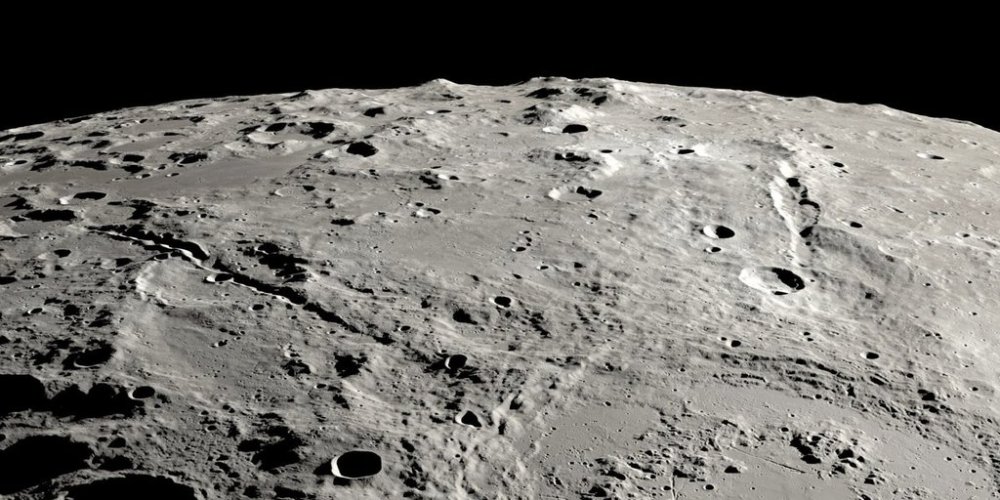
This image provided by NASA shows a view from orbit looking obliquely across the surface of the moon, where an ancient asteroid strike carved out a pair of grand canyons on the moon’s far side. (Ernie T. Wright/NASA via AP)

The incoming space rock passed over the lunar south pole before hitting, creating a huge basin and sending streams of boulders hurtling at a speed of nearly 1 mile a second (1 kilometer a second). The debris landed like missiles, digging out two canyons comparable in size to Arizona’s Grand Canyon in barely 10 minutes. The latter, by comparison, took millions of years to form.

“This was a very violent, a very dramatic geologic process,” said lead author David Kring of the Lunar and Planetary Institute in Houston.

Kring and his team estimate the asteroid was 15 miles (25 kilometers) across and that the energy needed to create these two canyons would have been more than 130 times that in the world’s current inventory of nuclear weapons.

Most of the ejected debris was thrown in a direction away from the south pole, Kring said.

That means NASA’s targeted exploration zone around the pole mostly on the moon’s near side won’t be buried under debris, keeping older rocks from 4 billion plus years ago exposed for collection by moonwalkers. These older rocks can help shed light not only on the moon’s origins, but also Earth’s.

Kring said it’s unclear whether these two canyons are permanently shadowed like some of the craters at the moon’s south pole. “That is something that we’re clearly going to be reexamining,” he said.

Permanently shadowed areas at the bottom of the moon are thought to hold considerable ice, which could be turned into rocket fuel and drinking water by future moonwalkers.

NASA’s Artemis program, the successor to Apollo, aims to return astronauts to the moon this decade. The plan is to send astronauts around the moon next year, followed a year or so later by the first lunar touchdown by astronauts since Apollo.

___

The Associated Press Health and Science Department receives support from the Howard Hughes Medical Institute’s Science and Educational Media Group and the Robert Wood Johnson Foundation. The AP is solely responsible for all content.

Report Error Submit a Tip

More Stories

Winnipeg and choosing its future direction

Kate Kehler 5 minute read 2:00 AM CDT

Winnipeg, the capital of ‘Friendly Manitoba’, is becoming far less friendly to anyone who is struggling to survive. The city is also less and less supportive of the not-for-profit sector which struggles to support those struggling to survive.

Municipal politicians have long insisted that social services are provincial responsibilities. However, the city charter makes it clear that mayor and council are “to promote and maintain the health, safety and welfare of the inhabitants.”

Mayor and council are empowered to decide how they do that. Every four years, we citizens get to vote on what we think and feel about those decisions. That’s our democracy, weighted against the disenfranchised though it is.

In 2022, only 37.17 per cent of eligible voters, the lowest percentage since 1989, voted. Recent Probe Research data demonstrates that only one-third of Winnipeggers believe the next mayor and council will make even a minor difference in addressing Winnipeg’s challenges, and another third believe they will make no difference at all.

Puzzles Palace

1 minute read Monday, Jul. 27, 2026

To solve our puzzles, please subscribe with this special offer: |

Letters, Sept 15

7 minute read 2:00 AM CDT

Building for the future

It’s hard to argue with Tom Brodbeck’s column Carney cashes in standing to U.S. bully, Free Press, Sept. 12, because everything in the article makes sense.

But I think Canada is cashing in as well.

The rather depressing environment created by Trump has given impetus to an aggressive slate of policies promulgated by Prime Minister Mark Carney that with a little luck (that’s code for preparation, opportunity and hard work) will position Canada for a much brighter future once the tin-pot dictator is gone.

Transit safety drives first mayoral debate

Morgan Modjeski 4 minute read Preview

Transit safety drives first mayoral debate

Morgan Modjeski 4 minute read 2:01 AM CDT

The safety of Winnipeg Transit drivers was front and centre Monday as the first mayoral debate of the 2026 election focused on public transit.

Kevin Klein, the most experienced of the 10 candidates at the Amalgamated Transit Union 1505-hosted debate, said the time for partial safety shields has passed.

“The partial shields have failed drivers. That’s why we need change,” the former PC MLA and city councillor said, adding driver safety is not a staffing issue, but a “protection failure.”

If elected, Klein said he will bring in full-shield implementation across the city within two years and start a nine-bus pilot project immediately.

Read
2:01 AM CDT

Treating the disease we simply won’t insure

Rafiq Andani 5 minute read Yesterday at 2:00 AM CDT

There is a condition affecting tens of thousands of Canadians. In 2024, one national measure estimated that almost 120,000 people had the condition. The estimate captures only part of the problem.

How an ancient asteroid strike carved out 2 grand canyons on the moon

Marcia Dunn, The Associated Press 3 minute read Preview

How an ancient asteroid strike carved out 2 grand canyons on the moon

Marcia Dunn, The Associated Press 3 minute read Wednesday, Feb. 5, 2025

CAPE CANAVERAL, Fla. (AP) — New research shows that when an asteroid slammed into the moon billions of years ago, it carved out a pair of grand canyons on the lunar far side.

That's good news for scientists and NASA, which is looking to land astronauts at the south pole on the near, Earth-facing side untouched by that impact and containing older rocks in original condition.

U.S. and British scientists used photos and data from NASA’s Lunar Reconnaissance Orbiter to map the area and calculate the path of debris that produced these canyons about 3.8 billion years ago. They reported their findings Tuesday in the journal Nature Communications.

The incoming space rock passed over the lunar south pole before hitting, creating a huge basin and sending streams of boulders hurtling at a speed of nearly 1 mile a second (1 kilometer a second). The debris landed like missiles, digging out two canyons comparable in size to Arizona's Grand Canyon in barely 10 minutes. The latter, by comparison, took millions of years to form.

Read
Wednesday, Feb. 5, 2025