Science in steel boxes: how research teams hitched a ride with navy to Antarctica
Advertisement
Read this article for free:
or
Already have an account? Log in here »
To continue reading, please subscribe:

Digital Subscription
One year of digital access for only $205*
- Enjoy unlimited reading on winnipegfreepress.com
- Read the E-Edition, our digital replica newspaper
- Access News Break, our award-winning app
- Play interactive puzzles
*First annual payment billed as $205.00 + GST for one year. This annual subscription will automatically renew at $233.00 + GST every 52 weeks (10% off the regular annual price of $259.35). Offer available to new and qualified returning subscribers only. Cancel any time.
To continue reading, please subscribe:
Add Free Press access to your Brandon Sun subscription for only an additional
$1 for the first 4 weeks*
- Enjoy unlimited reading on winnipegfreepress.com
- Read the E-Edition, our digital replica newspaper
- Access News Break, our award-winning app
- Play interactive puzzles
*Your next Brandon Sun subscription payment will increase by $1.00 and you will be charged $17.95 plus GST for four weeks. After four weeks, your payment will increase to $24.95 plus GST every four weeks.
Read unlimited articles for free today:
or
Already have an account? Log in here »
Hey there, time traveller!
This article was published 25/03/2025 (560 days ago), so information in it may no longer be current.
HALIFAX – Scientists who went aboard a Royal Canadian Navy mission to Antarctica say the trip demonstrated how portable labs and gear can effectively probe the ocean depths.
Marine scientists have traditionally relied on specialized vessels, but there’s been a scarcity of such research ships in Canada, particularly since the Hudson, a Coast Guard oceanographic vessel, was retired in 2022.
As a result, during the HMCS Margaret Brooke’s journey to the Antarctic Ocean this month, entire labs and sampling systems were placed in reinforced, steel containers and fastened to the stern of the patrol vessel.
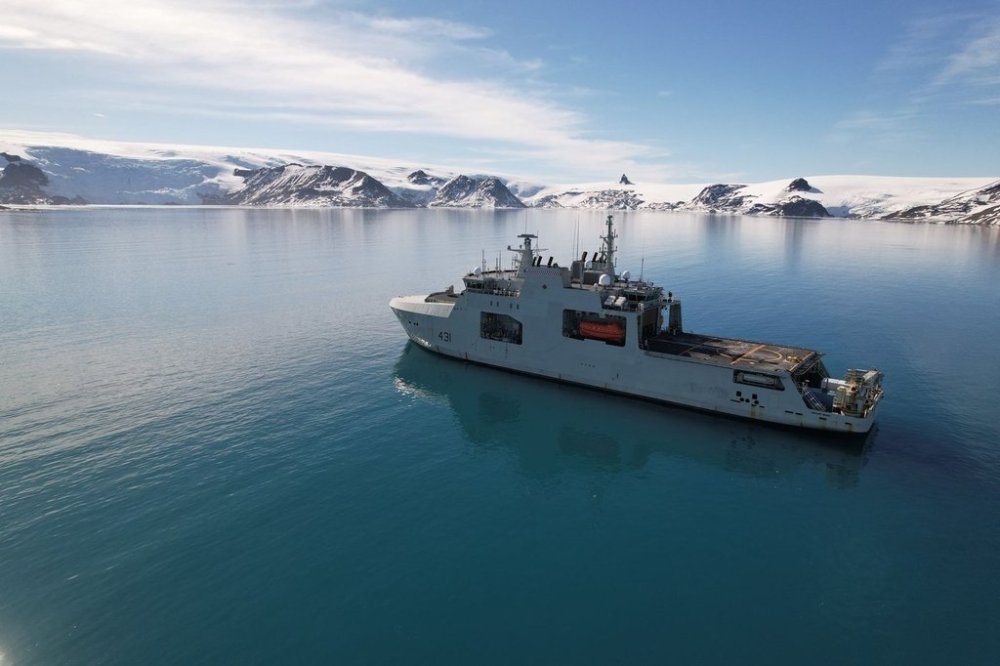
“It’s science in a box,” said Douglas Wallace, a Dalhousie University oceanographer who is associate science director of the Marine Environmental Observation Prediction and Response Network. The non-profit group helped develop the modular system, with assistance from Irving Shipbuilding Inc., for use on both navy and conventional vessels.
“Our fleet of specialized research vessels has been gradually dwindling,” Wallace said in a recent interview, adding that the modular systems are a way to bridge the gap.
Fifteen scientists, including a team from Natural Resources Canada, studied a range of topics including glacial melt, the composition of the ocean floor, the presence of contaminants like microplastics, and levels of carbon dioxide in the sea water.
Brent Else, co-chief scientist on the journey, said one of the modular units — engineered by Hawboldt Industries of Chester, N.S. — carried a winch that lowers a set of water sampling bottles referred to as a “rosette” by a thick cable into the frigid Antarctic depths.
Else, a University of Calgary geography professor, said in a telephone interview Monday that one sign of the collaboration’s success is that roughly 2,000 scientifically useful samples were collected, ranging from the sea water to core samples of ocean floor.
Else said there were worries before the voyage about working on a ship with no positioning system to keep it still while cables are lowered. However, the all-Canadian team of sailors, engineers and scientists found ways to make it work. For example, when the rosette was lowered, the navy manoeuvred their vessel sideways to the wind currents — moving the ship away from the cable to avoid it going beneath the ship.
His particular research interest was measuring carbon dioxide held in the deep ocean waters. He said that as the rosette was plunged into the waters, research teams could observe in real time as temperature, salinity and depth readings came back, telling them they were collecting the required samples.
As the planet’s natural methods of absorbing carbon dioxide — through forests, permafrost and bogs — are diminished, it’s critical to know more about how the cold polar waters can compensate, Else said.
“If we’re finding that the oceans aren’t absorbing carbon dioxide at the rate that they once were, I think it adds more imperatives to do something about cutting emissions,” he added.
The water collected is now in labs across the country, and he said it should provide valuable data on carbon absorption in cold waters that can be compared with other data.
The navy patrol vessel was in the area as part of its mission to circumnavigate South America and strengthen ties to Southern Hemisphere navies. Under an international treaty, military ships are only permitted within Antarctica’s boundaries if involved in scientific research.
Wallace said he sees the modular science units that hitched a ride on the ship as part of the solution to maintaining Canada’s science sovereignty while also saving money.
“It gives us the ability to use private sector vessels, navy vessels, government vessels, whatever is out there,” he said. “It really opens up more potential for getting out on the ocean when you need to be out there.”
Else estimates that renting space for a large team of scientists on a comparable non-military vessel might have cost between $75,000 to $100,000 daily, and if it were a foreign-owned ship, Canadian research goals might not be given priority.

However, the Calgary professor cautions that while the modular approach is helpful, he’s also eager to have access to Canadian ocean research vessels — which have space for larger science teams, added cranes and the ability to remain in one spot while sampling systems are deployed.
Last summer, Seaspan Shipyards in Vancouver announced the launch the Canadian Coast Guard’s flagship science vessel, CCGS Naalak Nappaluk, the 88-metre-long vessel will support marine surveys and scientific research on ocean currents and the seabed in Atlantic Canada.
But, for now, ocean researchers say the modular system has shown a less costly, if scaled-down, way to keep exploring the ocean.
“It’s something we need to think about a little more if some of our reliable allies aren’t there for us,” Else said. “It looks like the United States may be pulling back significant investment in some of their oceanographic research activities. We might need to find some ways to go on our own.”
This report by The Canadian Press was first published March 25, 2025.