Eggs are less likely to crack when dropped on their side, according to science
Advertisement
Read this article for free:
or
Already have an account? Log in here »
To continue reading, please subscribe:

Digital Subscription
One year of digital access for only $205*
- Enjoy unlimited reading on winnipegfreepress.com
- Read the E-Edition, our digital replica newspaper
- Access News Break, our award-winning app
- Play interactive puzzles
*First annual payment billed as $205.00 + GST for one year. This annual subscription will automatically renew at $233.00 + GST every 52 weeks (10% off the regular annual price of $259.35). Offer available to new and qualified returning subscribers only. Cancel any time.
To continue reading, please subscribe:
Add Free Press access to your Brandon Sun subscription for only an additional
$1 for the first 4 weeks*
- Enjoy unlimited reading on winnipegfreepress.com
- Read the E-Edition, our digital replica newspaper
- Access News Break, our award-winning app
- Play interactive puzzles
*Your next Brandon Sun subscription payment will increase by $1.00 and you will be charged $17.95 plus GST for four weeks. After four weeks, your payment will increase to $24.95 plus GST every four weeks.
Read unlimited articles for free today:
or
Already have an account? Log in here »
Hey there, time traveller!
This article was published 08/05/2025 (462 days ago), so information in it may no longer be current.
NEW YORK (AP) — Eggs are less likely to crack when they fall on their side, according to experiments with over 200 eggs.
What does this mean for the best way to crack an egg for breakfast? Not much, since a break around the middle is the best way to get the golden yolk and runny whites to ooze out.
But scientists said it could help with hard-boiling eggs in a pot: Dropping eggs in horizontally may be less likely to cause a stray crack that can unleash the egg’s insides in a puffy, cloudy mess.
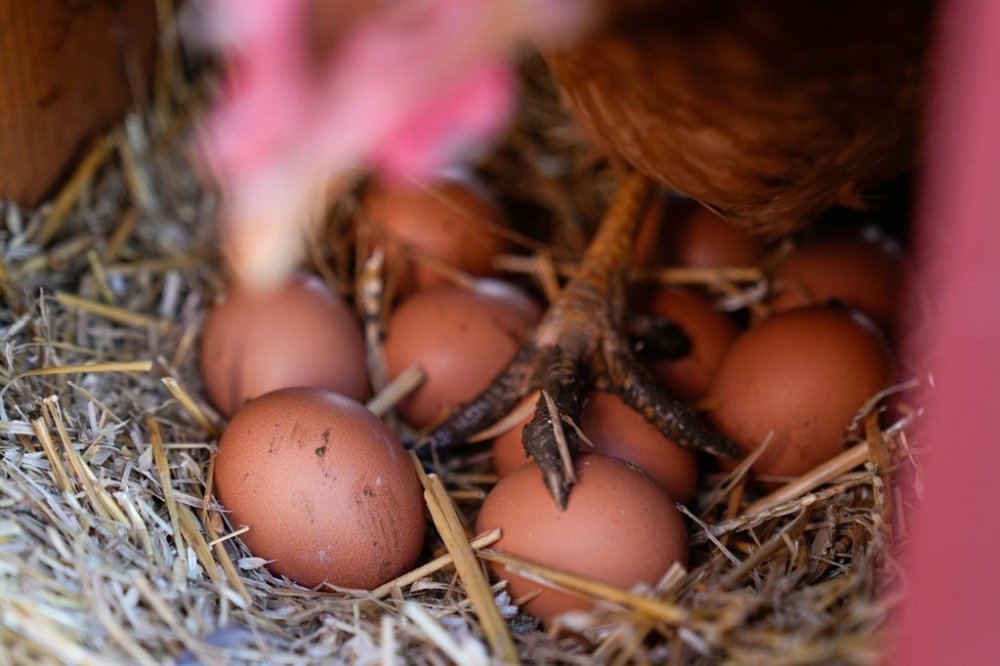
It’s commonly thought that eggs are strongest at their ends — after all, it’s how they’re packaged in the carton. The thinking is that the arc-shaped bottom of an egg redirects the force and softens the blow of impact.
But when scientists squeezed eggs in both directions during a compression test, they cracked under the same amount of force.
“The fun started when we thought we would get one result and then we saw another,” said Hudson Borja da Rocha with Massachusetts Institute of Technology, who helped run the experiments.
The researchers also ran simulations and dropped eggs horizontally and vertically from three short heights up to 0.4 inches (10 millimeters).
The egg result? The ones dropped horizontally cracked less .
“The common sense is that the egg in the vertical direction is stronger than if you lay the egg down. But they proved that’s not the case,” said materials scientist Marc Meyers with the University of California, San Diego who was not involved with the new study.
Scientists found that the egg’s equator was more flexible and absorbed more of the energy of the fall before cracking. The findings were published Thursday in the journal Communications Physics.
Eggs are also usually nestled top-down into homemade contraptions for egg drop challenges as part of school STEM projects, which partially inspired the new study. It’s not yet clear whether the new results will help protect these vulnerable eggs, which are dropped at much loftier heights.
It’s a bit counterintuitive that the oblong side of an egg could hold up better against a tumble, said study co-author Tal Cohen with Massachusetts Institute of Technology.
Countless broken eggs show “the courage to go and challenge these very common, accepted notions,” Cohen said.
___
The Associated Press Health and Science Department receives support from the Howard Hughes Medical Institute’s Science and Educational Media Group and the Robert Wood Johnson Foundation. The AP is solely responsible for all content.
Related Articles
How to cook the perfect boiled egg, according to science
Advertisement Advertise With Us