How ancient reptile footprints are rewriting the history of when animals evolved to live on land

Advertisement

Advertise with us

WASHINGTON (AP) — Scientists in Australia have identified the oldest known fossil footprints of a reptile-like animal, dated to around 350 million years ago.

Read this article for free:


or

Already have an account? Log in here »

To continue reading, please subscribe:

Subscribe and receive a limited-edition Free Press branded hat or tote.

Digital Subscription

One year of digital access for only $205*

  • Enjoy unlimited reading on winnipegfreepress.com
  • Read the E-Edition, our digital replica newspaper
  • Access News Break, our award-winning app
  • Play interactive puzzles

*First annual payment billed as $205.00 + GST for one year. This annual subscription will automatically renew at $233.00 + GST every 52 weeks (10% off the regular annual price of $259.35). Offer available to new and qualified returning subscribers only. Cancel any time.

To continue reading, please subscribe:

Add Free Press access to your Brandon Sun subscription for only an additional

$1 for the first 4 weeks*

  • Enjoy unlimited reading on winnipegfreepress.com
  • Read the E-Edition, our digital replica newspaper
  • Access News Break, our award-winning app
  • Play interactive puzzles
Start now

*Your next Brandon Sun subscription payment will increase by $1.00 and you will be charged $17.95 plus GST for four weeks. After four weeks, your payment will increase to $24.95 plus GST every four weeks.

Hey there, time traveller!
This article was published 14/05/2025 (504 days ago), so information in it may no longer be current.

WASHINGTON (AP) — Scientists in Australia have identified the oldest known fossil footprints of a reptile-like animal, dated to around 350 million years ago.

The discovery suggests that after the first animals emerged from the ocean around 400 million years ago, they evolved the ability to live exclusively on land much faster than previously assumed.

“We had thought the transition from fin to limb took much longer,” said California State University paleontologist Stuart Sumida, who was not involved in the new research.
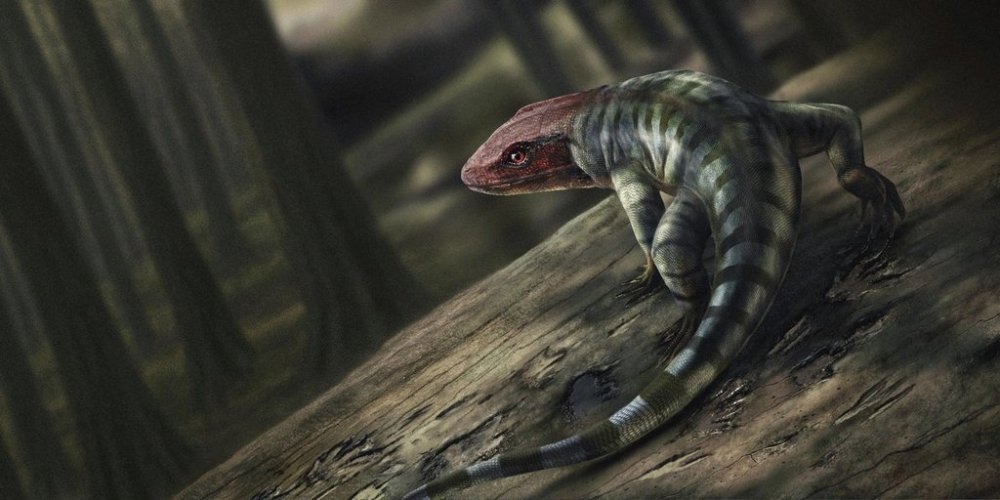
This image provided by Prof. Per Erik Ahlberg shows an artist's illustration of the possible appearance of a reptile-like creature that lived around 350 million years ago in what's now Australia. The animal was around 2 ½ feet long (80 cm) and its feet has long fingers and claws, which are visible in newly discovered fossil footprints. (Marcin Ambrozik/Prof. Per Erik Ahlberg via AP)

Previously the earliest known reptile footprints, found in Canada, were dated to 318 million years ago.

The ancient footprints from Australia were found on a slab of sandstone recovered near Melbourne and show reptile-like feet with long toes and hooked claws.

Scientists estimate the animal was about 2 1/2 feet (80 centimeters) long and may have resembled a modern monitor lizard. The findings were published Wednesday in Nature.

The hooked claws are a crucial identification clue, said study co-author and paleontologist Per Ahlberg at Uppsala University in Sweden.

“It’s a walking animal,” he said.

Only animals that evolved to live solely on land ever developed claws. The earliest vertebrates — fish and amphibians – never developed hard nails and remained dependent on watery environments to lay eggs and reproduce.

But the branch of the evolutionary tree that led to modern reptiles, birds and mammals – known as amniotes — developed feet with nails or claws fit for walking on hard ground.

“This is the earliest evidence we’ve ever seen of an animal with claws,” said Sumida.

At the time the ancient reptile lived, the region was hot and steamy and vast forests began to cover the planet. Australia was part of the supercontinent Gondwana.

The fossil footprints record a series of events in one day, Ahlberg said. One reptile scampered across the ground before a light rain fell. Some raindrop dimples partially obscured its trackways. Then two more reptiles ran by in the opposite direction before the ground hardened and was covered in sediment.

Fossil “trackways are beautiful because they tell you how something lived, not just what something looked like,” said co-author John Long, a paleontologist at Flinders University in Australia.

___

The Associated Press Health and Science Department receives support from the Howard Hughes Medical Institute’s Science and Educational Media Group and the Robert Wood Johnson Foundation. The AP is solely responsible for all content.

Report Error Submit a Tip

More Stories

Canada resorting to its tried and true playbook

Niigaan Sinclair 5 minute read Preview

Canada resorting to its tried and true playbook

Niigaan Sinclair 5 minute read Monday, Sep. 28, 2026

In 1846, Britain faced an emergency influenced by the Irish famine, so leaders repealed the country’s “Corn Laws” and restrictions on imported food and grain, transitioning to a system of free trade.

This created a crisis in the then Province of Canada, which had relied on British “preferential” status to prop up its agricultural and resource industries.

As a result, Canada looked south for new markets and eventually negotiated a free trade agreement with the United States.

This required land to be acquired and converted for industrial use quickly, so Canada quickly dispatched Commissioner William Robinson to negotiate with Indigenous communities along Lake Huron and Lake Superior for land.

Read
Monday, Sep. 28, 2026

Retiree sues neighbour over alleged dog attack

Scott Billeck 2 minute read Yesterday at 2:00 AM CDT

A Winnipeg man is suing his neighbour over an alleged dog attack he says occurred while he was helping him with a lawnmower.

Arthur Cabel, a retiree who lives on Selkirk Avenue, is seeking unspecified damages from neighbour Saisamone Saegone, according to a statement of claim filed in the Manitoba Court of King’s Bench last week.

Cabel claims he went to Saegone’s home in the afternoon on Sept. 23, 2024, to help him with his lawnmower.

According to the lawsuit, Saegone’s large dog, initially in a fenced backyard, escaped, approaching Cabel and “mauling, attacking and biting him.”

Hero fought to remember children lost at residential school

Niigaan Sinclair 5 minute read Preview

Hero fought to remember children lost at residential school

Niigaan Sinclair 5 minute read Yesterday at 6:25 PM CDT

The story of the gravesites of students who attended the Brandon Indian Residential School underneath the Turtle Crossing Campground is truly a Manitoba tragedy.

Read
Yesterday at 6:25 PM CDT

Obsessed stalker who shot, killed young woman at bus stop in 1993 dies behind bars at age 74

Erik Pindera 3 minute read Preview

Obsessed stalker who shot, killed young woman at bus stop in 1993 dies behind bars at age 74

Erik Pindera 3 minute read Yesterday at 5:53 PM CDT

A Winnipeg man who stalked a woman for several years before shooting her dead in the street in 1993 has died in Stony Mountain prison.

On Monday, 74-year-old Ronald Edd Bell died of apparent natural causes at the federal prison just north of Winnipeg, the Correctional Service of Canada said.

Bell had been in prison since May 30, 1994, when he was given a life sentence with no chance of parole for 18 years for killing Terry-Lyn Babb, 25, on Jan. 21, 1993.

Bell walked up behind an unsuspecting Babb, who was waiting at a bus stop at Sherbrook Street and Wolseley Avenue, and shot her in the head with a pistol in front of horrified witnesses, says the Free Press report of his sentencing hearing.

Read
Yesterday at 5:53 PM CDT

Perfumer battling city hall to keep his shop open

Gabrielle Piché 5 minute read Preview

Perfumer battling city hall to keep his shop open

Gabrielle Piché 5 minute read Monday, Sep. 28, 2026

Michael O’Malley has been here before — fighting the City of Winnipeg to keep his business open.

He usually spends his days concocting scents. He’s owned La Parfumerie, a Wolseley shop, since 1993.

Twenty-seven natural perfumes line shelves on 145 Evanson St.’s bottom floor. O’Malley lives above the space.

Now, he’s required to change the home’s zoning or shut out walk-in customers. Either would kill the company, O’Malley said.

Read
Monday, Sep. 28, 2026

Chalk surprise gift up to lust, not love

Maureen Scurfield 4 minute read Yesterday at 2:00 AM CDT

DEAR MISS LONELYHEARTS: I just got a funny birthday card and a single pink rose delivered to me at work from a boyfriend who broke up with me last spring because I’d gotten too serious (in his opinion). I cried for days back then. He ignored his phone.

I don’t know how to respond to him now. Do you think he’s really had a change of heart, or has he just not gotten lucky for a long time and thought I might be open to hooking up on my birthday?

— Suspicious Ex, Downtown

Dear Suspicious Ex: You just received a birthday card, a single pink rose and no voice contact? He wasn’t taking any chances on being shot down face-to-face, but he definitely is taking a stab at possibly getting some action.