Northern lights could be visible again in some US states after weekend solar storms
Advertisement
Read this article for free:
or
Already have an account? Log in here »
To continue reading, please subscribe:

Digital Subscription
One year of digital access for only $205*
- Enjoy unlimited reading on winnipegfreepress.com
- Read the E-Edition, our digital replica newspaper
- Access News Break, our award-winning app
- Play interactive puzzles
*First annual payment billed as $205.00 + GST for one year. This annual subscription will automatically renew at $233.00 + GST every 52 weeks (10% off the regular annual price of $259.35). Offer available to new and qualified returning subscribers only. Cancel any time.
To continue reading, please subscribe:
Add Free Press access to your Brandon Sun subscription for only an additional
$1 for the first 4 weeks*
- Enjoy unlimited reading on winnipegfreepress.com
- Read the E-Edition, our digital replica newspaper
- Access News Break, our award-winning app
- Play interactive puzzles
*Your next Brandon Sun subscription payment will increase by $1.00 and you will be charged $17.95 plus GST for four weeks. After four weeks, your payment will increase to $24.95 plus GST every four weeks.
Read unlimited articles for free today:
or
Already have an account? Log in here »
Hey there, time traveller!
This article was published 02/06/2025 (445 days ago), so information in it may no longer be current.
NEW YORK (AP) — Northern lights may be visible in parts of the U.S. Monday night following weekend solar storms.
The sun burped out a huge burst of energy called a coronal mass ejection last week, prompting space weather forecasters to issue a rare, severe solar storm alert on Sunday, though it wasn’t as strong as last year’s record. Another one headed toward Earth on Monday could produce more aurora sightings.
Authorities are monitoring for possible disruptions, though the worst is already over. The weekend’s storms may have caused brief disruptions to high-frequency radio, said Erica Grow Cei, a spokesperson with National Oceanic and Atmospheric Administration.
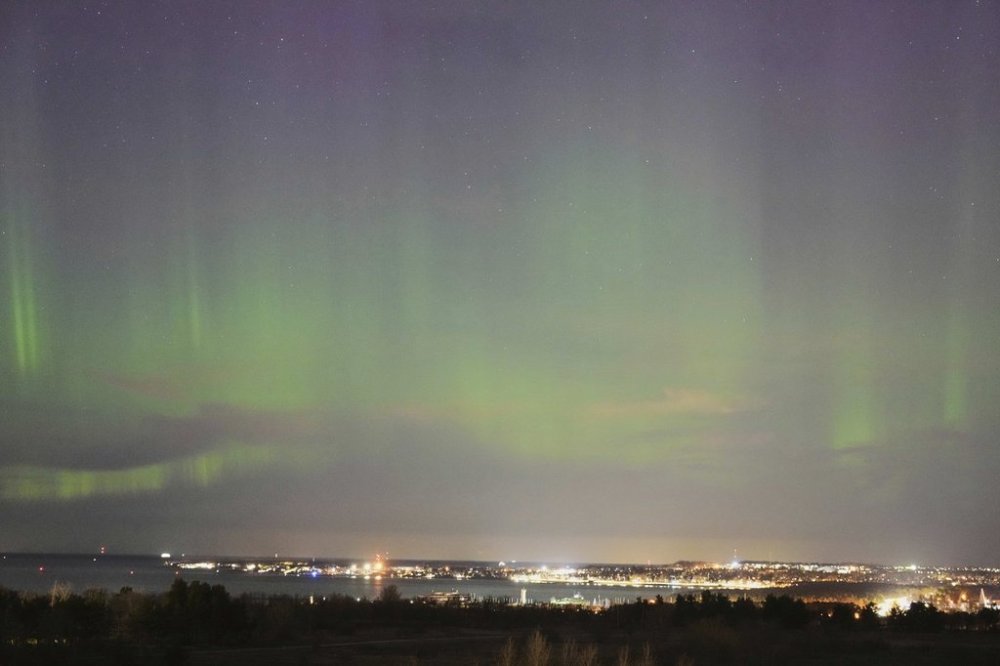
Auroras could be visible — especially in darker, rural areas — in Alaska, Washington, Montana, North Dakota, South Dakota, Minnesota, Michigan, Wisconsin, Maine and northern parts of Idaho, Wyoming, Iowa, New York, Vermont and New Hampshire.
Here’s what to know about auroras and how to spot them.
What are northern lights?
The sun is at the maximum phase of its 11-year activity cycle, making the light displays more common and widespread. Colorful northern lights have decorated night skies in unexpected places and space weather experts say there are more auroras still to come.
Last spring, the strongest geomagnetic storm in two decades slammed Earth, producing light displays across the Northern Hemisphere. And last fall, a powerful solar storm dazzled skygazers far from the Arctic Circle when dancing lights appeared in unexpected places including Germany, the United Kingdom, New England and New York City.
Aurora displays known as the northern and southern lights are commonly visible near the poles, where charged particles from the sun interact with Earth’s atmosphere.
Skygazers are spotting the lights deeper into the United States and Europe because the sun is going through a major facelift. Every 11 years, its poles swap places, causing magnetic twists and tangles along the way.
Severe storms are capable of scrambling radio and GPS communications.
The sun’s active spurt is expected to last at least through the end of this year, though when solar activity will peak won’t be known until months after the fact, according to NASA and NOAA.
What do solar storms do?
Solar storms can bring more than colorful lights to Earth.
When fast-moving particles and plasma slam into Earth’s magnetic field, they can temporarily disrupt the power grid. Space weather can also interfere with air traffic control radio and satellites in orbit.
In 1859, a severe solar storm triggered auroras as far south as Hawaii and caught telegraph lines on fire in a rare event. And a 1972 solar storm may have detonated magnetic U.S. sea mines off the coast of Vietnam.
Space weather experts aren’t able to predict a solar storm months in advance. Instead, they alert relevant parties to prepare in the days before a solar outburst hits Earth.
How to see auroras
Northern lights forecasts can be found on NOAA’s Space Weather Prediction Center website or an aurora forecasting app.
Consider aurora-watching in a quiet, dark area away from city lights. Experts recommend skygazing from a local or national park. And check the weather forecast because clouds can cover up the spectacle entirely.
Taking a picture with a smartphone camera may also reveal hints of the aurora that aren’t visible to the naked eye.
___
The Associated Press Health and Science Department receives support from the Howard Hughes Medical Institute’s Science and Educational Media Group and the Robert Wood Johnson Foundation. The AP is solely responsible for all content.