Bones of ancient child suggest humans could have interbred with Neanderthals earlier than thought
Advertisement
Read this article for free:
or
Already have an account? Log in here »
To continue reading, please subscribe:

Digital Subscription
One year of digital access for only $205*
- Enjoy unlimited reading on winnipegfreepress.com
- Read the E-Edition, our digital replica newspaper
- Access News Break, our award-winning app
- Play interactive puzzles
*First annual payment billed as $205.00 + GST for one year. This annual subscription will automatically renew at $233.00 + GST every 52 weeks (10% off the regular annual price of $259.35). Offer available to new and qualified returning subscribers only. Cancel any time.
To continue reading, please subscribe:
Add Free Press access to your Brandon Sun subscription for only an additional
$1 for the first 4 weeks*
- Enjoy unlimited reading on winnipegfreepress.com
- Read the E-Edition, our digital replica newspaper
- Access News Break, our award-winning app
- Play interactive puzzles
*Your next Brandon Sun subscription payment will increase by $1.00 and you will be charged $17.95 plus GST for four weeks. After four weeks, your payment will increase to $24.95 plus GST every four weeks.
Read unlimited articles for free today:
or
Already have an account? Log in here »
Hey there, time traveller!
This article was published 21/08/2025 (392 days ago), so information in it may no longer be current.
TEL AVIV, Israel (AP) — Modern humans and Neanderthals were interacting 100,000 years earlier than previously thought, according to researchers who used CT scans and 3D mapping to study the bones of a child they believe was the result of interbreeding between the two distinct groups.
The child, described in a recent study published in the peer-reviewed journal L’Anthropologie, was buried in a cave in Israel some 140,000 years ago. Because no ancient DNA was extracted from the fossilized remains, it’s impossible to confirm the child’s origins, but scientists say microscopic details in the bones indicate the child had traits of both groups.
When the bones were first excavated from Skhul Cave in northern Israel in 1931, archaeologists recognized that the child belonged to neither Homo sapiens, who had arrived in the region from Africa, nor Neanderthals, who arrived from Europe. They concluded it was a separate species indigenous to the area.
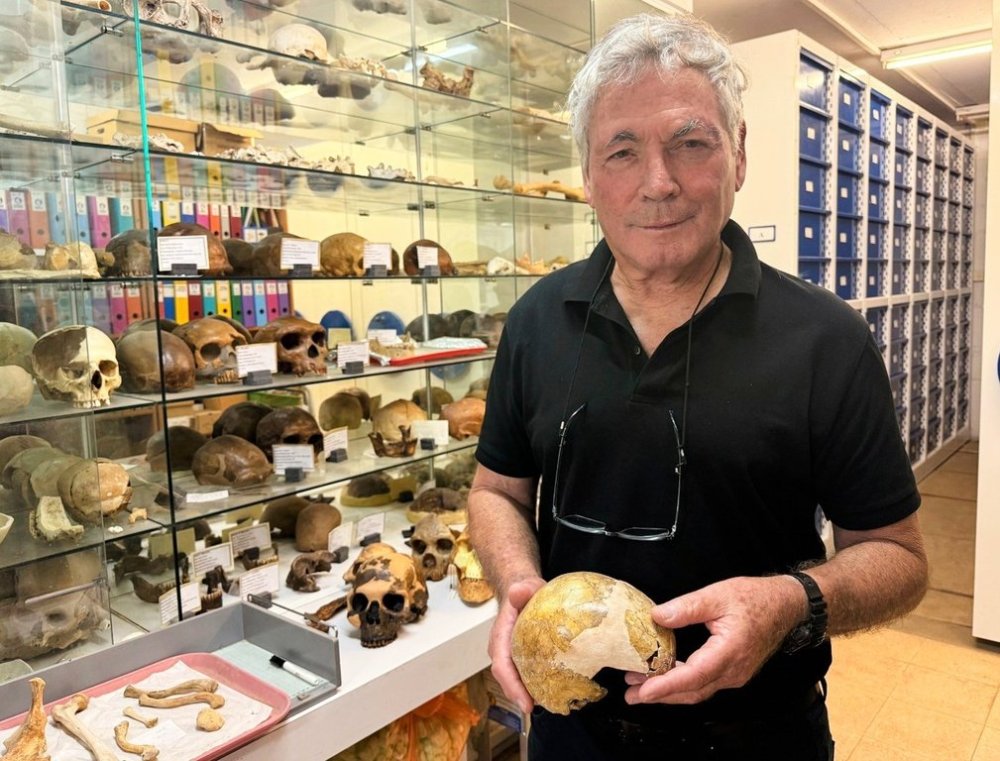
But the new 3D mapping allowed researchers to study small details of the skull that had previously been difficult to see or decipher. Researchers were able to examine distinctive traits such as the construction of the inner ear and the imprint of blood vessels that supplied the brain.
By comparing known characteristics of both Homo sapiens and Neanderthals, the researchers concluded the child was the result of interbreeding.
Previously, the earliest known example of interbreeding between the groups was around 40,000 years ago in central Europe, explained Israel Hershkovitz, the lead researcher of the study and a professor of archaeology and human evolution at Tel Aviv University.
A new glimpse into ancient relations
The new research helps shed light on when the two groups began interacting and offers clues about their relationships.
“What we’re saying now is that there was an extensive relationship between Homo sapiens and Neanderthals that started around 140,000 years ago,” and the two groups “managed to live side by side with no evidence for hostile encounters,” Hershkovitz said.
The interbreeding and shared cultural practices, including burials and tool construction, challenge the notion of Homo sapiens as “intolerant” to other human groups due to their eventual dominance, Hershkovitz said.
Without DNA, it will be impossible to prove that the child was a hybrid human, said Pascal Gagneux, an evolutionary biologist studying human origins at the University of California San Diego who was not involved in the research. Still, he said, the details revealed by the mapping, including the internal structure of some bones and several features, support the hybrid hypothesis.
Peering inside an ancient skull
Researchers took thousands of isolated scans of the skull and jaw of the child and then created a virtual 3D model of the fossil.
The model allowed them to analyze tiny details that are impossible to see on the fossilized bones, including delicate parts inside the skull. Blood vessels, for example, make a small imprint on the inside of a skull.
While some of the grooves are visible to the naked eye, the 3D scans allowed researchers to see the blood vessels like “tributaries of a river,” Hershkovitz said.
The patterns are distinct between the two groups, because Neanderthals and Homo sapiens have different brain shapes that require different blood delivery.
The virtual mapping created a more accurate reconstruction of the child’s skull than could be built from the bones and plaster when the remains were originally excavated. The new reconstruction is much more elongated, which is more typical for Neanderthals, Gagneux said.
However, the detailed reconstruction does not answer many of the questions surrounding the discovery, Gagneux said. Were the parents of the child also interbred? Or was one Neanderthal and the other Homo sapien? Why was the child, or anyone else, buried in the cave?
Thomas Levy, a professor in cyber-archaeology also at the University of California San Diego, said he was impressed by the study’s use of 3D models. The advances in scientific visualization allow more accurate measurements and comparisons of specimens, said Levy, who was not involved in the research.
The technology also offers archaeologists a fresh opportunity to review conclusions from objects excavated many years ago.

Living in harmony
Skhul Cave is one of three caves in the region that represent some of the oldest known intentional burials in the world, dating to more than 100,000 years ago, in the middle of the Paleolithic era. Multiple sets of remains were found at each site, and some are still being painstakingly excavated with tiny drills, which could provide more clues in the future.
In ancient times, Israel was a land bridge and point of interaction between Neanderthals and Homo sapiens.
Because Homo sapiens eventually replaced Neanderthals in the region and across the world, many people speculate that their interactions were violent and hostile, with Homo sapiens eventually responsible for the “total elimination” of Neanderthals, Hershkovitz said.
“What Skhul is telling us is that Homo sapiens are not a vicious, aggressive creature, but one that managed to live in peace” with other groups, he said. “Our aggressive behavior, which continues today in our long history, is a recent phenomenon that has cultural roots and not biological roots.”