Takeaways from a hunt for ‘secret’ fresh water under the North Atlantic seabed

Advertisement

Advertise with us

ABOARD LIFTBOAT ROBERT, North Atlantic (AP) — It turns out the Continental Shelf has been holding a secret from the ages. Beneath the sea floor off the U.S. northeast lies an enormous reserve of fresh water whose existence was long unknown, then was suspected and now is confirmed.

Read this article for free:


or

Already have an account? Log in here »

To continue reading, please subscribe:

Subscribe and receive a limited-edition Free Press branded hat or tote.

Digital Subscription

One year of digital access for only $205*

  • Enjoy unlimited reading on winnipegfreepress.com
  • Read the E-Edition, our digital replica newspaper
  • Access News Break, our award-winning app
  • Play interactive puzzles

*First annual payment billed as $205.00 + GST for one year. This annual subscription will automatically renew at $233.00 + GST every 52 weeks (10% off the regular annual price of $259.35). Offer available to new and qualified returning subscribers only. Cancel any time.

To continue reading, please subscribe:

Add Free Press access to your Brandon Sun subscription for only an additional

$1 for the first 4 weeks*

  • Enjoy unlimited reading on winnipegfreepress.com
  • Read the E-Edition, our digital replica newspaper
  • Access News Break, our award-winning app
  • Play interactive puzzles
Start now

*Your next Brandon Sun subscription payment will increase by $1.00 and you will be charged $17.95 plus GST for four weeks. After four weeks, your payment will increase to $24.95 plus GST every four weeks.

Hey there, time traveller!
This article was published 05/09/2025 (367 days ago), so information in it may no longer be current.

ABOARD LIFTBOAT ROBERT, North Atlantic (AP) — It turns out the Continental Shelf has been holding a secret from the ages. Beneath the sea floor off the U.S. northeast lies an enormous reserve of fresh water whose existence was long unknown, then was suspected and now is confirmed.

The first global expedition to drill systematically for undersea fresh water has come away with thousands of samples of it. And this comes as rising sea levels and other harms from a warming climate threaten freshwater supplies on land.

Expedition 501, a $25 million collaboration of more than a dozen countries including the U.S., drilled 20 to 30 miles (30 to 50 kilometers) off the coast into what is now believed to be a freshwater reserve stretching from New Jersey to Maine. It’s just one of many prospective depositories of fresh water hiding under shallow salt waters around the world that might some day be tapped to slake the planet’s intensifying thirst.
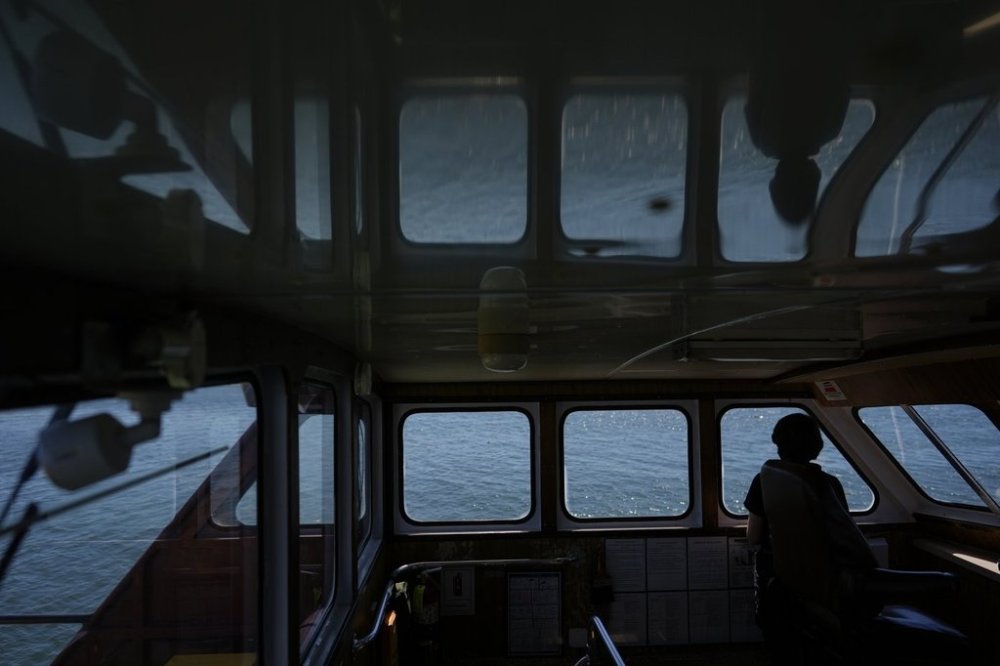
Expedition 501 member Verena Heuer looks out from the bridge of the Gaspee, a crew transport vessel, as it travels along Sakonnet River near Portsmouth, R.I., during the eight-hour trip to the Liftboat Robert platform in the North Atlantic, Saturday, July 19, 2025. (AP Photo/Carolyn Kaster)

Associated Press journalists visited the drilling platform last month, some seven hours out to sea by supply boat from Fall River, Massachusetts, to view the operation. Here are some takeaways:

Why drill? Because the world needs more fresh water

The potential of the undersea freshwater is enormous, but so are the hurdles of getting it out and figuring out who gets to control it. And yet the need is irresistible.

In just five years, the U.N. says, the global demand for fresh water will exceed supplies by 40%. One growing part of that is the data centers that power AI and cloud computing.

Cape Town, South Africa, came close to running out of fresh water for its nearly 5 million people in 2018 during an epic three-year drought. South Africa is thought to have a coastal undersea freshwater bonanza, too, and there is at least anecdotal evidence that every continent may have the same.

Canada’s Prince Edward Island, Hawaii and Indonesia are among places where stressed freshwater supplies coexist with prospective aquifers under the ocean.

It started with a fluke

Nearly 50 years ago, a U.S. government ship searching for minerals and hydrocarbons off the East Coast drilled into the seafloor over a vast area to see what it could find. It found fresh or freshened water in bore hole after bore hole.

That raised interest but it would take years to connect the dots. In 2015, a revelatory research project mapped contours of an aquifer remotely, using electromagnetic technology, and roughly estimated salinity of the water underneath.

That mission, by the Woods Hole Oceanographic Institution and Lamont-Doherty Earth Observatory, reported evidence of a “massive offshore aquifer system.” And it set the state for Expedition 501 a decade later.

Backed principally by the U.S. National Science Foundation and the European Consortium for Ocean Research Drilling, it was quite literally groundbreaking, penetrating Earth below the sea by as many as 1,289 feet or nearly 400 meters.

Drill, baby, drill. For water

The work unfolded around the clock over three months from Liftboat Robert, a vessel that, once on site, lowers three enormous pillars to the seafloor and squats above the waves. Normally it services offshore petroleum sites and wind farms.

Scientists went into the project believing the undersea aquifer they were sampling might be enough for a metropolis like New York City for 800 years. They now think the reserve is even larger than that.

Soon after Robert arrived at the first of three drilling sites, samples from below the seabed registered salinity of just 4 parts per thousand. That’s far below the oceans’ average salt content of 35 parts per thousand but still too briny to meet the U.S. freshwater standard of under 1 part per thousand.

But as Robert moved from site to site, it eventually found water at 1 part per thousand salt content. Some were even lower.

But not so fast

That’s water safe enough to drink, in theory.

But months of analysis lie ahead for scientists to test what’s in the water and whether it’s safe to drink and use.

They also need to figure out where it came from and how old it is. Those answers will determine whether the water is a renewable resource and shape opinion on whether it can be used responsibly.

___

Woodward reported from Seekonk, Massachusetts.

___

The Associated Press receives support from the Walton Family Foundation for coverage of water and environmental policy. The AP is solely responsible for all content. For all of AP’s environmental coverage, visit https://apnews.com/hub/climate-and-environment
Report Error Submit a Tip

More Stories

U of M study shows female entrepreneurs have it tough on dating market

Jen Zoratti 6 minute read Preview

U of M study shows female entrepreneurs have it tough on dating market

Jen Zoratti 6 minute read 10:00 AM CDT

Xiumei Li had a friend who had been on the dating scene for a while.

He’d been seeing an impressive woman, a startup founder building a successful business. She was a good conversationalist. She was interesting.

She sounded great. So why didn’t it work out?

Some gentle prodding revealed he was intimidated by her, but also felt that “there was a gap between what he expected for a partner versus what this female entrepreneur had to offer,” Li says.

Read
10:00 AM CDT

A life's story: translator, poet, radio host, actor loved life to the fullest

Tiago Resko 7 minute read Preview

A life's story: translator, poet, radio host, actor loved life to the fullest

Tiago Resko 7 minute read Saturday, Sep. 5, 2026

Born with an innate sense of curiosity, Charles Leblanc always wanted to understand the world around him. To him, words and theatre weren’t just pastimes. They were means of understanding the human experience and helping others see different perspectives.

The poet, translator, actor and radio host dedicated his life to this practice, founding the Winnipeg International Writers’ Festival, establishing French community radio station Envol — where he hosted a show for 25 years — and acting as a core member of the Association of Translators, Terminologists and Interpreters of Manitoba.

Leblanc’s contributions and dedication to Manitoba’s arts and literary scenes made an impact that continues to be felt by the community.

He died June 26 at the age of 75.

Read
Saturday, Sep. 5, 2026

Manitoba doctor denies working to revive Carberry ER in response to recruitment lawsuit

Erik Pindera 4 minute read Preview

Manitoba doctor denies working to revive Carberry ER in response to recruitment lawsuit

Erik Pindera 4 minute read Yesterday at 9:40 AM CDT

A Manitoba doctor has denied he was working as a recruiter after an Ontario doctor accused him of misleading him about a position at the Carberry hospital.

Dr. Klevis Iliriani, who worked at the hospital in Carberry from May to August 2024, filed his statement of claim in Court of King’s Bench earlier this year.

Iliriani, who lives in an Ottawa suburb, has alleged recruiters negligently misrepresented the job at the Carberry hospital and breached the terms of his contract, which resulted in less pay than promised.

His court filing names defendants Dr. Dave Maharajh and Barry Banek as the recruiters.

Read
Yesterday at 9:40 AM CDT

Takeaways from a hunt for ‘secret’ fresh water under the North Atlantic seabed

Calvin Woodward, Carolyn Kaster And Rodrique Ngowi, The Associated Press 4 minute read Preview

Takeaways from a hunt for ‘secret’ fresh water under the North Atlantic seabed

Calvin Woodward, Carolyn Kaster And Rodrique Ngowi, The Associated Press 4 minute read Monday, Oct. 6, 2025

ABOARD LIFTBOAT ROBERT, North Atlantic (AP) — It turns out the Continental Shelf has been holding a secret from the ages. Beneath the sea floor off the U.S. northeast lies an enormous reserve of fresh water whose existence was long unknown, then was suspected and now is confirmed.

The first global expedition to drill systematically for undersea fresh water has come away with thousands of samples of it. And this comes as rising sea levels and other harms from a warming climate threaten freshwater supplies on land.

Expedition 501, a $25 million collaboration of more than a dozen countries including the U.S., drilled 20 to 30 miles (30 to 50 kilometers) off the coast into what is now believed to be a freshwater reserve stretching from New Jersey to Maine. It's just one of many prospective depositories of fresh water hiding under shallow salt waters around the world that might some day be tapped to slake the planet’s intensifying thirst.

Associated Press journalists visited the drilling platform last month, some seven hours out to sea by supply boat from Fall River, Massachusetts, to view the operation. Here are some takeaways:

Read
Monday, Oct. 6, 2025

Puzzles Palace

1 minute read Monday, Jul. 27, 2026

To solve our puzzles, please subscribe with this special offer: |

‘We belong… and we are giving back”: Sikh celebration enlivens downtown Winnipeg

Melissa Martin 3 minute read Preview

‘We belong… and we are giving back”: Sikh celebration enlivens downtown Winnipeg

Melissa Martin 3 minute read Updated: Yesterday at 5:59 PM CDT

Downtown Winnipeg came alive with vibrant sights, sounds, and scents on Sunday, as Manitoba’s Sikh community flocked to Memorial Park to celebrate its annual Nagar Kirtan procession and festival.

This year marked the 422nd anniversary of the completion of the Guru Granth Sahib, the holy scripture central to the Sikh faith. Shortly after 1 p.m., a palanquin bearing a copy of the scripture was led in parade through downtown Winnipeg, with musical accompaniment.

“This is a chance to tell the public and the whole community where we come from and who we are,” said volunteer Prabh Grewal shortly before the procession got underway. “In a community there are people from every race and every country, and our main objective is to have everybody live in peace and harmony together.”

Before, during, and after the procession, the park hummed with life. As many as 55,000 people converged on the site, with the majority dressed in festive traditional attire. Near the height of the day’s 30 C heat, families relaxed in patches of shade, enjoying plates of Punjabi cuisine dished out for free at dozens of tents sponsored by local businesses.

Read
Updated: Yesterday at 5:59 PM CDT