How Indigenous veterans faced battles at home and abroad
Advertisement
Read this article for free:
or
Already have an account? Log in here »
To continue reading, please subscribe:

Digital Subscription
One year of digital access for only $205*
- Enjoy unlimited reading on winnipegfreepress.com
- Read the E-Edition, our digital replica newspaper
- Access News Break, our award-winning app
- Play interactive puzzles
*First annual payment billed as $205.00 + GST for one year. This annual subscription will automatically renew at $233.00 + GST every 52 weeks (10% off the regular annual price of $259.35). Offer available to new and qualified returning subscribers only. Cancel any time.
To continue reading, please subscribe:
Add Free Press access to your Brandon Sun subscription for only an additional
$1 for the first 4 weeks*
- Enjoy unlimited reading on winnipegfreepress.com
- Read the E-Edition, our digital replica newspaper
- Access News Break, our award-winning app
- Play interactive puzzles
*Your next Brandon Sun subscription payment will increase by $1.00 and you will be charged $17.95 plus GST for four weeks. After four weeks, your payment will increase to $24.95 plus GST every four weeks.
Read unlimited articles for free today:
or
Already have an account? Log in here »
Hey there, time traveller!
This article was published 08/11/2025 (320 days ago), so information in it may no longer be current.
VANCOUVER – John Moses says that when his father Russell Moses returned on leave from the Korean War, his battles weren’t over.
When the Indigenous residential school survivor came back to Canada in 1952, he was turned away from a bar in Hagersville, Ont., because of his race, his son said.
“That was not unique,” said John Moses, a member of the Delaware and Upper Mohawk bands from Six Nations of the Grand River, and himself a third-generation member of the Canadian Armed Forces.
His father, who served in the navy during the Korean War and later joined the air force, died in 2013, while his grandfather Ted Moses was a mechanic with the air force in Ontario during the Second World War.
“The irony of the situation was never lost on newly returned veterans,” said Moses, a communicator research operator with the Armed Forces in the 1980s before working at the Canadian Museum of History as director for repatriation and Indigenous relations.
“After having fought abroad for the sovereignty of small nations overseas, they come back to a country within which we still, at that point, did not enjoy the same range of civil and political rights as other Canadians.”
Official channels have also recognized this disconnect.
“Many faced injustices after returning home, yet served with pride and courage,” read a post on the official X account of the Canadian Armed Forces in marking Indigenous Veteran’s Day.
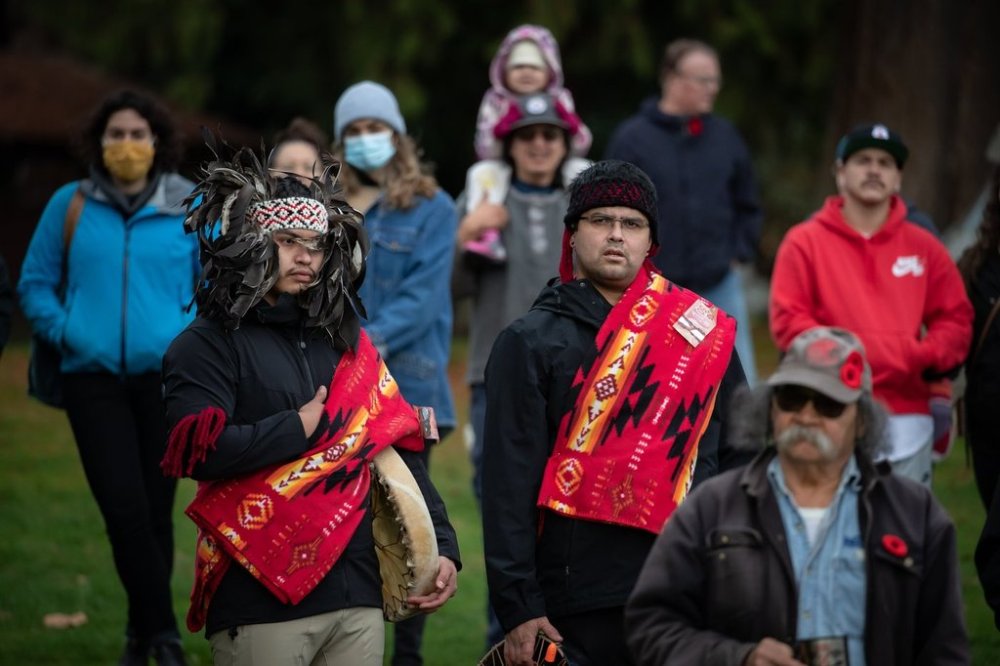
Canada marked Indigenous Veterans Day on Saturday, shining a spotlight on wartime experiences that historian Scott Sheffield says was a place where some would find a sense of belonging, away from racism at home.
Indigenous Veterans Day began as a grassroots movement in Winnipeg in 1993, but has since grown to be nationally recognized, with Sheffield calling it a “logical precursor to Remembrance Day” on Nov. 11.
Prime Minister Mark Carney pointed to this connection.
“Our freedom was won by brave women and men who answered the call — including the heroic First Nations, Inuit and Metis members of the @Canadian Forces,” he wrote on X. “On Indigenous Veterans Day, we honour the sacrifice of those who have served, those who serve today, and their families.”
Sheffield, an associate professor in history at the University of the Fraser Valley in B.C., said many ask why Indigenous people would choose to fight for a country that marginalized them.
He said the reasons varied according to the individual and the war, and in many cases, Indigenous fighters volunteered for the same reasons as others, such as adventure or economic reasons.
But, for some, he said it was a political statement.
“By enlisting, they were sort of declaring their right to belong, to be part of Canadian society,” he said.
One example was Tommy Prince, one of Canada’s the most decorated Second World War veterans, who “famously went to war to prove that an Indian was as good as any white man.”
“He served his whole career with that kind of chip on his shoulder to prove himself a superb soldier, which he did in spades, but it was partly to make that statement,” Sheffield said.
He said the “most consistent thread” to emerge from the Indigenous wartime experience was that serving “stripped away a lot of the prejudice” Indigenous soldiers faced in Canadian daily life.
“If you were sharing a foxhole with the guy, you only cared about his character, if you had confidence that he’d have your back, and that was something I think, that Indigenous men really came to prize — that they garnered respect for their character and their ability as soldiers, and that was really the main thing they took away from that experience,” he said.
But stories also echoed Russell Moses’ experience — the camaraderie seemed to vanish back home.
“They expected that acceptance to continue after the war, to be honest, and that was more disillusioning, because they returned home to a Canada where, in many ways, with their uniform off, they were still — in their words — ‘just an Indian again,'” said Sheffield.
He said many Indigenous veterans of the Second World War signed up to again serve the Korean War, “maybe to recapture some of that sense of acceptance and purpose again.”
The federal government says on its veterans website that more than 4,000 Indigenous people served in uniform during the First World War, in a “remarkable response,” that saw one in three able-bodied men volunteer. Communities including the Head of the Lake Band in B.C. saw every man aged between 20 and 35 enlist.
The veterans site says more than 3,000 First Nations people served in the Second World War.
But Sheffield said that may be understated.
“There was nowhere in the records where they recorded a person’s ethnicity or race,” said Sheffield, who believes as many as 4,300 Indigenous soldiers served in the Second World War.
The government acknowledges unfair treatment of Indigenous soldiers, noting many thought their sacrifice would “improve rights and standing in Canada.” That, it concedes, did not happen and “has had lasting physical and social effects for Indigenous veterans and their communities.”
As reconciliation efforts have gained momentum in recent years, so has a push to recognize Indigenous veterans, both on Nov. 8 but also through an initiative called the Last Post Fund Indigenous Initiative.
The fund has been in existence since 1909 with the mission of ensuring no veteran is denied a dignified funeral and burial, and a military gravestone.
The Indigenous Veterans Initiative began in March 2019, and to date, it says more than 265 grave markers have been ordered and placed, while 24 Indigenous community researchers across the country search for more unrecognized veterans’ graves.
Among the researchers is Floyd Powder, who spent 32 years in the Canadian Armed Forces before retiring in 2013.
He identifies graves of Indigenous veterans who lack a headstone. He said each marker should include an Indigenous symbol or language.
“It shows the family that Veterans Affairs Canada and the Last Post Fund recognizes their service and honours them by having those considerations of symbol and language on their headstone,” he said in an interview.
Veterans Affairs Canada, which helps to fund the project, said in a statement that celebrating Indigenous Veterans Day took nothing away from Remembrance Day.
“It does not replace or supersede Remembrance Day in any way — it instead enhances Veterans’ Week commemorations by shining a spotlight on the tremendous history of Indigenous service,” it said in a statement.
Sheffield said Nov. 8 serves as a reminder of the mutual respect and camaraderie felt by soldiers, both Indigenous and non-Indigenous, as they served alongside one another long before reconciliation efforts began.
“I think those are things maybe we should also take to heart, and that might help us as we’re walking a path of reconciliation and trying to find a way to successfully and respectfully coexist in our country going forward.”
This report by The Canadian Press was first published Nov. 8, 2025.
Related Articles
Undaunted defiance amid raw remembrance
Advertisement Advertise With Us
Advertisement Advertise With Us