16,000 fossil footprints in central Bolivia reveal dinosaur behavior

Advertisement

Advertise with us

TORO TORO, Bolivia (AP) — Legend once had it that the huge, three-toed footprints scattered across the central highlands of Bolivia came from supernaturally strong monsters — capable of sinking their claws even into solid stone.

Read this article for free:


or

Already have an account? Log in here »

To continue reading, please subscribe:

Subscribe and receive a limited-edition Free Press branded hat or tote.

Digital Subscription

One year of digital access for only $205*

  • Enjoy unlimited reading on winnipegfreepress.com
  • Read the E-Edition, our digital replica newspaper
  • Access News Break, our award-winning app
  • Play interactive puzzles

*First annual payment billed as $205.00 + GST for one year. This annual subscription will automatically renew at $233.00 + GST every 52 weeks (10% off the regular annual price of $259.35). Offer available to new and qualified returning subscribers only. Cancel any time.

To continue reading, please subscribe:

Add Free Press access to your Brandon Sun subscription for only an additional

$1 for the first 4 weeks*

  • Enjoy unlimited reading on winnipegfreepress.com
  • Read the E-Edition, our digital replica newspaper
  • Access News Break, our award-winning app
  • Play interactive puzzles
Start now

*Your next Brandon Sun subscription payment will increase by $1.00 and you will be charged $17.95 plus GST for four weeks. After four weeks, your payment will increase to $24.95 plus GST every four weeks.

Hey there, time traveller!
This article was published 08/12/2025 (250 days ago), so information in it may no longer be current.

TORO TORO, Bolivia (AP) — Legend once had it that the huge, three-toed footprints scattered across the central highlands of Bolivia came from supernaturally strong monsters — capable of sinking their claws even into solid stone.

Then scientists came here in the 1960s and dispelled children’s fears, determining that the strange footprints in fact belonged to gigantic, two-legged dinosaurs that stomped and splashed over 60 million years ago, in the ancient waterways of what is now Toro Toro, a village and popular national park in the Bolivian Andes.

Now, a team of paleontologists, mostly from California’s Loma Linda University, have discovered and meticulously documented 16,600 such footprints left by theropods, the dinosaur group that includes the Tyrannosaurus rex. Their study, based on six years of regular field visits and published last Wednesday in the peer-reviewed journal PLOS One, reports that this finding represents the highest number of theropod footprints recorded anywhere in the world.

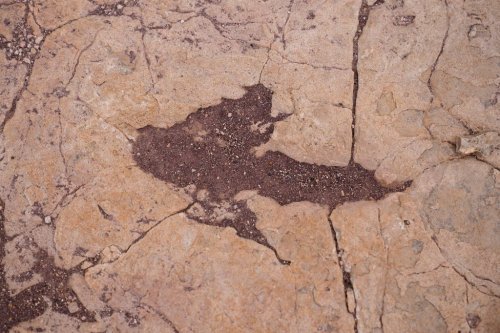
A petrified footprint by a dinosaur is visible in Carreras Pampa in Toro Toro National Park, north of Potosi, Bolivia, Saturday, Dec. 6, 2025. (AP Photo/Juan Karita)

“There’s no place in the world where you have such a big abundance of (theropod) footprints,” said Roberto Biaggi, a co-author of the study led by Spanish paleontologist Raúl Esperante. “We have all these world records at this particular site.”

Prints record dinosaur behavior — including attempts to swim

The dinosaurs that ruled the earth and roamed this region also made awkward attempts to swim here, according to the study, scratching at what was squishy lake-bottom sediment to leave another 1,378 traces.

They pressed their claws into the mud just before water levels rose and sealed their tracks, protecting them from centuries of erosion, scientists said.

“The preservation of many of the tracks is excellent,” said Richard Butler, a paleontologist at the University of Birmingham who was not involved in the research. He said that, to his knowledge, the number of footprints and trackways found in Toro Toro had no precedent.

“This is a remarkable window into the lives and behaviors of dinosaurs at the end of the Cretaceous,” Butler added, referring to the period around 66 million years ago at the end of which an asteroid impact abruptly extinguished all dinosaurs and 75% of living species along with them, according to scientists.

Footprints face preservation threats

Although they’ve survived for millions of years, human life has threatened these traces. For decades, farmers threshed corn and wheat on the footprint-covered plateaus. Nearby quarry workers didn’t think much of the formations as they blasted rock layers for limestone. And just two years ago, researchers said, highway crews tunneling through hillsides nearly wiped out a major site of dinosaur tracks before the national park intervened.

Such disturbances may have something to do with the area’s striking absence of dinosaur bones, teeth and eggs, experts say. For all of the footprints and swim traces found across Bolivia’s Toro Toro, there are virtually no skeletal remains of the sort that litter the peaks and valleys of Argentine Patagonia and Campanha in Brazil.

But the lack of bones could have natural causes, too. The team said the quantity and pattern of tracks — and the fact they were all found in the same sediment layer — suggest that dinosaurs didn’t settle in what is now Bolivia as much as trudge along an ancient coastal superhighway stretching from southern Peru into northwest Argentina.

The range in footprint sizes indicated that giant creatures roughly 10 meters (33 feet) tall moved in a herd with tiny theropods the size of a chicken, 32 centimeters (1 foot) tall at the hip.

In presenting a snapshot of everyday behavior footprints “reveal what skeletons cannot,” said Anthony Romilio, a paleontologist at the University of Queensland in Australia who also did not participate in the study. Just from footprints, researchers can tell when dinosaurs strolled or sped up, stopped or turned around.

It’s not clear why so many dinosaurs roamed the site

But the reason they flocked in droves to this wind-swept plateau remains a mystery.

“It may have been that they were all regular visitors to a large, ancient, freshwater lake, frequenting its expansive muddy shoreline,” offered Romilio.

Biaggi suggested that they were “running away from something or searching for somewhere to settle.”

What’s certain is that research into this treasure trove of a dinosaur tracksite will continue.

“I suspect that this will keep going over the years and many more footprints will be found right there at the edges of what’s already uncovered,” Biaggi said.

___

DeBre reported from Buenos Aires, Argentina.
Report Error Submit a Tip

More Stories

Psychologist sentenced to house arrest after affair with patient

Dean Pritchard 4 minute read Thursday, Aug. 13, 2026

A psychologist who didn’t disclose her sexual affair with a mental-health patient under her care when she testified on his behalf before the Criminal Code Review Board has been sentenced to 18 months house arrest.

Rise of social media reflects rise of self-promotion — to the detriment of genuine storytelling

Reviewed by Matt Henderson 4 minute read Preview

Rise of social media reflects rise of self-promotion — to the detriment of genuine storytelling

Reviewed by Matt Henderson 4 minute read 3:00 AM CDT

A conversation is overheard between two people; one congratulates the other on their success, evident through countless posts on LinkedIn, but the other confesses the prolific aggrandizement is due to slumping success.

A young man on an airplane spends three hours poring over selfies taken on a vacation, zooming in on his biceps and using AI to retouch photos before posting on Instagram.

Anonymous and cowardly trolls on Reddit attempt to end another person’s career.

All this “storytelling” was observed in one day by this reviewer.

Read
3:00 AM CDT

Manitoba supports MAID delay: Asagwara

Carol Sanders 5 minute read Preview

Manitoba supports MAID delay: Asagwara

Carol Sanders 5 minute read Yesterday at 2:00 AM CDT

The number of Manitobans receiving medical assistance in dying in 2026 is on track with previous years while the plan to extend it to those suffering from mental illness is delayed indefinitely by the federal government — a move Manitoba’s health minister supports.

“There’s so much more work that needs to be done,” Uzoma Asagwara said.

The parliamentary committee that issued its recommendation in June was the third special committee of Parliament struck to assess the eligibility of people with mental illness since 2021, when MAID eligibility was expanded to include people who were not at the end of their lives.

A key condition for MAID eligibility is that a patient must be suffering from a grievous and irremediable medical condition.

Read
Yesterday at 2:00 AM CDT

Men’s recovery home dedicated to ‘homeless hero’ Faron Hall’s memory

Scott Billeck 14 minute read Preview

Men’s recovery home dedicated to ‘homeless hero’ Faron Hall’s memory

Scott Billeck 14 minute read Yesterday at 12:30 PM CDT

Faron Hall never got the chance to begin recovery. Once heralded as Winnipeg’s “homeless hero” after twice plunging into the Red River to save strangers from drowning, Hall told St. Boniface Street Links executive director Marion Willis shortly before his death in 2014 that he wanted help for his alcoholism.

Read
Yesterday at 12:30 PM CDT

HSC weapons scanners effective, needed at other hospitals: nurses union

Carol Sanders 5 minute read Preview

HSC weapons scanners effective, needed at other hospitals: nurses union

Carol Sanders 5 minute read 9:57 AM CDT

The AI weapons scanners at Health Sciences Centre have detected close to 2,000 items since they were installed at Manitoba’s largest hospital.

From March 6, 2025 to the beginning of this month, a total of 1,973 items had been flagged by the scanners and identified for further review, Shared Health said this week.

Knives, Swiss army knives and other multi-tools, drugs, alcohol, box cutters, syringes and other injection devices were detected, it said. The technology set up at entrances to the adult and children’s emergency rooms and the crisis response centre is designed to identify a wide range of objects that may require review under site safety protocols.

But Manitoba Nurses Union president Darlene Jackson said the technology isn’t available everywhere at HSC, and a sawed-off rifle was discovered in the adult ER earlier this month.

Read
9:57 AM CDT

Meetings accomplish something that an email never could while respecting people’s time, building relationships

Tory McNally 7 minute read Preview

Meetings accomplish something that an email never could while respecting people’s time, building relationships

Tory McNally 7 minute read 3:00 AM CDT

There are few workplace experiences that unite employees quite like complaining about meetings. Ask almost anyone what frustrates them at work, and somewhere on the list will be the meeting that could have been an email. We’ve all been there. Thirty minutes scheduled for a simple update somehow turns into an hour. Half the attendees don’t need to be there. Someone shares their screen for ten minutes trying to find the right document. The meeting ends with everyone wondering what was actually decided.

It’s no surprise that organizations are looking for ways to reduce meeting fatigue. Every hour spent in a meeting is an hour that isn’t spent serving customers, solving problems, writing reports, or completing projects. As calendars become increasingly crowded, employees often find themselves working longer days simply to catch up on the work they couldn’t accomplish because they were in meetings.

The obvious solution seems simple: hold fewer meetings. In many cases, that’s exactly the right answer. Routine updates, policy reminders, project status reports, and information that doesn’t require discussion can often be shared through email and chat platforms. Not every piece of information deserves everyone’s calendar.

But eliminating meetings altogether would create a different problem, especially as more organizations embrace hybrid and remote work.

Read
3:00 AM CDT