‘Really inspiring’: How advanced technology is evolving baseball on Canadian soil
Advertisement
Read this article for free:
or
Already have an account? Log in here »
To continue reading, please subscribe:

Digital Subscription
One year of digital access for only $205*
- Enjoy unlimited reading on winnipegfreepress.com
- Read the E-Edition, our digital replica newspaper
- Access News Break, our award-winning app
- Play interactive puzzles
*First annual payment billed as $205.00 + GST for one year. This annual subscription will automatically renew at $233.00 + GST every 52 weeks (10% off the regular annual price of $259.35). Offer available to new and qualified returning subscribers only. Cancel any time.
To continue reading, please subscribe:
Add Free Press access to your Brandon Sun subscription for only an additional
$1 for the first 4 weeks*
- Enjoy unlimited reading on winnipegfreepress.com
- Read the E-Edition, our digital replica newspaper
- Access News Break, our award-winning app
- Play interactive puzzles
*Your next Brandon Sun subscription payment will increase by $1.00 and you will be charged $17.95 plus GST for four weeks. After four weeks, your payment will increase to $24.95 plus GST every four weeks.
Read unlimited articles for free today:
or
Already have an account? Log in here »
Hey there, time traveller!
This article was published 01/01/2026 (262 days ago), so information in it may no longer be current.
Inside a large indoor space marked with metal equipment, training gear and gadgets stored in drawers and shelves, athlete Peyton Markwood uses two hands to pull on the handle of a large machine with all the strength he can muster, as it measures the power and movement of his muscles.
Later, his performance director, Tyler Soucie, directs him to put a smaller machine on his wrist and force it against a nearby metal bar as quickly and forcefully as he can, to measure how fast his brain can command his shoulder and arm to push.
It’s all statistics, physics and incredibly precise measurements of biomechanics, ranges of motion and strength. But it’s not your traditional science lab – it’s a baseball training facility in Kitchener, Ont.
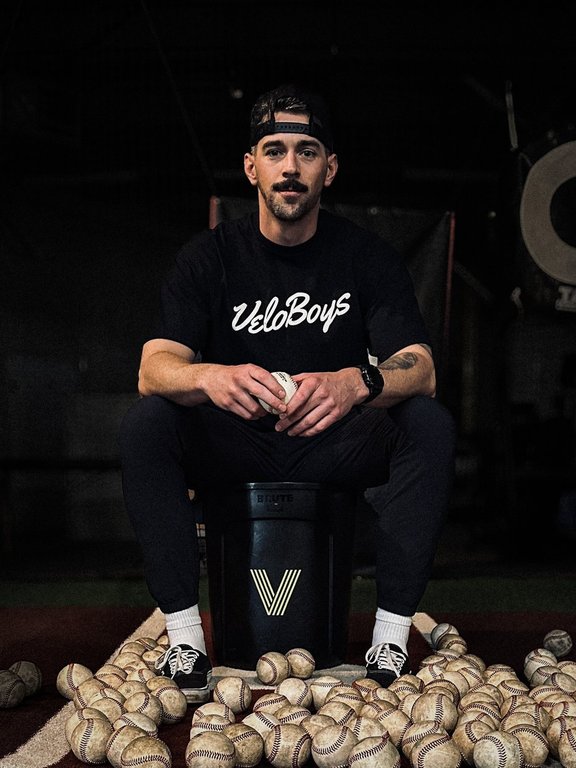
“It seems to evolve every day,” said Soucie, who founded Velo Baseball in 2018 and opened the facility in 2021. “There’s always something new coming out, some sort of new edge. It usually starts at the major league level and then trickles its way down.”
In the past four years alone, technology in the sport has advanced in ways he never could have imagined, he said.
“When I was growing up, even getting access to a radar gun was difficult,” he said.
Baseball players and trainers are increasingly using emerging technology to advance the game – some of which has been developed in Ontario. Some say they believe it’s part of growing interest in the sport across Canada, which comes off the heels of the Toronto Blue Jays’ historic playoff run last season.
“It’s been amazing,” said Soucie. “I’ve seen the growth firsthand from a very grassroots standpoint.”
Part of the reason why technology has advanced so quickly in the sport is because of smartphones, Soucie added. New machines can often connect to apps or websites, making it easier for players and coaches to log in and track performance in real time.
“We have the ability to collect biomechanical data on the fly, whereas before you had to get a $50,000 biomechanics lab to be able to do things like that,” he said.
In the new year, Soucie said Velo has plans to start using a new machine called Rapsodo, which can gather data on pitchers and hitters including a baseball’s spin rate, velocity, and launch angles and simulate other minute measures of the ball on screen.
They’ll also use 3motion AI, a Waterloo, Ont.,-based company that uses artificial intelligence to assess baseball players’ joints, rotation, strides and more when pitching and hitting, Soucie added. Velo was among the first groups to beta test the AI technology, he said.
The rapid advancement of baseball technology has gained momentum partly thanks to the wider emergence of artificial intelligence in sports, said Brad Millington, an associate professor of sports management at Brock University.
“You can use AI in order to sort of analyze data, big data, in ways that were difficult in the past, ways that were difficult for people to do, because it just sort of exceeded human capabilities, even with preceding technologies in tow,” said Millington.
Meanwhile, John Zelek, a professor at the University of Waterloo, is part of a research team developing AI to measure pitching mechanics for the Baltimore Orioles.
A few years ago, the Major League Baseball team reached out to the school to find researchers to help them analyze pitcher performance in away games and scouting sessions. The result was PitcherNet, which takes video and uses AI to analyze a pitcher’s joints and throwing mechanics, explained Zelek.
The data can be used to analyze a pitcher’s performance, prospects and possible areas of injury, he said.
“We’re trying to do this with just one camera. In essence, we’re inferring — based on how we infer the body shape — what the 3D position is of the pitcher is over time, essentially using AI technology,” said Zelek, adding that one of the researchers, Jerrin Bright, had spent a month this past summer in Baltimore working on the tech with the team.
Zelek added he thinks it’s “pretty cool” to see Canadian-made technology go all the way to the top of the sport. The research team has developed a good relationship with the Orioles, he said.
“They’ve been pleased with the progress and they’re a savvy group in the sense that they know what other teams are doing, so they know that what we’re trying to come up with is kind of the leading edge.”
Leading edge baseball technology is also found elsewhere in Ontario, with Mississauga-based pitch modelling company Trajekt Sports reportedly providing their machines to several Major League Baseball teams. The company has developed technology that simulates a pitcher’s throw with precise measurements, allowing hitters to prepare for their at-bats.
This kind of emerging technology is especially exciting for Velo Baseball pitching coach and Canadian Baseball League pitcher Aidan Armitage.
Armitage, a master’s student at the University of Waterloo who is researching the biomechanics of pitcher command, said it’s fun to meet others who are passionate about the science of the sport, and he even applies his studies to his own performance.
“As an athlete currently, it’s interesting to be able to read certain things in literature and then test them on myself as my own guinea pig,” he said.
Armitage added that when modern baseball technology is developed by Canadian researchers, it contradicts the idea that Canada is only a hockey or winter sport country.
“I think it’s really fascinating, it’s also really inspiring as a Canadian,” he said. “In reality, there’s 20-something odd MLB players that were born in Canada that played this past year or had Canadian connections, and there’s Canadian technology that’s pervasive across all of Major League Baseball.”
Armitage added this is especially pertinent after millions of Canadians tuned in to watch the Toronto Blue Jays make it to the World Series for the first time in more than 30 years.
After a playoff run that saw the team go to Game 7 before falling to the Los Angeles Dodgers, Armitage said he believes it’ll inspire more Canadians to tune into the game and even start playing, advancing the game as a whole.
“I think that any time that you see success in a sport close to home, it can inspire other increases or other advancements, whether that’s technology or anything,” he said. “What we need in Canada is just more interest, which can then drive more research.”

Soucie said Velo Baseball has already received numerous inquiries from parents seeking guidance for their children who are interested in baseball for the first time after watching the Jays in the playoffs.
“Seeing that type of interest now when people aren’t really thinking about baseball and we’re all kind of still mourning the Jays’ loss in the World Series has been pretty cool.”
Soucie added it’s exciting to see homegrown technology being used in the sport, and it’s even more special to see Canadian researchers and athletes at the helm.
“When youth athletes are developed to a higher degree eventually some of them will move on to professional baseball. We’ve had that happen both in our facility and others alike,” he said. “It really just pushes the game forward.”
This report by The Canadian Press was first published Jan. 1, 2026.