More Canadian athletes powered by artificial intelligence at Winter Games

Advertisement

Advertise with us

Just for fun, Xavier McKeever and his cross-country ski teammates once tasked ChatGPT to design a training plan for them.

Read this article for free:

or

Already have an account? Log in here »

To continue reading, please subscribe:

Subscribe and receive a limited-edition Free Press branded hat or tote.

Digital Subscription

One year of digital access for only $205*

  • Enjoy unlimited reading on winnipegfreepress.com
  • Read the E-Edition, our digital replica newspaper
  • Access News Break, our award-winning app
  • Play interactive puzzles

*First annual payment billed as $205.00 + GST for one year. This annual subscription will automatically renew at $233.00 + GST every 52 weeks (10% off the regular annual price of $259.35). Offer available to new and qualified returning subscribers only. Cancel any time.

To continue reading, please subscribe:

Add Free Press access to your Brandon Sun subscription for only an additional

$1 for the first 4 weeks*

  • Enjoy unlimited reading on winnipegfreepress.com
  • Read the E-Edition, our digital replica newspaper
  • Access News Break, our award-winning app
  • Play interactive puzzles
Start now

*Your next Brandon Sun subscription payment will increase by $1.00 and you will be charged $17.95 plus GST for four weeks. After four weeks, your payment will increase to $24.95 plus GST every four weeks.

Just for fun, Xavier McKeever and his cross-country ski teammates once tasked ChatGPT to design a training plan for them.

“It was the craziest training plan we’ve ever seen,” said the 22-year-old from Canmore, Alta.

“It basically said you should do intensity every single day. You should do three hours of skiing and then an hour of intensity, and repeat that a few times — and then you should take a week off completely. We know you can’t do that.

Mikael Kingsbury from Deux-Montagnes, Que., celebrates silver in the men's moguls at the Milano Cortina 2026 Winter Olympic Games in Livigno, Italy on Thursday, Feb. 12, 2026. THE CANADIAN PRESS/Sean Kilpatrick

“It was pretty funny to see and do, to see Chat GPT can’t write a training plan, and that we need our coaching to help us with that.”

While OpenAI’s chatbot didn’t nail a workout for the skiers, artificial intelligence has entered the lives of Canada’s athletes at the Winter Games in Milan-Cortina, Italy.

The Oxford Dictionary defines AI as “the capacity of computers or other machines to exhibit or simulate intelligent behaviour” and “software used to perform tasks or produce output previously thought to require human intelligence, esp. by using machine learning to extrapolate from large collections of data.”

“The word ‘artificial intelligence’ or ‘AI’ is so misunderstood,” said Andy Van Neutegem, vice-president of performance sciences, research and innovation at Own the Podium, Canada’s high-performance sport funding and advisory body.

“We tend to use the word ‘machine learning.'”

From Apple and Garmin watches and Oura rings that feed sleep and heart-rate data into smartphones to generate recovery scores, to inertial measurement units attached to athletes’ bodies for three-dimensional positioning analysis, the AI boom is inescapable.

A common theme among Canadian athletes is that AI is more of a tool for training than competition. They value instinct and lived experience just as much as, if not more than, data.

“In my sport that’s performance on demand, it’s important to have some data, but have a very good feel for the snow,” said freestyle skier and triple Olympic moguls medallist Mikael Kingsbury.

“In a sport where things change a lot because we’re outside, I don’t want numbers to be my indicator.”
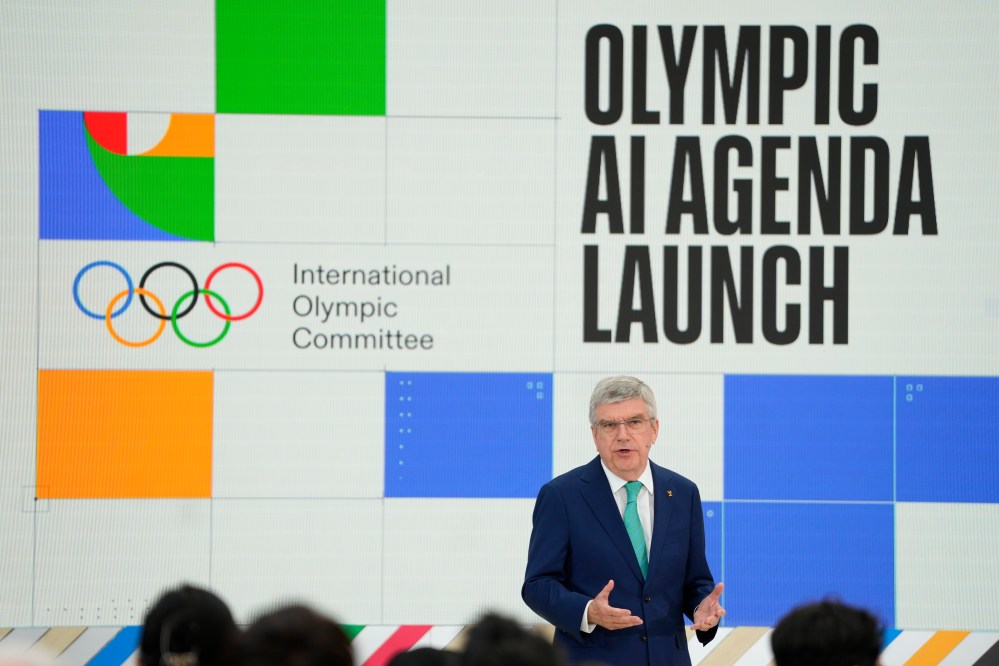
Thomas Bach, IOC President speaks at the International Olympic Committee launch of the Olympic AI Agenda at Lee Valley VeloPark, in London, Friday, April 19, 2024. The IOC will be presenting the envisioned impact that artificial intelligence can deliver for sport, and how the IOC intends to lead on the global implementation of AI within sport. (AP Photo/Kirsty Wigglesworth)

When it comes to Olympic and Paralympic Games, sport science is the game within the Games as countries keep their technology secrets under wraps.

Van Neutegem won’t get into specifics on the Canadian team’s preparation for the Milan Cortina Games, but allows some sports to make heavy use of AI.

“You can talk about snowboarding, talk about freestyle,” he said.

“When it comes to AI, where we’re at right now globally in Olympic and Paralympic sport and pro sport is that we’re using AI to track biomechanical positioning of the body. It’s about body shapes. Are the body shapes optimal? AI does the work of a human eye. It’s a branch of AI that we call computer vision, and it really just mimics the capabilities of the human brain. The computer detects, does object recognition, and it starts understanding whether that’s optimal.”

Sliding sports used local positioning systems (LPS) and leveraged AI to determine the fastest line down a track, he added.

“You’re bringing an extraordinary amount of information into a computer, which is computating it and spitting out an interpretation of whether this is optimal or not optimal based upon data that’s been collected over a long period of time,” Van Neutegem explained.

When the International Olympic Committee launched its AI Agenda almost two years ago, IOC president Thomas Bach said, “AI can revolutionize judging and refereeing.”

The International Gymnastics Federation implemented an AI judging platform at the Paris 2024 Summer Games to help human judges evaluate gymnasts’ moves.

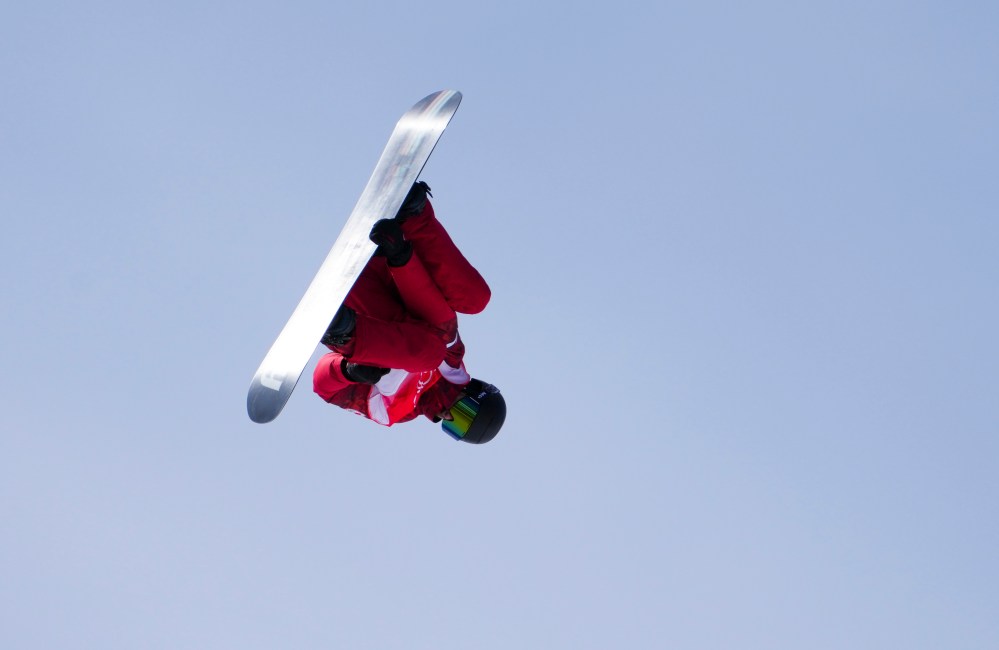
Snowboard judging was a flashpoint in Beijing in 2022, when Canada’s slopestyle champion Max Parrot acknowledged he touched his knee instead of grabbing his board on one run — and the judges missed it.
Canada's Max Parrot, of Bromont, Que., makes his way to gold in the men's slopestyle final at the Beijing Winter Olympic Games, in Zhangjiakou, China, Monday, Feb. 7, 2022. THE CANADIAN PRESS/Sean Kilpatrick

The X Games, ESPN’s action sports competition that helped popularize disciplines later added to the Olympics, has turned an AI judging platform into a business called “The Owl AI” since first testing it on men’s halfpipe snowboarders at the 2025 event in Aspen.

“They were using AI to see if it could call the tricks to make sure that that is what someone did,” recalled Canadian freestyle halfpipe skier Rachel Karker.

“I still think it’s really important to have a human set of eyes to watch because the issue with our sport is that everyone does their tricks slightly differently. It’s not like gymnastics or aerials, where they have a really strict way of how you do a trick.

“Everyone sort of spins on a different axis and sort of has a slightly different variation to it. It might struggle to pick up on nuances like that and maybe call it a bit different, but it’s starting to get introduced in competition. I’m torn on whether it’ll make it better or make it worse.”

This report by The Canadian Press was first published Feb. 13, 2026.

Report Error Submit a Tip

More Stories

Nine-block walk on Portage Avenue reveals difficult present, some cause for optimism

Dan Lett 5 minute read Preview

Nine-block walk on Portage Avenue reveals difficult present, some cause for optimism

Dan Lett 5 minute read Yesterday at 3:32 PM CDT

On a recent visit back to Winnipeg, I got to witness the multitudes of Portage Avenue.

From my Airbnb on Hargrave Street, I had the opportunity to do quite a bit of walking on Portage Avenue, from Portage and Memorial all the way down to the recently opened intersection at Portage and Main.

Along the way, I saw it all: huge and dynamic construction projects, persistent urban decay and the occasional oasis of revitalization.

All in the space of nine blocks.

Read
Yesterday at 3:32 PM CDT

‘Catastrophic’ ending to eventful Manitoba Derby

Mike McIntyre 6 minute read Preview

‘Catastrophic’ ending to eventful Manitoba Derby

Mike McIntyre 6 minute read Tuesday, Aug. 4, 2026

It had everything you could have wanted for the signature racing event of the season, including plenty of drama and excitement in front of a packed crowd at Assiniboia Downs.

Unfortunately, Monday night’s Manitoba Derby also served up another painful reminder of the potential perils of “The Sport of Kings” and what can occasionally happen when these magnificent animals are pushed to their limits.

Forty Twenty, a three-year-old bay colt who was one of the morning line favourites, looked to be in great shape as he approached the final turn and was near the lead in the nine-horse race.

But disaster struck as he approached the final turn and suddenly pulled up as the rest of the packed passed him.

Read
Tuesday, Aug. 4, 2026

Federal government to build $267-M emergency research lab in Winnipeg

Chris Kitching 6 minute read Preview

Federal government to build $267-M emergency research lab in Winnipeg

Chris Kitching 6 minute read Updated: Yesterday at 4:42 PM CDT

The federal government says it will build a $267-million medical countermeasures laboratory in Winnipeg with the goal of preparing Canada for future pandemics or outbreaks.

Expected to open in 2033, the national site will help the country develop vaccines, therapeutics and diagnostic tools, Winnipeg Liberal MP Terry Duguid said.

“This is a big deal for our city and for our province, a big deal for life sciences in Canada,” he told reporters Wednesday. “This facility is going to help protect the nation and help protect the world.”

Ottawa said the site — to be located next to the National Microbiology Laboratory’s Canadian Science Centre for Human and Animal Health on Arlington Street, just north of William Avenue — draws on lessons learned during the COVID-19 pandemic.

Read
Updated: Yesterday at 4:42 PM CDT

Homegrown grub: Resto turns to the Leaf for freshest ingredients

AV Kitching 4 minute read Preview

Homegrown grub: Resto turns to the Leaf for freshest ingredients

AV Kitching 4 minute read Tuesday, Aug. 4, 2026

The term “eat local” has taken on a whole new meaning at Gather Craft Kitchen and Bar, where the journey from plot to plate is measured in footsteps rather than miles.

Head chef Mike Licharson has expanded the restaurant’s focus on local sourcing by incorporating fruit and vegetables grown in The Leaf’s biomes and outdoor kitchen garden into his menu.

Bananas from the tropical biomes star in his banana-bread French toast and accompanying banana compote. Leeks, braised slowly and paired with Manitoba-grown beluga lentils, and Swiss chard — which takes the place of grape leaves in Licharson’s play on classic meze dolmades, a nod to the chef’s Greek-Ukrainian-Irish heritage — are both grown in the outdoor kitchen garden.

The park’s produce complements the restaurant’s other locally sourced ingredients, Licharson says.

Read
Tuesday, Aug. 4, 2026

More Canadian athletes powered by artificial intelligence at Winter Games

Donna Spencer, The Canadian Press 6 minute read Preview

More Canadian athletes powered by artificial intelligence at Winter Games

Donna Spencer, The Canadian Press 6 minute read Wednesday, Mar. 11, 2026

Just for fun, Xavier McKeever and his cross-country ski teammates once tasked ChatGPT to design a training plan for them.

"It was the craziest training plan we've ever seen," said the 22-year-old from Canmore, Alta.

"It basically said you should do intensity every single day. You should do three hours of skiing and then an hour of intensity, and repeat that a few times -- and then you should take a week off completely. We know you can't do that.

"It was pretty funny to see and do, to see Chat GPT can't write a training plan, and that we need our coaching to help us with that."

Read
Wednesday, Mar. 11, 2026

Canad Inns puts Portage Avenue hotel, MET, office building ‘connected campus’ up for sale

Gabrielle Piché 4 minute read Preview

Canad Inns puts Portage Avenue hotel, MET, office building ‘connected campus’ up for sale

Gabrielle Piché 4 minute read Yesterday at 5:57 PM CDT

Downtown entrepreneurs are watching with wary eyes as a prominent hotel and event centre hits the market.

Read
Yesterday at 5:57 PM CDT