How common are fireballs streaking across the sky?
Advertisement
Read this article for free:
or
Already have an account? Log in here »
To continue reading, please subscribe:

Digital Subscription
One year of digital access for only $205*
- Enjoy unlimited reading on winnipegfreepress.com
- Read the E-Edition, our digital replica newspaper
- Access News Break, our award-winning app
- Play interactive puzzles
*First annual payment billed as $205.00 + GST for one year. This annual subscription will automatically renew at $233.00 + GST every 52 weeks (10% off the regular annual price of $259.35). Offer available to new and qualified returning subscribers only. Cancel any time.
To continue reading, please subscribe:
Add Free Press access to your Brandon Sun subscription for only an additional
$1 for the first 4 weeks*
- Enjoy unlimited reading on winnipegfreepress.com
- Read the E-Edition, our digital replica newspaper
- Access News Break, our award-winning app
- Play interactive puzzles
*Your next Brandon Sun subscription payment will increase by $1.00 and you will be charged $17.95 plus GST for four weeks. After four weeks, your payment will increase to $24.95 plus GST every four weeks.
Read unlimited articles for free today:
or
Already have an account? Log in here »
Hey there, time traveller!
This article was published 18/03/2026 (201 days ago), so information in it may no longer be current.
The Earth is under assault. Space rocks are constantly hurtling toward us, slamming into the atmosphere and often exploding into fireballs that both delight and alarm.
Thankfully, the vast majority cause no damage because they are pulverized into dust or small chunks by the journey to Earth.
A fireball streaked across the sky near Cleveland this week, caused by what was thought to be a space rock nearly 6 feet (1.8 meters) across and weighing 7 tons. It was seen from Wisconsin to Maryland, according to the American Meteor Society.
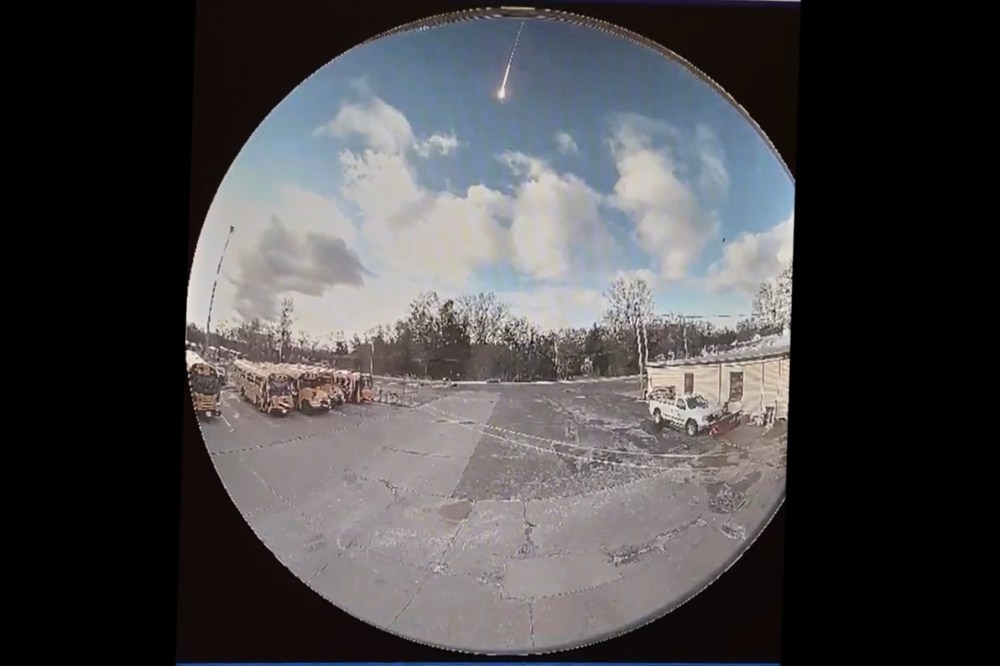
It traveled more than 34 miles (55 kilometers) through the upper atmosphere before breaking apart, according to NASA. No fragments have been found yet.
As dramatic as it was, it was also incredibly common. Here’s what to know:
What’s the difference between a meteor and an asteroid?
An asteroid is a chunk of rock, ice or metal that’s left over from the solar system’s formation 4.6 billion years ago. A meteoroid is a fragment of a larger space rock such as an asteroid or comet. A meteor is the light emitted from a meteoroid or asteroid as it burns up through the atmosphere. If a meteor is brighter than the planet Venus in the morning or evening sky, it is called a fireball. If a chunk of it makes it to land, it’s called a meteorite.
How common are meteors?
Flashes of light from meteoroids are incredibly common, and there are times — called meteor showers — when they can be seen every few minutes in the night sky, weather permitting. The Perseids meteor shower, which happens in mid-August every year, is considered the best, according to NASA.
How common are fireballs?
There are “several thousand” meteors that would qualify as fireballs in the Earth’s atmosphere every day, according to the meteor society. The problem is that most occur over oceans or other places where people don’t live, or the sun is too bright to notice them.
Still, plenty are seen by people. And if you see one, the American Meteor Society and the International Meteor Organization want you to tell them so they can check it out. So far in 2026, 10 fireballs have drawn more than 100 reports, which averages nearly one per week.
Why do meteoroids break up before they land?
Meteoroids travel through empty space at extraordinarily high speeds — from 25,000 mph (40,233 kph) to as high as 160,000 mph (257,495 kph). When they suddenly hit the gases that blanket Earth, they undergo incredible stress as they compress the air in front of them, which heats the object to the point it starts to melt and break apart.
___
The Associated Press Health and Science Department receives support from the Howard Hughes Medical Institute’s Department of Science Education and the Robert Wood Johnson Foundation. The AP is solely responsible for all content.
Related Articles
Looking to see the solar eclipse from Winnipeg? Here's where and when to catch a sliver
Advertisement Advertise With Us